
1 Thessalonians 1:1–7
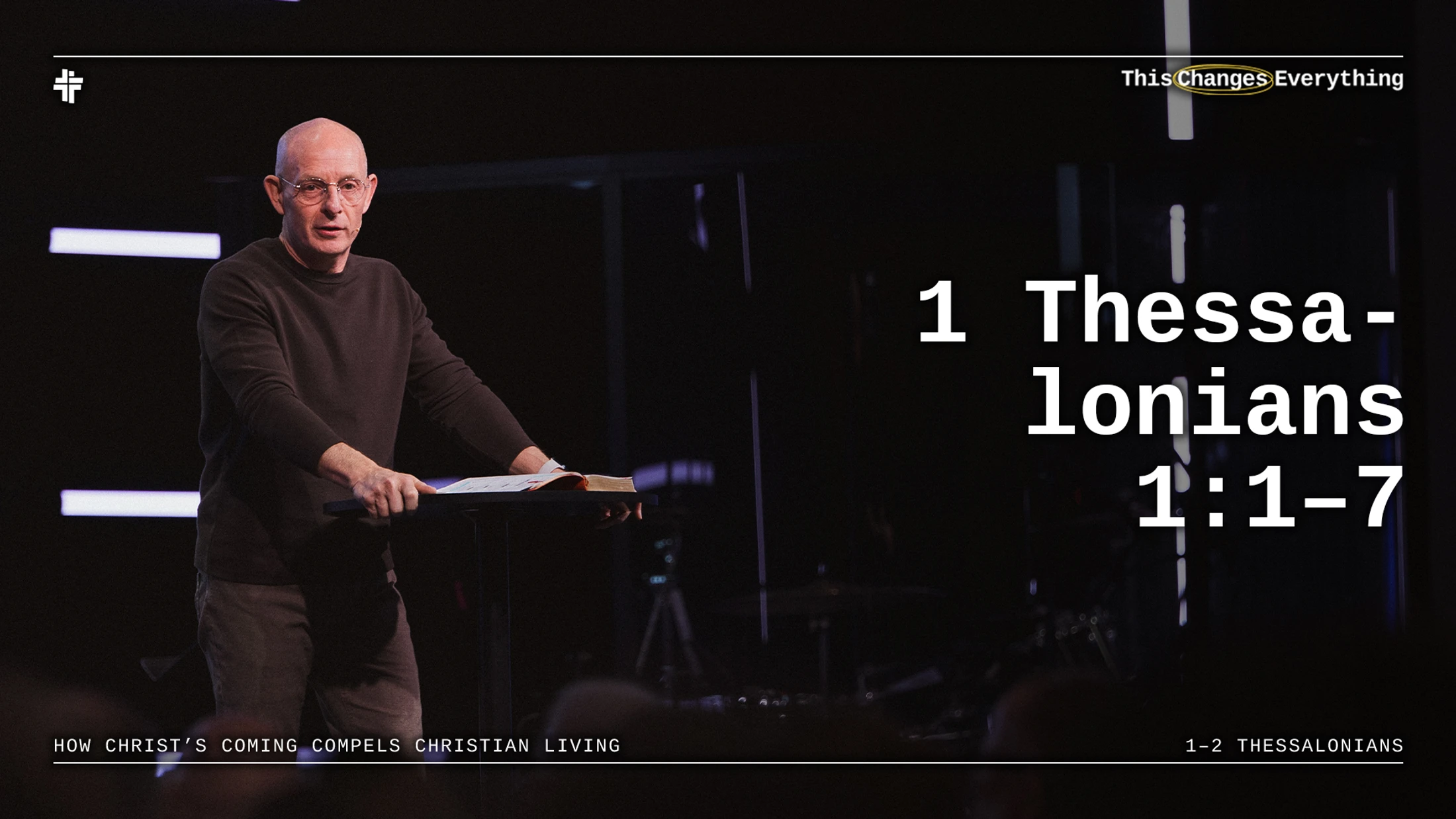
Grateful prayer for change is ultimately linked to the gospel's power to change. Listen to the first sermon in our series in 1–2 Thessalonians from Pastor Todd, and learn more about the series here.
Christ's second coming is transformative. It gives every moment eternal significance and empowers Christians with profound hope, urgency, and purpose. Discover this compelling truth about Christ's second coming through this series in Thessalonians and see how this changes everything.
Let's get under the weight of the word this morning as we begin a brand new series. I want to invite you to take your journals and your Bibles. If you don't have a journal, they're available in the lobby of the location you're at or of course right out here at our Connect Center.
Be sure to pick one up. We're beginning a brand new series today through 1 Thessalonians. We'll start there.
So just in your Bible, just kind of find that book for now. We'll give you more specific instruction in a moment. Let me see if I can help set the framework for not only today but also just this entire book by asking you to think of perhaps an event or an item that affects lots of other events or items.
It's not a hard task. I was speaking with a young couple, in fact, before the service. They just had their first child a few months ago and he said to me, he said, yes, it's really changed a lot of stuff already.
So that's an event that causes a lot of other events to happen. Would you agree? You could back that joke up and just talk about marriage. You could even think of something like a domino.
You hit the first one and then what happens? The domino effect. You could think of things like graduation that occurs and then a number of things occur as a result of that. Again, maybe a non-human item would be like rust.
When you see rust, it's not the first time that something's happened. Rust is a visible sign of really oxygen, water, and iron mixing, and you don't see it when it first happens. You see it when you've got to deal with it, right? And so this idea of a chain reaction, that really would be a good way to see First Thessalonians because what First Thessalonians does is it really prioritizes and highlights the second coming of Christ and connects a lot of things to it to show us that that one event changes everything.
And that's why our series is called This Changes Everything. So your Bibles are open to First Thessalonians, right? As you are thinking about that book, it is a collection of two letters to a church that we read about how they started in Acts chapter 17. So don't turn there, but just mentally note Acts 17.
That's the narrative behind the letters of First and Second Thessalonians. And in these letters, you'll find a couple of interesting things. One is the first three chapters of First Thessalonians are very personal.
The last two are more practical. Also, interestingly, every chapter in First Thessalonians ends with a reference to the second coming of Christ. And so you'll begin to see as we work our way through this book, its emphasis on this event and how it affects and connects to a lot of other events.
And that's why throughout this series, we're going to stop every so often and we'll take a larger look at the other events mentioned in connection with the second coming of Christ. We're going to call those theological rest stops. We've got three of them planned so far, and one of us will then take a topic mentioned in that area of the text and we'll talk more about it from a topical point of view.
That's all ahead for us in this series. And of course, the goal is change. And we're going to see this even in the very first few verses of the first chapter, that change is what occurs and in a chain reaction sort of way.
And this is why the word you've been staring at for a while is not misspelled. Some of you were just waiting to text me in, text a number like Todd, you can't even spell. It's actually on purpose.
It's just another one of the ways that I bring a little cheese to you every week. Because I want you to see that change actually is part of a series of events. We're going to see this throughout the epistle and today's no exception.
As within these seven verses, we're going to see that there is a series of events, now watch this, that are connected and transformative. In fact, that's the definition I would give to the new spelling of the word change. This kind of change, the one with an I in it, it's a series of connected and transformative events.
Let's see what they are in 1 Thessalonians 1, the first seven verses. Actually, we'll teach all ten over two weeks. This is change part one, next week change part two.
We'll cover eight through ten next week. This week, just the first seven verses. Follow along with me as I read these and we'll just kind of walk through them and explain them and I'll show you this chain of events that results in beautiful change with an I. Verse one, Paul, Silvanus and Timothy, to the church of the Thessalonians in God the Father and the Lord Jesus Christ, grace to you and peace.
A very normal greeting from the Apostle Paul. I love it that in this first verse he does locate the church in God the Father and the Lord Jesus Christ. Amen.
That's our truest location. Verse two, we always thank God for all of you. Let me pause again and say that's the main verb of the first few paragraphs.
That's really the point he is making. In fact, let me just be grammatical with you for a moment. This would be the primary verb and then he uses three participles as the chapter unfolds to describe and explain this.
Those would be the words making mention and then the word recall in verse three and then the word knowing in verse four. I'll say more about that. Just be aware, if you were to say what's the big idea of chapter one, it's that Paul is grateful in his prayer.
Okay, so he says we always thank God for all of you, making mention of you constantly in our prayers. Now, can you notice with me the three words that stand out? Always, all, and constantly. That's a pretty good template for prayer.
I've not reached that template yet. Think about this. In this church, Paul is saying that he's always thanking God for all of them and he's mentioning them constantly in his prayers.
Beautiful. Just a wonderful delight to think about the gratitude that the Apostle Paul is not only experiencing but then expressing for this church. Let me let you into my world just for a moment.
Take a personal pastoral aside. I know the word database is not a very emotional word. It doesn't contain a lot of love in it.
Most of you hear database, you're like, oh my goodness, my name's on somebody's list. They've got my information. I'm getting spam or mail.
That's what we normally think. But can I just say to you, in my world, I thank God for our church database because your name is on there. And most every week, I'll pray through that database.
I'm mentioning you by name and your children, individuals, families. And I have to admit to you that this is a level of prayer that I'm unfamiliar with to a large degree. I strive for this right here.
And I do have a sense of what Paul meant because every week, praying through the database, maybe you think differently about that word now, and seeing your name, I thank God for you. You say, Todd, you thank God for me? I just had a tough conversation with you two weeks ago. I sent you an email that you probably didn't like.
I disagreed with you last year on something. I thank God for you. Todd, you know all about my past.
I came here 15 years ago and what do you mean you thank God for me? I've got a thousand sins in my past. I thank God for you. In other words, there's not a single person in this church.
This is not the goal of our pastors, our leaders, to thank God for all of you and to make mention of you constantly in our prayers. It is our first and best action, right? So know this church, your pastors, your leaders pray for you. We make mention of you and we thank God for you.
We would ask you to do the same, to follow in that pattern. Even amidst our differences, even amidst our preferences that are varied, even amidst our opinions, can we seek to emulate this template in which Paul says, I always thank God for all of you, making mention of you constantly in our prayers. Amen, church? It's this gratefulness in prayer that Paul is really kind of signaling out as the primary thing he's going to mention.
But here's why he can do that. It's the next verse, verse 3. We recall, the word recall there, again, just another participle modifying the idea of thanking God. I think it's synonymous with this idea of making mention.
He's saying that I mentally remember when I'm praying your work produced by faith, your labor motivated by love, and your endurance inspired by hope. As he thinks about these things, that's what prompts him and motivates him to be grateful in prayer for them. So it's the spiritual growth that God is giving these people, that's why he's grateful.
Now, can we just dive in a little bit here at these words? Because sometimes we are drawn to the words faith, love, and hope. You see those there, right? They're used often in scripture, 1 Corinthians 13. Now, there are three things that remain, faith, hope, and love, but the greatest of these is love.
That's the love chapter. But Paul's primary aim in this verse is not to draw attention to these virtues or this underlying source. He's drawing attention really to the things they are producing.
Look what he says. We recall in the presence of God and our Father your work produced by faith. The word there, work, you'll love this.
It's a word that simply means activity or your job or something you're doing, not necessarily an occupation only, but just something that you're involved in that contains energy. In fact, the word here is ergon. And some of you in your work environments, you have things that are ergonomically correct.
You've seen that on labels. You've seen it advertised. Some companies promote that our environments ergonomically beneficial.
That's the actual Greek word for work is ergon. He's saying when you are involved in an activity and you're doing something, this is produced by faith. He's saying your work for God comes from your faith in God.
I love this because it's a beautiful early reference to salvation by grace alone. Some would say, well, our works save us. No, this verse clearly says there's work as Christians, but it's not to give us faith.
It's because of our faith. Faith produces work. He says next that there's labor and it's motivated by love.
The word labor here is just an intensified form of the word work. It's intensified because attached to it is the idea of toil and struggle. So he's saying, yes, you got to work because of your faith.
But then when it got hard, love motivated you. So here he's describing a type of activity that was difficult. It had struggle involved and is motivated by love.
Maybe he's meaning love for Christ. Maybe he's meaning love for each other. But love is driving their willingness to stay at the task even when it's hard.
And this is further amplified by this next phrase. He says he thanks God for their endurance inspired by hope in our Lord Jesus Christ. So endurance means to stay under, to remain under.
So they started by faith. They increased because of love. And then when it really got difficult, they didn't quit.
They remained. They continued. In fact, the word remain here or the word endurance, always picture a watermelon seed between your two fingers.
It's slippery and wet. And if you put a little bit of pressure, what does the watermelon seed do? It finds a way out. The pressure forces it out.
We're not the watermelon seed. When the pressure's applied, we remain under. We endure.
We persevere. That's because of the hope of the Lord Jesus Christ. That he's coming again.
That our work is not in vain. That there is fruit in the garden as we toil, as we till it, as we sow and water. God will give the increase.
And so I love these three things that Paul says drives his gratefulness. You see how they're linked together? Again, a chain reaction here. There's spiritual growth among the people from God, and that's what's causing and driving Paul to be grateful.
But notice why there's spiritual growth among the people. Let's connect the next link, shall we? Verse four, for we know, this is the third participle that modifies the idea of thanking God. For we know, brothers and sisters, loved by God, that he has chosen you.
So there is spiritual growth in people because God has chosen those people. This would be referring to God's election or his action of choosing a people to change. And let's be sure we understand this clearly.
Those whom God chooses, he changes. And aren't we thankful for that? Hallelujah. That those whom God chooses, he changes.
This is speaking simply of God's action to choose the people and redeem them unto himself. Now, admittedly, this can be difficult to grasp. Sometimes folks are quick to run to debates, and they want to argue about election.
But I find it intriguing in the text that this is never really up for debate to Paul. In this book, it's very assumed, but this is how it works. God's choice is before your choice.
God's activity not only precedes your activity, it causes your activity. And so the action of God here is not meant to be a controversy. It's not even written that way.
He is not even thinking they're going to have a problem with it. It's stated really as a comfort. Like this is why they're changing.
This is why they're growing, because God has chosen you. It's evident you belong to God. The question may be then, Todd, why has God chosen us? Is it something I did? Was it something he knew I would do? Like, where am I in this picture? Well, that's what the earlier phrase now tells us, that the spiritual growth in God's people, which is caused because of God's election of his people, is because of God's love for people.
Do you see the phrase in the text? For we know, brothers and sisters, loved by God that he has chosen you. So God's action of election is because of God's reason of love. It's all within himself.
God acted because of who he is, not because of who you are. In theological words, we call this unconditional election. It simply means that God in and of himself, out of his great love, sent his son to be the full satisfaction for the sins of those who are lost.
And it wasn't dependent upon you or contingent to you. It wasn't because you were good or bad. It wasn't because you did or didn't do anything.
It was strictly because God is a loving God. In fact, John would say that God so loved the world that he gave his only one-of-a-kind son so that whoever believes in him would never perish but have eternal life. What are the first words of that verse? For God so loved the world.
A lot of you hear that and you may struggle. You say, Todd, what about my free will? Here's some beautiful news for you. It was out of God's free will that you're able to even exercise your will.
The greatest news in the world is that we have no place to fall but on the love and mercy of God. I'm so thankful that the reason God chose a people unto himself is out of his great love. Hebrews calls Jesus the author and finisher of our faith.
I bring that to your mind because I want you to realize that salvation wholly and solely belongs to God. Do you hear the words author and finisher? He's the beginner. He's the ender, concluder.
The CSB uses the words he's the pioneer and perfecter. So you say, well, Todd, what are we? Here's the best word to describe it. We're the glad recipients of God's salvation.
Amen? And for all who believe in the name of Christ alone as the only way to have your sins forgiven, God out of his great love saves us. Now let me pause one more time and share a grammatical thing with you again that I think will help this first set of verses just come to life. This is where I think the first sentence ends is at the end of verse 4. I know in your CSB it doesn't show that.
I think the King James actually here does a better job of deciding where commas and periods go. Again, it's a little speculative admittedly, but we are given good clues in the original language. And I think this is where the best place is for a period.
And if you'd allow me, can I read for you these verses now again, knowing that there are three participles that modify the thinking. So I think this is what Paul is saying. He says, I thank God.
Here's three ways to modify that and explain it. And then he closes his first sentence. So I'm going to read it to you grammatically, and I want this to weigh on you and just massage your heart and bring you to a place of great joy.
This chain reaction of how things occur in our life, the change that occurs, these connected but transformative set of events. Listen to this how Paul describes it. I'm going to read it as I think grammatically it is.
Verse 2, we always thank God for all of you by making mention of you constantly in our prayers and recalling in the presence of God and Father, your work produced by faith, your labor motivated by love and your endurance inspired by hope in our Lord Jesus Christ, knowing brothers and sisters loved by God that he has chosen you. Question, when read with what I think is the correct punctuation or the best punctuation, maybe that's a better way to say it. On whom is the emphasis? It's God.
He thanks God and they're part of that grateful prayer, but they're not the reason for it. It's God's growth in them, which was because of God's election of them and because of God's love to them. This is all about God.
So learning to be grateful in prayer isn't something we like try harder at. It's not something we have to, you know, run faster at the treadmill of good works or the, you know, grip it tighter and hold on and see if I can make it. Man, becoming more grateful in prayer is a work of God.
When he helps us see his work in others, then he grows and flourishes greater gratefulness in us. This is why verses five and six now matter so much because for that to occur, it's good to watch the gospel do its work. And that's something visible.
Admittedly, some of these first two steps, you could say the first two being God's love and God's election aren't visible to us. They're the work of our sovereign God in bestowing a sovereign grace. We do see his growth in us.
We're able to give thanks for that and in others. But here is the actual initial link that helps us see, oh, so God is now showcasing how he's loved these people and chosen them and growing them. Look what it says in verse five.
For our gospel, I think it's the beginning of a new sentence, for our gospel did not come to you in word only. In other words, Paul's not minimizing words. He's just saying there's more to the gospel than just human language.
It's not just an announcement of words that we've created in our language. So it didn't come just in word. It came instead in power.
Speaking of a full enablement by the Holy Spirit, it would do its work and with full assurance. Words there would be conviction or confidence, something perhaps the full assurance phrase refers to the apostles who delivered it and they delivered it with great conviction. I think they all three refer to the word gospel.
This is how the gospel came to the Thessalonians. Yes, through the apostles, no doubt. They were the ordained means the preaching of it came through them, but it came in power, visibly seen change, transformation produced by the Holy Spirit and with confidence that it would work, that it did its job, full assurance.
Like this is how people are changed. This is how our sins are forgiven. We have conviction, confidence that this is a true message by what we are seeing it do in our lives.
Then he says this, you know how we lived among you for your benefit. Now the question is how did they live among them? How did the apostles who delivered the gospel to them live among them? Well, if you read Acts 17, you'll find that when they first started preaching the gospel to these Thessalonians, there was a lot of conflict, a lot of persecution and they did not leave. They didn't run.
They stayed. They remained under, they didn't really what they were thanking God for doing in their lives. These apostles stayed at the task.
They preached and what's this? It says that these Thessalonians then became imitators of us and of the Lord when in spite of severe persecution, that's Acts 17, they welcomed the message. So the apostles not only preached the gospel amidst great conflict, they heard and welcomed the gospel amid great conflict. So the gospel's landing in a thorny landscape, but the preachers aren't running, the hearers aren't running and what happens in verse 7? As a result, you became an example to all the believers in Macedonia and Achaia.
This is really another way to talk about verse 3. They began to grow. They accepted the gospel. It took root in them.
They began to grow. They became examples. It's God's growth in them.
So 3 and 7 are very synonymous. This is what they, this is how they responded to the gospel even in severe persecution. So do you see what's happening here? The gospel is shared, it's preached, it's communicated and then its effect is seen in that people are converted.
They believe, they come to faith in Christ and that's the initial evidence. Oh, they've heard about the love of God. They believe in the Son of God.
They're accepting the gospel of God, which means they must be the children of God and over time they show growth. So it's God's growth in their life and at the end of the day when Paul sits back and sees all this and thinks about it, he says, man, I give God thanks for every bit of that. That's the chain reaction that began with the gospel being shared in a very difficult situation.
Now there's a ton here to apply, a ton here to say. Let me just simply make one application while we linger on these verses. When you're fearful to share the gospel, that's probably the best time to share it.
So that it will do its work. It will land. It will bring forth fruit.
It will be evidenced who heard, who accepted, who believed. They'll understand God's love for them. They'll believe in God's Son.
They'll accept God's gospel and over time God will work in them and grow them. One day you'll look back at that moment and you'll think, man, I was sure scared that day to share the gospel. It was tense.
It was hard. But you'll look back and see all that God did from that moment and you'll say, I'm so glad for all that God did in your life from the moment you heard the gospel forward. This is really the chain of events that's happening and it's God's chain of events that leads to change.
No wonder Paul would say in Romans 116, for I am not ashamed of the gospel, for it is the power of God unto salvation to everyone who believes, Jew and Gentile. Amen church? So what we're seeing in this text to be accurate and true to these first seven verses is that Paul's grateful response is caused by God's gospel. That's what he's saying.
He starts out, I thank God for you always, constantly when I pray. Here's why. Because God has changed you.
That's because God elected you. That's because God loved you and you heard all about that when the gospel was preached to you. This is why it's important.
Preach the gospel. We stay tethered to the gospel. We remember the gospel in multiple ways.
We say here often, let's celebrate the gospel. Why? Because that is often the initial link to the beginning of the change that can occur in people's life. We often say this, the change that causes thanks is caused by Christ.
Here's a better way to say all this. Here's our take-home truth. The single sentence I want you to put in your pocket and take home from First Thessalonians 1, 1 to 7. Jot this down, snap a picture, say it mentally with me.
Here's what the verses are aiming at. That grateful prayer for change is ultimately linked to the gospel's power to change. Will you say it with me? Grateful prayer for change is ultimately linked to the gospel's power to change.
That's our take-home truth. But I did have one more slice of cheese to bring to you because I was thinking about this take-home truth. It's a common element in our services and our teaching style.
20 plus years we've always pretty much tried to summarize every single message in a single sentence. And so the take-home truth has three letters, you know, T-H-T, not hard to spot. So does Thessalonians truth, T-H-T.
We might for this series say, here's our Thessalonian truth. Just say we might, who knows. Either way, do you see the point of the first seven verses? We'll talk more about the last three next week.
But in these first seven, Paul says, here is why I'm grateful. It's because when you heard the gospel, even though it was in a difficult situation, you welcomed it. And it was proof then that you'd heard how much God loves you, that you were his people.
He changed you. And now I'm giving abundant thanks constantly for all that God has done in your life. Now, as you meditate on that, kind of mull that over, I need to bring in the loop on something that isn't always true in every service.
There is not a single person here in this room, nobody upstairs at our campuses, and there's not a single breathing human being that can say today, hey, I'm out for the application. I've got it covered. Now, sometimes in messages, that could be the case.
Did you know that? There are sometimes very specific messages through very specific texts. And someone may say, hey, I'm good there. I got that.
And that's fantastic. There's nothing proud or sinful about that. Sometimes as pastors, we apply the text and not everyone fits in every application, but that's not true today.
No one, myself, our elders, first time guests, locations, like there's no person breathing, who's listening and watching and engaging, who gets a pass from saying, what should I do in light of this? Here's why. There are two words I want you to see in this take home truth, prayer and change. I would say to you, prayer is the main thought of the first seven verses.
So if you're saying, Todd, I've got the whole prayer thing down, thanks, but no thanks. We should talk afterwards. We could all grow in our prayers, couldn't we? I've got a thousand miles to grow in my prayer life.
You probably have some. To make sure this text applies to us, here's what we should ask God. God, would you cause me to be more observant to your work so that my prayer is even more grateful? We could all increase the gratefulness in our prayers, couldn't we? I think that's a given yes.
So for sure at this level, no person escapes that application. No person has reached the pinnacle of prayer and says, Todd, I'm out. I don't need this.
All of us should today leave saying, at a minimum, God calls deeper gratefulness in me to you as I watch your gospel do its work around me. Amen? So there's one application no one can escape, but here's why I would say to you that in this room, no one escapes because not just is that true, but there may be folks here saying, well, I don't pray, Todd, at all. I don't even believe I should pray.
I don't even believe in God, so I'm out. No, actually, you need changed. You need the gospel to do its work in you.
You need to hear this news that God loves you, and He's not loving you because you did or didn't do something. He's not looking into the future and saying, well, they're going to be good one day, so I'll love them now. That's not God.
It's unconditional. It is out of God's own character that He loves you. It's amazing, isn't it? The Bible says that God loved us when we were separated from Him, enemies to Him, sinning against Him.
The Bible uses the word lost to describe that, and the Bible says that when we were lost, God loved us and Christ died for us. So this is what begins change is seeing how much God loves us and then responding to that love by believing in how that love was put into action. Say, Todd, how was God's love put into action? Through the person of Jesus Christ.
He came to earth, God in flesh. It's called the incarnation. Still fully God, but now fully visible as a man, and He lived for 33 years in time and space in an evidential manner.
Thousands saw Him. History records His existence. History also records, and it was seen by hundreds, His crucifixion in which this man who was fully God willingly sacrificed himself as the payment for the sins of the world, 1 John says.
Proof that that offering was satisfactory forever, eternally sufficient, is the fact that God raised Jesus from the dead after He was crucified. Again, seen by hundreds, written by historians, marked in history. These are evidential time and space realities.
Now admittedly not everyone believes that, but you can't deny they happened. The question is what would you do with historical, supernatural, evidential truth? The Bible says that to those who believe God gives the right to be called children of God, and this is when change begins. When you realize that God's love for you was evidenced in God's action for you by sending His Son to be your only Savior.
And the moment you believe in Jesus Christ as the only way to be saved and have your sins forgiven, God gives you what the Bible calls the gift of eternal life. You didn't earn it. You didn't purchase it.
You don't deserve it. God gives it because of Jesus's work for you. All He asks is that you believe in Jesus.
That's the gospel, and the minute you believe in that, everything changes. God saves you. Your life begins to change, which is evidence that you truly do belong to God, and as other people watch that, they give thanks to God for His work in your life.
That's 1 Thessalonians 1, 1-7. And this is why I say to you, no one, nobody today escapes the application. Either you need to pray better, or you need to be changed.
Amen, church? And the only way either of those happens is because of the power of the gospel at work around us or in us. We notice it and are grateful, or we experience it and are grateful. Where are you today? One of our staff members said to us Monday, I thought this was a wonderful application.
He said, after going through the stewardship series, he said, I want to pray more. I want to pray in a way that exemplifies stewardship. So he's tithing his work week in prayer.
He said, I'm going to try to pray four hours a week. That's some good application, isn't it? He's seeking to really up his prayer life. So he's accepting the, hey, no one gets out of this.
We're going to pray more, and I'm actually going to give 10% of my work time in prayer. So he's finding how to do that in the right kind of places. I watched a man last week after the service, stay in his seat.
His wife came over and said, could you talk to my husband for a minute? And I know them and their names and whatever. He was just weeping. He was weeping.
I checked on him later the week, and he just said, God's doing something in my life. God's working in my life. And I don't think I knew.
He didn't know. We were just like seeing what God was doing is a little unexplainable in the moment. I asked him today, I said, what do you think was going on? And we chatted and he said, I think that was my moment of conversion.
God saved me. Man, immediately I was grateful for the work of the gospel. Amen.
So I'm just saying to you, which one needs to happen in your life? Do you need to ask God to create deeper gratefulness in your life because of the gospel and a greater awareness of its work around you so that you can be more thankful in your prayers? Or are you at the place where you're finally just ready to fall on the mercy of God? I would say to you, that's the best place to fall because God has mercy and love. He will extravagantly lavish that on those who believe. Which one today? I'm praying the Holy Spirit will drive home the point to all of our hearts so that we see the work of the gospel around us or in us.