Gentleman, Restart Your Engine | 2 Timothy 1:1–7
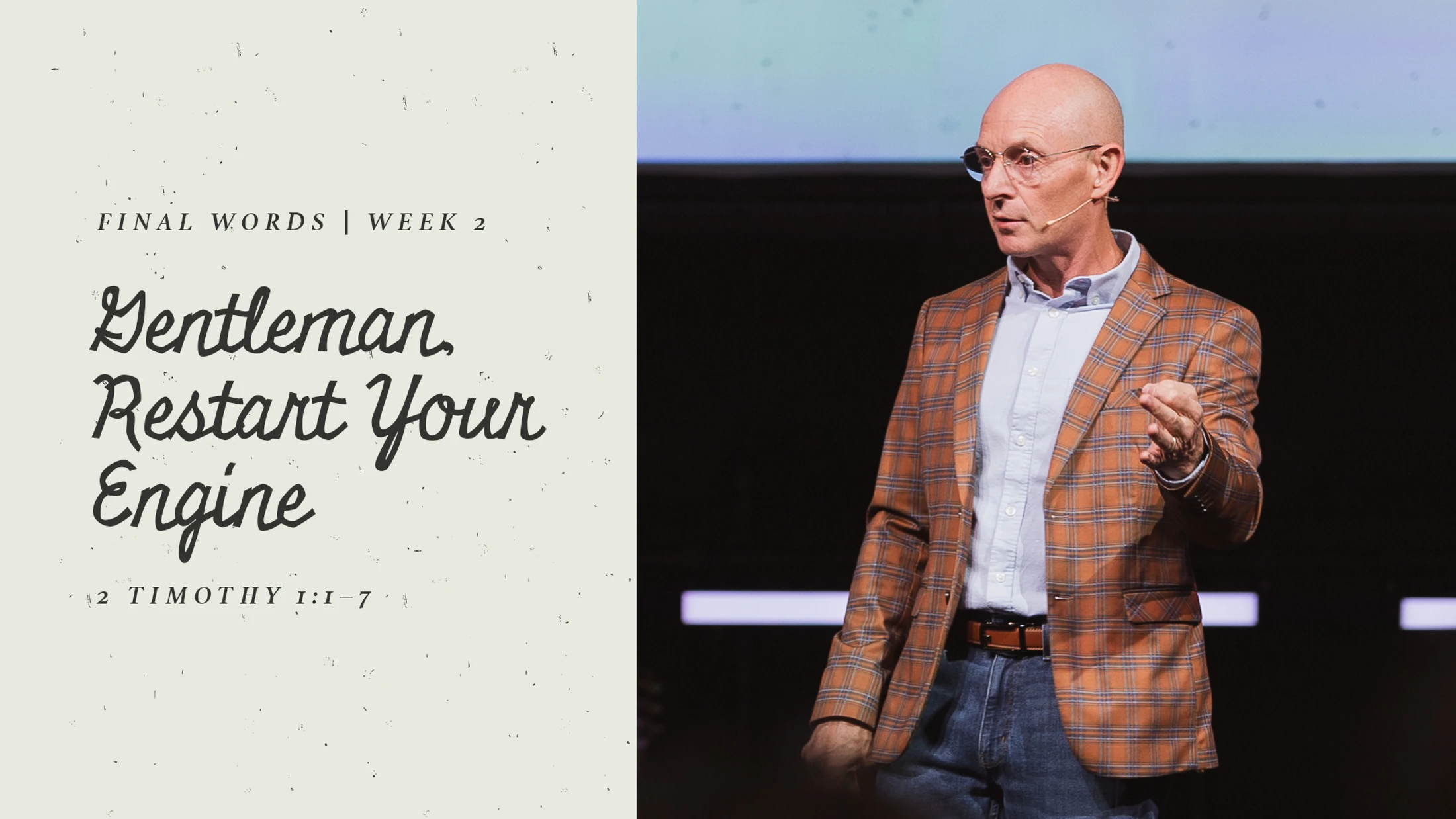
Paul's final letter wasn't just for Timothy, it's for you. It calls you to endure, to stay rooted in God's Word, and to live with bold faith in a drifting world. These are his final words, and they still speak today.
I would invite you to take your copy of the Word of God, locate 2 Timothy. Would you do that? You received a bookmark when you entered today, I know it's all of our campuses as well, and it will kind of lay out for you what we went over last week, the overview of the book, the four sections that will kind of guide us through our study. We're going to cover the first section this week, so I trust you have your series guide and your Bible ready as we dive into this series through 2 Timothy, Final Words.
Let me ask you a question, see if there's anyone in the room who may be able to answer this. Has anyone in this room, and maybe in our campuses you can think about this as well, has anyone here been to the Indianapolis 500? Not just the site, but the actual race. Anyone been to the race? Let's look for a hand maybe.
Is there a hand? Okay, right here, Bill. All right, good, okay. So if you go to the race, and if you've watched it on TV, there's a line that's used that's kind of known to the Indianapolis 500, and you know what it is.
I think it's four words. It starts with the word, gentlemen, say it with me, gentlemen, start your engines. That started in 1953 at that speedway, and so it's been around ever since.
They have lately begun to say, ladies and gentlemen, start your engines. What if you were there at the race, and you heard this, gentlemen, restart your engines? That's not what's supposed to be said, right? And yet, that's exactly what Paul said to Timothy in the opening paragraph of 2 Timothy. In his final letter, metaphorically speaking, that's what he said.
He said, gentle man, restart your engine. Let's check it out. 2 Timothy, chapter one, let me read for you the first seven verses, and see if you can spot this as well.
Well, the Bible says to us in verse one of 2 Timothy, Paul, an apostle of Christ Jesus by God's will for the sake of the promise of life in Christ Jesus. That's why God made him an apostle, to share the news that there's life in Christ with others. He's writing to Timothy, and notice this next phrase, my dearly loved son.
He means there a spiritual son. Paul is the one that brought Timothy to faith, and trained him for ministry, and he loved him dearly. To this dearly loved son, he extends grace, mercy, and peace from God the Father and Christ Jesus our Lord.
Then Paul says this in verse three, I thank God, it's a common way that he begins most of his letters. He's a very grateful person. And so he says, I thank God whom I serve with a clear conscience as my ancestors did, when I constantly remember you in my prayers night and day.
So he's thankful to God for Timothy, as he prays for Timothy regularly. Verse four says he remembers his tears, see that, remembering your tears, I long to see you so that I may be filled with joy. I recall your sincere faith that first lived in your grandmother Lois and in your mother Eunice, and now I am convinced is in you also.
Therefore, say it with me, therefore, here's the coalescing and the culminating of the first few verses. This is the tension point of the passage. Therefore, I remind you to rekindle the gift of God that is in you through the laying on of my hands.
Common vernacular, gentlemen, restart your engine. Verse seven, for God has not given us a spirit of fear, but one of power, love, and sound judgment. Now, I'm not going to work through all the verses and explain the nuance of the greeting and his remembrance of Timothy and the tears, because really the focus of these seven verses is singular.
Paul opens the letter with one aim. He wants to address a flickering dilemma going on in Timothy's life, and that flickering dilemma is that Timothy is giving in to fear. I know that because of the word, therefore, in verse six, and it seems that what Paul is doing prior to verse six is remembering Timothy's pedigree, shall we call it? He's remembering his experience with Timothy, and I personally think Paul, however he heard about Timothy's fear and timidity, I think he's surprised by it.
It's like Paul saying, Timothy, I know your family. Like, that's not how you were raised. That's not where you come from, and I think that's why he says, and I'm convinced that faith is in you as well, like, this is really not you, Timothy.
I've seen a different you. In fact, if you think about the phrase that Paul said in verse four, he says, I remember your tears. Like, when did Paul see Timothy cry? It's probably Acts 20 when Paul left Timothy in Ephesus with the other elders.
That was the last time Paul saw Timothy. He wrote both of these letters to Timothy from another location, sent them back to Ephesus, and maybe he's thinking, you know, prior to Ephesus, Timothy, I saw you in different places and you were bold. If you read Acts 16 is where Paul met Timothy, some of his first actions were very bold.
You'll need to read that to find out what I mean, okay? Timothy was a courageous, young Christian, a pastor in training, but for some reason, my opinion is this. When he left Ephesus and Timothy was apparently crying, as much of the elders there were, perhaps at that moment, Timothy began to wonder, well, Paul's not around, what am I going to do? And I believe fear began to settle into Timothy, apprehension, hesitancy, questions, and Paul's writing now to say, Timothy, I'm aware of this, I've heard of this, and I want to remind you, rekindle the gift of God that is in you. Restart your engine.
That's the answer to the flickering dilemma, because what Timothy was experiencing was really just some embers now that were, they were glowing, they were warm, but they weren't a burning blaze. Fear had kind of smothered his fire for the Lord. Apprehension, timidity, something was going on, we're not sure what it was, I think it started when Paul left, but Timothy's now got a posture of perhaps waiting, of wondering, he's not spiritually aggressive for the gospel's sake.
So right out of the gate, Paul says, Timothy, this is not who you were, this is not what I've known, therefore, I want to remind you, rekindle the gift of God that is in you by the laying on of my hands. He's giving him the answer to this flickering faith he has. This dilemma where fear has crept in, and it seems to have more of an influence than it should.
He's saying, here's the answer, here's the fiery answer, and the answer is the Spirit of God. That's how he's to rekindle this gift of God in him. Notice what verse 7 says, for God has not given us a spirit of fear.
The implication is, Timothy, this is what you're operating under, but that's not from God. The timidity you're experiencing, the hesitancy you're going through, that's not from God. Instead, God's given us a spirit of power, love, and sound judgment.
Timothy, operate in that realm, that will allow you to experience a rekindling of the gift that's in you. Now, I think what's happening here is, Paul is expecting Timothy to lean into the Holy Spirit so that the Holy Spirit shapes his human spirit. Did you follow that? Paul is expecting Timothy to lean into the Holy Spirit so that the Holy Spirit shapes his human spirit.
I say that because if you notice in your text, verse 7, the word Spirit's not capitalized. Is he referring to Timothy's just human spirit, which is not a bad thing, kind of who you are, the inner you, your personality, you could call it various things, but is he referring to Timothy's demeanor and spirit and posture that it's now one of fear, and he's saying that's not who you are, that's not what I've known, and that's not what God's given you. He's given you a spirit of love, power, and sound mind.
I think what Paul's saying, and I think he's kind of double-loading the word Spirit, if I can say it that way, maybe a play on words, because we know the Holy Spirit specifically and very clearly gives these three things. I'll give you proof. When it says that God's given us a spirit, he's given us a spirit of power, what does Acts 1.8 say? That when the Holy Spirit is from upon you, you will receive power, it's the Holy Spirit.
Romans 5.5 says the Holy Spirit sheds abroad in our hearts the love of God. It's the Holy Spirit who helps you understand the love of God and sound judgment, or the word there is self-control. Galatians 5 says that self-control is a fruit of the Spirit.
Ephesians 5 says that the Holy Spirit controls us. I think Paul intentionally is kind of double-loading the word Spirit. Like I said, a play on words, and he's saying, Timothy, you're living under the wrong kind of spirit.
It's affecting you wrongly. The Holy Spirit instead needs to shape your spirit. He'll give you power, he'll give you love, he'll give you sound judgment, self-control.
Let the Holy Spirit shape your spirit so that you're not living in fear, but living in faith. This is what I saw in you, Timothy, when I saw that gift in you. I think that gift became the preaching pastoral ministry that he was then ordained to when Paul laid his hands on him.
It is an office, yes, but it was noticed first as a gift given by the Holy Spirit. The word there, gift, is the same word for other passages when he talks about spiritual gifts as the word grace. I think the Holy Spirit gave Timothy a spiritual gift that was necessary for his office of pastor, elder, but for some reason he began to be fearful.
I think it's Paul's absence that caused that. Paul's now writing to say, Timothy, you cannot pastor in a fearful posture. Your sheep need more than that, and God can give you more than that, so quit living by your spirit and rekindle the gift the Spirit gave you and live by his power, love, and sound mind and self-control.
That's all Paul's doing in these first seven verses. The book, as it unfolds, will really be maybe a further unpacking of all the ways Paul is encouraging Timothy to quit living by fear and live by faith. The way to quit living by fear and live by faith is the Holy Spirit of God.
He's the one who rekindles us. The word rekindle there simply means to relight, to blow upon, to reignite. You can pick your word.
I think a metaphor works well. You've seen your fire pit when it's just a little orangey at the bottom. There's some nice coals, and you wouldn't touch it, but it's not a flame, right? You know it's in its cooling off period.
That's what you would say. Now, again, you wouldn't touch it. You wouldn't walk on it, but you know that it's calmed down.
That's what's happened to Timothy. He's got some embers. They're orange.
And to some people, he may seem hot, but Paul knows he's cooling off. There's not a fire. There's no blaze.
And so he says, let's get the bellows of the Holy Spirit and let's ... It's an old-fashioned picture, isn't it? Let's get down by those embers, and let's ... Let's see some flames come up. Let's stoke that fire. Let's rekindle.
Let's restart that. It really leads me just to one simple observation from this opening set of verses, that the antidote to fear is the flame of the Spirit. Will you say it with me? The antidote to fear is the flame of the Spirit.
And what every one of us, what we need, is exactly what Timothy needed, the Holy Spirit of God to refresh us, to rekindle us, for us to ask the Holy Spirit to shape our human spirit. And by the way, that understanding of this word spirit, I'm not the first guy to think of that. Most commentators, most trusted scholars agree and use the very same wording.
I'd encourage you to just check it out. Double check me. Paul is being very intentional to say to Timothy, how you're made and wired and who you are, it needs the Holy Spirit to shape and form that, so that you're not fearful, but you're bold and clear.
And you see why Paul would say later, preach the word, do the work of an evangelist, fulfill your ministry. Much of this book, you can now begin to see, oh, no wonder Paul said that, because he knew Timothy was struggling and battling with a fearful posture. And the antidote to that, for Timothy and for us, is the Holy Spirit of God, who gives power, love, and self-control.
That's a courageous lifestyle. That's a bold lifestyle. That's a clear and disciplined, and it's a lifestyle that honors God with its pursuit of holiness.
So as I read this, I think about Timothy's situation, and contextually, I'm convinced. Paul was saying, Timothy, you need a rekindling of the Holy Spirit in your life to overcome this posture of fear you have. But can I just speak to you plainly? I don't want to live in 64 AD only.
We learn much from that, but I think this speaks volumes to 2025. I mean, is this not the posture of the American church? Is this not the posture of many people at First Family Church? Fearful, unaggressive spiritually, undisciplined, a lack of power, barely believing, almost apologetic, trying to figure out how you can balance what the culture thinks and what God thinks, trying to find words that make sense so no one's offended. Who can walk that line? The more you try, the more fear will run your life.
It's proof positive you're lacking the flame of the Holy Spirit. You too, I too, should ask God to rekindle us, to refresh us. In the metaphor we used at the beginning, to restart our engines, right? So that not only are your pastors and elders fulfilling their roles as clear voices in this time, but that every member is walking boldly and courageously, humbly, compassionately, yes, but with clear distinction in a culture that's trying to make sure they minimize and trivialize what you believe.
We do not need fearful followers. We need faith-filled, Holy Spirit-formed followers. We need the Holy Spirit of God to refresh us.
He is the antidote to your fear. Now I know you'll agree with that. There's not a person here that would say, I beg to differ.
In this room, across our campuses, you're going to say amen to that doctrine and theology. Let me give you three principles that will help you take the posture of rekindling. Because I think a lot of folks nod their heads in this room and they leave and say, but it's not worth it.
I'm going to stay in fear. And you have no idea, I'll just be very pastorally plain with you, you have no idea the joy and the power available from walking in the Spirit, from being led by the Spirit. As the Bible says, keeping in step with the Spirit, all you know is walking in your own power, walking in your own ability.
And life in the Spirit seems like distant to you, so you stay afraid. You stay carnal, you stay weak, you stay immature. I want to invite you into a rekindled life, a refreshed, Holy Spirit controlled life.
To do that, here's nine words that will help you form a posture, maybe have some language. This is just auxiliary to the main point of the text, okay? But I want to kind of give you some ways to put this into practice, because there's a posture that we have to have to be able to see the Holy Spirit work, to see Him revive us, reignite us. Nine words, three principles.
Here's rekindling principle number one, integration without separation. You say, Todd, what do you mean? The Holy Spirit of God and the Word of God are inseparable partners. But the minute I say that, most of you, maybe I shouldn't say most, many of you will still rank them.
You'll say, you're right, Todd, and so it's the Word of God and then the Spirit of God, and so you have a, instead of a trinity, you have like a quad something. There's the, you know, God the Father, God the Son, God the Bible, then God the Spirit. That's how you see it.
That's not true. It's one God in three persons, God the Father, God the Son, and God the Holy Spirit. They are the Word of God, and the Word of God and the Spirit of God always work in tandem.
They're inseparable. If you try to divide them or rank them, you diminish both. In fact, let me just share with you how both are always at work.
I'll be brief here. Maybe I'll unpack more of this on the podcast Tuesday, but watch this. In creation, it was the Word and the Spirit.
The Spirit hovered over the waters and then God spoke. You can't take one or the other. They're inseparable.
They're both necessary. This is true when you were born again. The Word and the Spirit acted upon you to show you your need and give you faith to believe and was, you were convicted and you repented and trusted Christ.
It was the Word and the Spirit. Both are necessary. In fact, Peter says that we were born again through the living and abiding Word of God.
John would say this, you are born of the Spirit. One and the same. When it comes to Christ and his ministry, Christ was always empowered by the Spirit without measure.
He says he never did anything that was not the will of the Father, and he never did anything that was not empowered by the Spirit. In fact, he said about his own words, my words are spirit and they're life. I'd remind you that he spent a good portion of his final week instructing his disciples on the necessity of the Holy Spirit that he would send.
It was the best news he could have given them. He said, you won't be orphans and it's good that I go away. There are folks who say, well, you can't talk about the Holy Spirit much because it's really about Jesus.
I think I get the heart of that. I want to be equally critical. But can I say to you, Jesus talked a lot about the Holy Spirit.
He was never threatened by the Holy Spirit. We should talk more about the ministry and roles of God, the Holy Spirit, so that we know how to live with power, self-control, and love, so that we can experience a rekindling and a refreshing and leave fear, pursue faith. This is true about the church.
Both the Word and the Spirit were necessary. Listen to this. Paul said when he came to Corinth, he came in demonstration of the Spirit and of power, and yet in Thessalonica, he said, you know what, it's the Word that does the work.
Listen to what Ephesians says to us, that the church is built on the foundation of the apostles and prophets. That's Word. Then he says this, it is a dwelling place for God by the Spirit.
So I just want to say to you, in all pastoral frankness, I tend to be a Word-based person. I have for years, and I'm under conviction that I've never eliminated the Holy Spirit, but I have ranked them, and I'm done ranking them. I'm done ranking them.
Both are necessary equally. We need the Spirit of God to quicken us to the Word of God, and we need the Word of God to guide us, and the Holy Spirit uses it to guide us. They're both necessary.
Let's not try to split or rank or divide. We'll diminish both if we do, and when we do, what happens is this. Word without Spirit becomes dry formalism.
You just go through the motions. That's where most people in my circles tend to land. They can wordsmith their way out of any true problem, and they think, perhaps, it's the Holy Spirit's power, and it's just their wordsmithing.
But if you have the Spirit without the Word, you have unstable subjectivism. Like anything goes, what's the guide? Are you with me? But I love the way 1 Corinthians 11 through 14 combines both beautifully in the context of a church service. The Word is always clearly in charge.
The Holy Spirit's always clearly working, and both work together in the church service. Here's a challenge for you. I give this to our elders Tuesday.
I would challenge you, if you want to experience what I've been walking with for the last 30 years, read 1 Corinthians 11 through 14 once a day for 30 days, and then you ask yourself this question. Where's that church service today? A lot of folks, they run to history to figure out their liturgy. Nothing wrong with that.
They'll go to the church fathers. They'll go to the Reformation. A lot of folks go to other principles, like the regulative principle, to kind of guide their liturgy.
Those aren't sinful, but I think it's odd that most folks don't go to the biblical pattern for a gathering of God's people. I think the most amount of Scripture that describes and defines a gathering of God's people is 1 Corinthians 11 through 14, and for 30 years, I've wondered, how do we put this into practice? I've made one inch of progress. I challenge you.
You read those chapters once a day for 30 days, and you ask yourself this question. Where's a service like that when the Word and the Spirit are not ranked or divided, but they come together as inseparable partners for the glory of God and the good of the church? We must maintain integration without separation. I need to move quickly here.
Second rekindling principle, invitation without apology. There are some people who get really uncomfortable if you say, come Holy Spirit. We need to get over that discomfort, because just as you can quench the Holy Spirit, and just as you can grieve the Holy Spirit, which may be tantamount to saying, you can leave now.
There's a posture that welcomes the work of the Holy Spirit, and so we want to say, come Holy Spirit. Now listen very carefully. We're not saying that He's absent.
We know He indwells every believer. We know He's present everywhere. He's God.
He's omnipresent. But the word come there is a poetic posture word that describes our heart to see God's manifest presence, where He's working in our midst, where spiritual gifts are being distributed by the Holy Spirit for the edification of the body of Christ. We're saying, Holy Spirit, do that.
That's why I like the song, Make Room. There are some folks who say, I don't like that song. Well, you can't actually not make room by grieving and quenching Him.
I'm suggesting strongly we make room by not quenching and not grieving, but by welcoming the Holy Spirit. That's saying, you have your way with us. When you lead, I'll follow.
I want to have ears to hear you. It's invitation without apology. And again, I'm just kind of confessing some of my own faults to you and my sins.
I have actually talked myself out of several moments of Holy Spirit presence and awareness through what I would call manufactured precision with words. I've said this before. Well, He's already here.
Well, you know, we don't need another Pentecost. He's already come. So technically, that's correct.
But it's precision that I'm using to make sure that you don't get too close. Like I don't want to venture into areas where I'm not in control, where I'm not the one making the call. And I don't want to venture into areas that perhaps I'm hearing posture language in a poetic way that that's what is describing a hunger.
But this is what I've been, I'll use this word right, rightly. This is what I have been sensing and feeling for a number of months in an increasing fashion, that more than anything in the world, what I deeply want is the presence and power of God. I mean, it's no surprise.
I'm on the last few laps of my time as your pastor. I don't know how long that is, but let's just get the cards on the table. I'm 61.
I don't know how long I'll preach here. Maybe till I'm 90. Who knows? You probably don't want that, by the way, trust me, you don't, okay? I'm not making any predictions.
I'm not making any promises. I'm simply saying this. I'm aware we have some super young leaders in the pipeline.
I'm on the tail end. The baton's got to be handed at some point. And you know what I find more and more? I don't want to end my time here wondering what would it have looked like if God would have.
I'm just asking God, God, do something in our church. You can pick that language apart. You can pin me down and say, Todd, that's not what that actually means.
I'll stay there and endure that. But I'm asking the Holy Spirit to come and take control. I'm asking the Holy Spirit to come and gift His people.
I'm asking the Holy Spirit to refresh us and rekindle us. I want the Holy Spirit poured out on us in ways we've not experienced before. I want you to be filled with the Spirit.
I want to pray Ephesians over you, it says, be filled with the knowledge of His will in all spiritual wisdom and understanding. That means something given by the Spirit. I deeply crave that.
I'm not saying that God's not done work or that He's not doing work. Hallelujah for all the ways God's working. But can I say to you, I don't want to be content with that.
I'm content with God. I don't want to be content with what He's doing here in the sense of, well, that's enough. That's all we need, God.
You can take a break now. Don't you want to be overwhelmed with God's work? Don't you sometimes crave for an Asbury moment in ankeny? I do. I crave for a revival that you cannot explain.
Confession, solemn assemblies, moments of repentance that are unexplainable because God's Spirit is compelling and moving people beyond explanation. That's what I long to see. So I've just, the last few months, I've just said, God, I'm going to have invitation without apology and where my language may kind of not be precise enough for some, God is greater than our fears and He knows our heart and the Holy Spirit prays for us and we don't know what to pray.
Hallelujah. Amen. I think we have to adopt an invitation without apology kind of mindset.
It's integration without separation. Invitation without apology. Oh, Holy Spirit, do a work in our midst and then it's expectation without agenda.
In other words, it's faith with surrender. You see, expectation means eagerly anticipating the Spirit's presence and power. And yet, without agenda means to fully surrender the outcome to His sovereign will.
By the way, Scripture repeatedly calls people to wait expectantly for the Lord. Isaiah even said, Oh God, would you rend the heavens and come down? There are 13 references in Psalms alone for people to wait on the Lord. That's a phrase of expectancy.
And yet, it's also a phrase that does not hold God to their agenda. Now, those who tend to lean towards a word-based type of dominance, we'll call it, or posture, you'll love this because this really is theologically aligned well with God's sovereignty. You're saying, God, work in our midst.
Do a work. Come and take over, take control. But you're realizing what God does and how He does that, that's His discretion totally.
So you're not trying to manufacture anything. You're not trying to build an environment where somebody's going to feel something. You just want to have an invitation without apology and expectation without agenda.
Because you know that the Word and the Spirit always work together to rekindle God's people. And that's the goal of these three principles, these rekindling principles, these nine words, is to help you do what Paul told Timothy to do, rekindle the gift of God that's in you by the laying on of my hands. Because there's a place in Timothy's life where he asked the Holy Spirit to shape his human spirit.
It's the work of the Holy Spirit. That's what he needed. And my sense is that's what we need.
And if we don't pursue this, here's what can happen. Your life, our church, could become Nazareth. You know what Nazareth was? It was the one place where Jesus did not do many mighty works.
Was that Jesus' fault? Not on your life. The Bible says Nazareth considered him like, he's just a boy that grew up here. I'm not Jesus.
He's not the Son of God. So they had no expectation, but they did have an agenda. And so they drove him out of town, Mark 6, because he didn't fit what they were looking for.
The result, a dead, spiritually vacant town. It's almost prophetic of the Western world, filled with knowledge, lots of information. Yet sometimes you look around and you say, where is the power? You ever wonder why you see more miracles? I'll use the word signs, why you see more manifest works of God in other countries? You ever wonder why that is? It's a good discussion.
Could it be that God still does what he wants to do, but he does respond to faith? We don't make God do anything. We don't move him by our amount of faith. But God does respond to faith.
And here in the West, man, we've got way more brains than we do faith. I don't want to live in Nazareth, do you? I don't want my life to be in Nazareth. What I want is a fresh rekindling by the spirit of my spirit, so that I'm not fearful, but courageously faithful.
I want that as a pastor. I want our elders to have that, our staff to have that. And I want you as our sheep to have that.
A church filled with people seeking a rekindling in their life through the Holy Spirit's power and presence. So would you adopt that posture this morning? Would you say the antidote that Paul gave Timothy is the exact one I need this morning? I need the Holy Spirit to rekindle me. I need the Holy Spirit to form my spirit, to shape my spirit.
I need his power and love and the judgment that he gives, the self-control that he gives, so that I can leave the land of fear and walk in the power of the Holy Spirit step by step. Oh, Holy Spirit of God, rekindle your people. Refresh us.
Pour out your filling over us to degrees we've not known before. Would that be your prayer? If so, I want to ask you to, right now, bow your head, and I'm going to ask everyone that can to take a knee by their seat one more time. I'll take a knee here.
I'm just going to ask you to join me. And can we, in a posture of humility, can we ask the Holy Spirit of God to rekindle this gift within us? I'll give you a few moments to find a knee. Here in this room, all of our campuses, we're all joining together in all locations.
And if possible, if you humanly can, to symbolize your humility and deep desire, your hunger, will you take a knee before the King of Kings and Lord of Lords, before Jesus, and to our Trinitarian God, would you pray, Oh, Holy Spirit of God, rekindle, shape my spirit by your spirit. Refresh me. Just say these words just above a whisper.
Pray to your Father, asking for a relighting, a restarting, asking for a fresh outpouring of his Holy Spirit upon your life. And God, I pray you'd see your church in this posture of hunger and humility. Oh, Spirit of God, fall fresh on us.
Mold us. Make us. Melt us.
Use us. Spirit of the living God, fall fresh on us. Rekindle us.
Gift us. Empower us. Fill us.
We invite you, Holy Spirit, to do what only you can do. With the Word as your inseparable partner, drive out fear and shape our spirit humanly to be one empowered by you, Holy Spirit, to be one of love and power and of self-control.