
Endure from a Horizontal Perspective | 2 Timothy 1:13–2:2
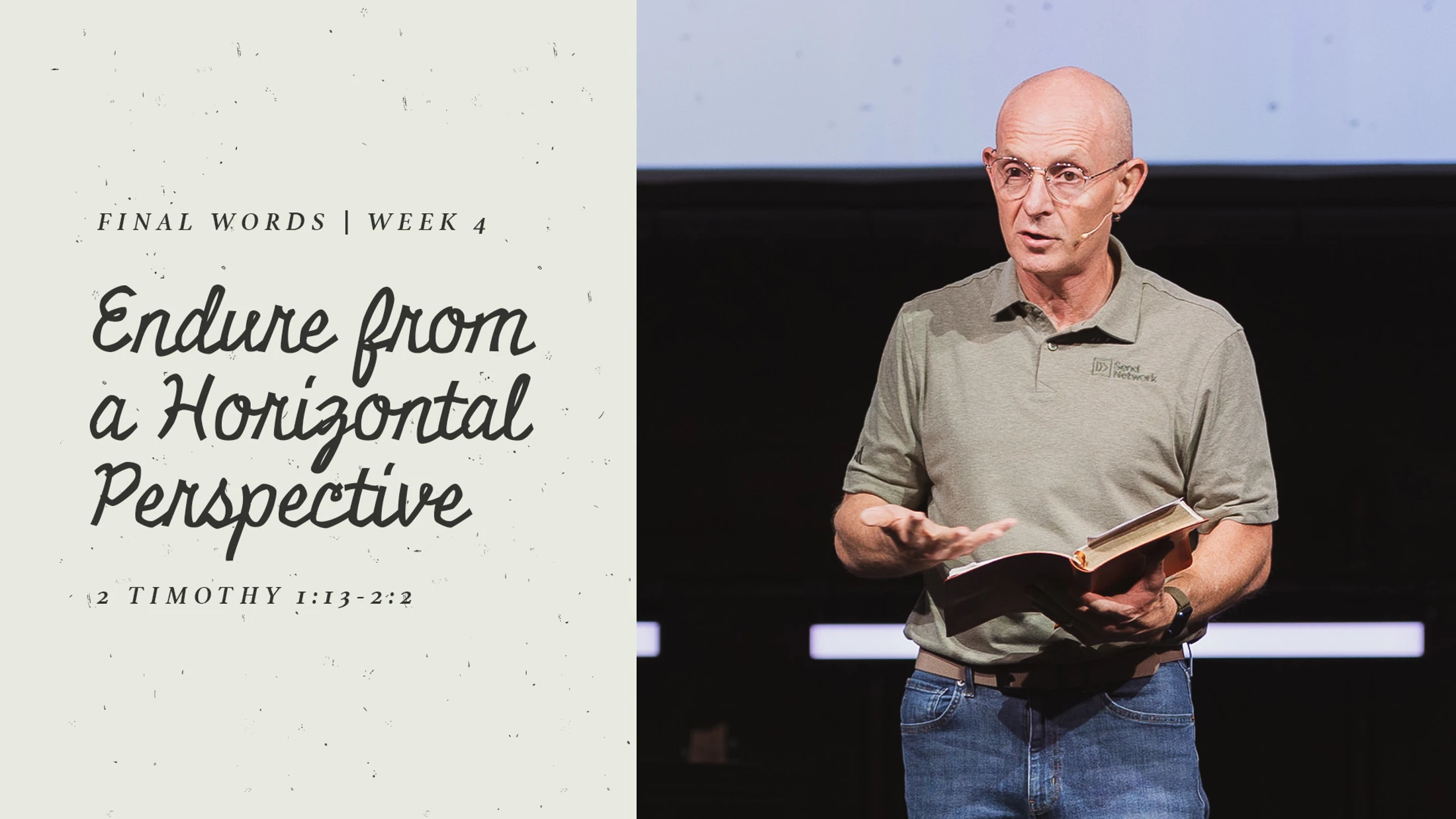
Paul's final letter wasn't just for Timothy, it's for you. It calls you to endure, to stay rooted in God's Word, and to live with bold faith in a drifting world. These are his final words, and they still speak today.
Well, our campuses are joining us now, and I want to ask all of us to take our Bibles and let's get under the weight of the Word, both here, Lamoni, Carlisle, our Guttenberg gathering, our Cornerstone campus, let's all take our Bibles. Second Timothy, it's week number four in our series, Final Words. So we're looking today at all the end of chapter one and the beginning of chapter two, so locate that portion in your Bible, put your eyes on there and a finger there, have your series guide ready as well, and as you do that, think with me of a time when perhaps you were under intense physical pressure.
Maybe it was a deep or a dark valley physically for you. It may have been maybe you were training for an event. Maybe you were sick with illness or just something where there was some intense physical pressure.
In that moment, here's what's true, that what you put in you fuels you. You've heard the phrase, you are what you eat? It's true. In fact, it's so true that if you don't eat, you'll die.
You know this, it's logic, but you can train, have the best weight machines, you can take the best supplements, but if you don't actually eat food, guess what? You won't live. So, there's an internal aspect that matters. What you put in you matters, but here's what also matters, your relationships.
So there's an internal factor that is primary, but there's also a horizontal aspect that matters, it's secondary, it's important. In fact, stats continually show decade after decade that isolation shortens lifespan. The more you seek to kind of hide away or anything like that, when there's isolation, you just live a shorter life.
So there's a horizontal aspect to enduring, there's an internal aspect to enduring. The same thing is true spiritually. We need the internal food of the gospel spiritually, amen church? We need to feed on the gospel, we need to eat the gospel, so to speak, regularly, daily, ingest the truth of the gospel, but we also need relationships.
We need that horizontal aspect, people prodding us, encouraging us, we need that. So, just as it's true in life, it's true spiritually. There's an internal aspect to our endurance and there's a horizontal aspect to it.
And this morning, that's what I want to share briefly with you, is some insight from the scriptures on the horizontal aspect of endurance. In fact, here's what we'll see from 2 Timothy 1, about verse 013 through chapter 2, verse 2. We're going to read that and look at a few things in there, but here's the take home truth we're going to pull from that passage. I'll give it to you up front this week and you can just kind of watch it emerge as we walk through this text.
It's simply this, that the Holy Spirit shapes me for gospel suffering through gospel relationships. You recall last week, right? We learned how the Holy Spirit shapes me through the gospel to suffer for the gospel, which is the power of God, so that was the internal aspect. We're now looking at the horizontal aspect and what these verses will show for us is that there is a power in gospel relationships that gives us endurance for the moment.
It's the horizontal aspect. So say this with me as we dive into our text together. The Holy Spirit shapes me for gospel suffering through gospel relationships.
Let's see it in the text. Let's check it out. 2 Timothy chapter 1, beginning in verse 13, here's what God would say to us.
Hold on to the pattern of sound teaching that you have heard from me in the faith and love that are in Christ Jesus. Guard the good deposit through the Holy Spirit who lives in us. You know that all those in the province of Asia have deserted me, including Phygellus and Hermogenes.
May the Lord grant mercy to the household of Vanessa Forrest because he often refreshed me and he was not ashamed of my chains. On the contrary, when he was in Rome, he diligently searched for me and found me. May the Lord grant that he may obtain mercy from him on that day.
You know very well how much he ministered at Ephesus. You therefore, my son, be strong in the grace that is in Christ Jesus. What you have heard from me in the presence of many witnesses, commit to faithful men who will be able to teach others also.
Now let's just be honest that there is a ton of things in here that we could bring to the table today, right? Well, we could preach four or five weeks from so many things in this text. There's a number of verbs, do you see them? Just circle them. There's hold on, guard, the idea of desertion, then there's the idea in contrast of refreshing and not being ashamed in verse 16, searching and ministering and then committing and being strong.
Those are all verbs. We could spend a number of weeks just talking about the verbs in this set of verses. We could spend a number of weeks talking about the proper nouns in these verses.
Do you see them? Christ Jesus in verse 13, the Holy Spirit in verse 14, the Lord in verse 16, again the Lord in verse 18, Christ Jesus in verse 1 of chapter 2. So while the verbs may speak to the what, these proper nouns, they speak to the who. Who empowers the what? You add to that all the other just proper nouns that aren't divinity based, such as Onesiphorus, there's places like Ephesus, these men Phygelus and Hermogenes. You begin to see that there's the what and the who all throughout these verses.
So there's a lot here, I want to say that to you, because I'm not going to spend time going over every single detail. That'd be fun, but it won't happen in 40 minutes. Are you with me? Instead, what I want to do is something the Lord taught me just a few weeks ago that I found quite instructive, and I want to bring it to you, is that the what and the who happen in an arena.
In other words, there's a laboratory, you could even say a kitchen, or you could say a gym, there's a place where the who and the what are experienced. And I would say to you, it's in the arena, the laboratory, the kitchen of relationships. That's where those things that we're to do, that God empowers us to do among other people, all of that occurs in the arena of relationships.
And there are three relational links that I want to point out to you in this section that I think, personally, they make the whole passage, can I say to you, it kind of shines a little brighter when I see these six words, they're three relational pointers. Let me show them to you. Just circle them in your Bible.
The first one's in verse 13. It's these two simple words, from me. You see that? Think about Christian mentoring as we think about the words from me.
And really, this is just a matter of addition. Paul is simply saying, Timothy, I gave you something. You saw something in me, it was one-on-one, and you can call this Christian discipleship.
I'm not going to argue about which word to use. I chose mentoring in this case because there is a sense in which what's happening here is more than just knowledge. And I'm not saying discipleship is just knowledge, but sometimes in the church, hang on to this, we think it is.
We think I've got to learn more, and so we go to class, we read a book, and we think we're being discipled, but actually discipleship means learner, not just what to know, but how to live. That's where you should say amen. And often we associate discipleship with a class, but discipleship is lifelong.
It's learning to live like Jesus. So I think the word mentoring works, but the thing I want to focus on is that it's not just any kind of mentoring. It's not just any kind of discipling.
It's Christian mentoring. You hear me okay? It's Christian discipleship. I base that on what Paul says here in the verse.
He says, what you've heard from me, you know, and it comes from Christ Jesus. So Paul's not just like talking about how to throw a football, kick a soccer ball, make a tent. That's what Paul did, right? Work with leather.
That's not what Paul said. He said, Paul said, Timothy, I'm going to come to you now, and you're going to hold on to the pattern of sound teaching that is from Christ Jesus. You got this from me.
Like, this is what I'm going to mentor you in. I'm going to disciple you in how to hold on to this. It's Christian mentoring.
It's acutely Jesus-based. It's blatantly, unashamedly Christ-centered. That's the kind of mentoring and discipleship Paul was giving Timothy.
And he says to him, he's to hold on to this, which means to cling to, to grasp, that which he received from him, notice what it says here, in the faith and love that are in Christ Jesus. So the question is this, is he to hold on to this in faith and love? Or did he hear this in faith and love? Maybe a little picky or technical, but I was wondering this week. Did he hear this in faith and love from Paul, or is he to hold this in faith and love? I think it's referring to the holding.
Now we can say both and feel good about ourselves. I land on the word hold. I think Paul is saying, Timothy, here's what you watched and you saw.
Now I want you to hold on to this pattern of sound teaching and hold it in the faith and love that's in Christ Jesus. So Christ is the source of it, but Timothy's to hold onto it in faith and love. What does that mean? How do you hold something in faith and love? Here's what I think he's saying to him.
Listen very carefully. I think he's saying, Timothy, you must trust and treasure God's word. Faith is the idea of trusting, and so we receive that from Christ.
And then with that faith, we hold onto the word and we believe it. We trust it, but we also treasure it. That's what love is.
Love is treasuring something. So I think Paul is saying, Timothy, God has given you his word. You've seen it work in your own life.
You've trusted it. You've seen it change you. You should treasure it.
And so you hold onto that with a trusting, treasuring spirit. Value the word of God. You've seen me do this.
Now your turn, Timothy. Hold onto it. Don't be fearful of it.
Don't back away from it. Don't be ashamed of it. Trust it and treasure it.
It's the word that does the work. Timothy here is being emboldened. He's being mentored.
He's being discipled to make sure that what he got from Paul is what he held onto and trusted and treasured, which is the word. This is essentially discipleship. It's Christian mentoring.
I'm really thankful for this concept, this principle. I've seen it in my own life. Other than my parents, probably the most instrumental person who really taught me how to love the Bible, and he did it by his actions, was my junior high youth pastor.
His name was Richard Jones. I won't go into how we met or any more stories, except to say this, 7th, 8th, and 9th grade, Richard taught us every Sunday night in this classroom. And I remember thinking, how does a Richard was a college student, may have been in seminary then, but he was young, unmarried.
And I remember just thinking, how does he know all this? How does he teach us this? We met in small group studies as well. And over three years, I remember Richard just really unpacking the Bible for me. So my parents obviously first just did this well.
But when you get another voice in your corner as a parent, you're always going to say, listen, listen, right? Every parent loves echo voices that say the same thing, amen. That's when you say amen again. I mean, come on, parents, you know this is true.
And Richard was one of those at our church and in my life. My parents would say, listen to Richard, hang out with him. Make sure you go to class and the training union and the Sunday school and the youth activities.
And he would just teach me. He had an overhead projector. He knows what those are.
Most of you don't. Most of you should. They're a big, massive dinosaur machine and you could ride on it on this plastic sheet that would shine on the screen behind you.
He would use one every Sunday night and he would dissect the Bible. He'd mark in his Bible. He would show me what words connected.
He taught me Greek when I was in high school. It really wasn't Greek. He just made me think it was.
He wanted me to see how beautiful the Bible was. And I remember when I graduated, I was thinking, man, the Bible is so rich and so beautiful. I know it's the Holy Spirit's work.
It's God's calling on my life. So I'm not doubting that. But from a human point of view, from the ordained means, who does God use to accomplish his purpose? I mean, Richard was instrumental in showing me just how wonderful the Bible is.
When I graduated from high school, he asked me to serve with him as a volunteer youth leader. So I did. And then when I was a sophomore in college, he left.
And so that's when my home church said, hey, would you take over Richard's place? And here's what's so funny. In my first year as a sophomore, as a junior high youth director, the biggest criticism was why are you trying to act like Richard? That's what they would tell me. And I really couldn't because Richard had a stutter.
He never stuttered when he preached, when he taught us. But in conversation, he stuttered a lot. G's and D's, and you'll probably hear this, were difficult for him.
But he never let it bother him. He never was afraid of it. And when he taught, I never recalled Richard stuttering.
So when they said to me, why are you acting like Richard? I was like, well, I don't stutter. But I just kind of took on the habits of this man that I had watched and really admired. And he kind of gave me a real love for the Bible.
That's Christian mentoring. It's Christian discipleship. It's transferring the love and faith you have in God's Word and in God's plan in the Lord to another by being with them and teaching them and modeling for them and urging them to do the same thing you're doing.
It's what Paul said to the Corinthians, you follow me as I follow Christ. So I have a question for you. In light of this simple relational pointer from me.
Something went from Paul to Timothy. It's God's pattern of sound teaching, his word. I have a question for you.
I'll give you five seconds to answer. That's all you get. I'll give you the question, then I'll count down.
You're ready? You're nervous, I can tell. That's good. Who are you discipling? Five, four, three, two, one.
If there's no name in your head, you're not discipling anyone. Trust me. If you were discipling someone, you would know it.
And see, this is one of the problems in the American church. We talk discipleship, but ask someone, who are you discipling? And they're, well, they can't think of a name. They don't have one.
They don't know. I'm just going to ask you to be much more intentional about Christian mentoring. Call it Christian discipleship.
But you should always have a name on the tip of your tongue of the person that you're trying to transfer all that God's taught you into their life. That means you need to be bold about it, put it on the table. If you need a name, come see me.
I've got multiple people who are looking for a mentor or a discipler. I'll try to connect you. If right now you're mad at me for the quiz, you'll get over it.
Thank the Lord that someone had the guts and the courage to ask you the question that we should be asking ourselves more often around this place. Did you know that's actually our mission to make disciples of all nations? That's the mission of the church. So what Paul is doing to Timothy should be what the church does across the spectrum, consistently making disciples, Christian mentoring, acutely Christian Jesus-based discipleship.
Are you doing that? Okay, on top of that guilt, let me just ask you this question now. Who will you disciple? And will you mentor someone? Let that process and let that kind of percolate in your brain for a bit. Let's notice number two here.
We'll add to that another question, all right? Here's the second relational link that I have found that really makes this passage shine even more brightly. Even though we can't cover every detail. I love the two words at the end of verse 14, in us.
You see those? He said, Timothy, guard the good deposit through the Holy Spirit who lives in us. So at first he's like, Timothy, hold on to what I've given you. Now he's saying, guard a deposit through the Holy Spirit who lives in us.
Now, is he referring to just him and Timothy? Is that the us or is the us him and Timothy and the church? Good question. I think on this one I'll be political and say it probably is both and I'm going to tell you why. I think he's thinking of him and Timothy, but I do think his mind quickly goes to other people who did or didn't have the Holy Spirit, which would be those who were in the church and then those who weren't.
Those who did guard and those who didn't guard. Let me show what I mean. Because following verse 14, look what he does.
He really lists a number of things that happened to him, descriptions of people who some guarded and some didn't, which I think is tantamount. If you didn't guard well, it means you didn't have the Holy Spirit. You deserted.
You see that in verse 15? All those in the province of Asia deserted me. They didn't guard something well, so they didn't have the Holy Spirit in them. That's what he's saying.
But Onesiphorus, man, he refreshed me. He was not ashamed. The other group, they were ashamed, especially Phygelus and Hermogenes.
But Onesiphorus, he was not ashamed. So do you see the contrast here? Paul is thinking that the Holy Spirit empowers us to guard something, yes, him and Timothy specifically, but other people in the church as well. And there are those who don't guard well.
They start off thinking they are. They make you think they are. But they end up deserting, which from my theological perspective means they never really were in in the beginning.
They never were part of the group at all. They just thought they were, 1 John 2, 19. But then there are those who in tough times, they do guard.
They hang on. They endure with you. So I call these spiritual partnerships.
And just as discipleship and mentoring is acutely Christ-centered and Jesus-based, so partnerships in this way, the people we can count on in difficult times, that's a spiritual partnership. It's empowered by the Holy Spirit who lives in us. Don't you find it interesting that in this verse, Paul mentions the Holy Spirit specifically? He says you guard the deposit through the Holy Spirit who lives in us.
So when times are tough and things are kind of not looking great on the horizon in regards to your testimony and your boldness, who is it that empowers you? It's the Holy Spirit. Read Acts 2, 3, 4. When they were just about to get martyred, and some did, but when their life was on the line and they were being persecuted and beaten, it was the Holy Spirit of God who empowered them to remain true and endure. And so church, our partnership with each other, our willingness to stand together and stand strong is a result of the Holy Spirit in us, giving us the power to be witnesses.
Now some of you know this, but let me just pause and say this. In Acts 1, 8, when the promise is that the Holy Spirit would give us power to be witnesses, you know what the word witnesses is in the original language? It's the word martyr. It's the Holy Spirit of God that gives you the power to be faithful and guard what God has given you, even to the point of death.
That's how powerful God's Spirit is. And Paul here is saying this is the type of spiritual partner we need in the church. We don't need another Phygelus or Hermogenes.
We don't need folks like in the province of Asia who desert. We need folks like Onesiphorus. And notice this, he paints the picture of a guard in very proactive terms.
Do you see what he says about Onesiphorus? Onesiphorus, he says, he searched for me. He refreshed me. He was not ashamed.
So you don't have this picture of somebody hunkered down like, okay, I'm guarding what God gave me. Leave me alone. I think I'll make it.
You find this offensive in the right sense of the word, okay? Proactive person. He's searching Paul out. He's looking for him.
He's finding him. He's refreshing him. He's not ashamed of him.
Man, that's the kind of partner you need, isn't it? That's the kind of person you want in your corner is an Onesiphorus. Ask yourself this question. Who's that person in your life? Who can you count on that when things are down, you know, one call to them, they'll be there.
Are you that kind of person? Does the Holy Spirit give you the kind of boldness that at the toughest moments, you're not going to falter? You're not going to distance yourself from those who are standing strong. You're going to guard with them. You're going to be like Desmond Doss.
Who's Desmond Doss? He was the army medic in World War II during the Battle of Okinawa. Under intense fire, most of that unit, they had to retreat. He went into the battle, which was on a pretty big ridge, and he saved 75 wounded people.
Wounded soldiers. Fellow soldiers. You know this more than you realize.
It was a movie in 2016, Hacksaw Ridge, it's his story. He's the kind of guy that when things weren't going well, you could count on him. He actually rescued and lifted to safety 75 injured soldiers in the middle of intense fire.
He didn't run. He was the partner you could count on. I want to encourage us to be the Onesiphorus and not the Phygellus and Homogenes, right church? Let's stand strong together and let's be spiritual partners, connected because of the Holy Spirit.
One more relational link I want to show you here is at the end of verse 2, chapter 2, it's the words to others. Here, really, what Paul is discussing is a faithful legacy. If the first one was about addition, one-on-one, and the second's more about a collection, two or more, here I think Paul is talking about multiplication.
Watch this, church. Multiplication across generations. He's saying, Timothy, what I've given to you, you teach others who then will teach others.
All of this, of course, is under the umbrella of faithful men, and so we're not just talking about anyone but those who have proven to be the kind of guards that the other verses talk about. Yes, let's find those men and let's commit this to them so they can commit it to others. Paul is expecting here a faithful legacy.
It's a beautiful verse that really describes what should happen over the course of many years. This really is the long game of the horizontal perspective. When it comes to endurance for the sake of the gospel and really being strong in the face of suffering, this is the long game of you.
Generations from you and from now, there will be people, men, standing strong for the sake of the gospel, and so it takes this kind of effort and activity. In fact, don't you love this? You'll find the phrase, heard from me, two times. You'll find it in the beginning of this section and at the end of this section.
The first one's more singular, Timothy, what you heard from me, you do. The last one's, Timothy, what you heard from me, you make sure someone else is doing it as well, and then they tell someone else, and so there's this long line, this legacy of faithful men. It's a faithful legacy.
So just really six words, from me, that's addition, who are you discipling? In us, that's more like collection, the church, who can you count on? And then to others, it's multiplication, who's coming after you? Who will you entrust to pass it on? And then, I told you about Richard, didn't I, in the first point? Here's what I love about that story, and some of you are aware of this, but most of you aren't. Richard was just a lost pagan teenager in Chattanooga when he got saved at the church where he was eventually one of the youth pastors. I think he was saved as a junior, maybe a sophomore in high school.
He was led to the Lord and came to Christ and discipled and grown by a man named Ab Thomas Ab was our main youth guy. We had several youth pastors. He was our main youth pastor And so Richard was discipled by Ab Thomas Richard and I connected when I was in seventh grade Richard was really instrumental discipled me And eventually I kind of took over Richard's job and one of the first kids I met who was in seventh grade was a guy Named Mike Haynes.
Some of you know Mike Mike was our youth pastor here He moved from Florida back in 04 helpless plant for his family I know of two men in our church who really appreciate Mike my son Brett and my son-in-law Matt They are with Mike a lot and Mike just really influenced him and I thought about that chain this morning ab to Richard the Todd to Mike Matt And that's not to prop us up that's just to say this to you that's how things keep going That's how you pass it on you with me So you got to have somebody in your mind like, okay. I'm not only discipling someone I'm thinking generations ahead Who are they going to disciple? How will this be passed on? It's addition Collection multiplication Who are you discipling? Who can you count on and who do you trust to pass it on? And what you're seeing in these three relational pointers is this So much of endurance for the gospel happens in the arena of relationships. Are you with me? We don't endure alone all the time sometimes that's our call and Paul mentions it later about that But ideally when we're enduring we should have a group with us Some folks that we're standing with like a small group.
Are you in a small group? Here's ample biblical evidence to get in a small group So there's addition collection multiplication So you can answer the questions. Who are you discipling? Who can you count on who can you trust to pass it on? This is all about relationships to a large degree So we do want to make sure that we understand primarily we have to internalize the gospel. Amen But then there's a horizontal aspect that comes out in relationships No one disciples others or counseled others or creates a legacy in isolation nobody You need other people I'm intentionally Speaking to anyone here who might still be kind of hanging out in the shadows You're kind of existing in the closet You like what you see in the living room, but you don't want to come out and join the group Or you're at the table you love the fact that we had pork chops for dinner But hey, I don't want to get in the kitchen to prepare or clean up.
Can I just have another pork chop, please? I'm calling on you to come out of the closet and get in the living room and pick a chair with the group Put a name on it like I'm in I'm calling on you to get up from the table and either meet me in the kitchen in advance Let's make some meals together or come up afterwards and let's clean up together Like let's do more than just enjoy the meal or watch from the closet That clear enough. I think so I'm speaking to you to get in on the joy and beauty of gospel Relationships because it's in gospel relationships That the lord builds us and equips us for gospel suffering That was our take-home truth remember will you say with me again You've seen it emerge now. It's all clicking your mind's like I get it now Six words three pointers.
Here's the main truth eight verses Okay, say it with me the holy spirit shapes me for gospel suffering through gospel relationships So I want to encourage you pursue Relationships, is it messy at times? Yes, but it's far better than isolation Isolation will always shorten your lifespan Is it harder relationships? Yes, they are Do they take time? Yes, they do But a man that has friends proverb says must show himself friendly if you're whining and complaining about no friends I'm going to first of all ask you How friendly have you shown yourself to be? That's just straight out of proverbs. Don't get mad at the preacher I'm calling on many of you to increase your value of relationships You weren't made To do this alone And part of the reason you're feeling the pull to fear And to abandon and to go back and to shrink is because you don't have people in your life Holding your feet to the fire and helping rekindle a fire in your life As I thought about that this week, I was reminded of something julian. I love to do and with this I close We love to camp We like to Take our pop-up, which we don't have right now, but we're going to get one soon And find a state park or a campground Set it up and then we always build a fire and sometimes we build fires at the weirdest times Like we'll just build one in the morning We don't even cook over we just build it We'll build it in the afternoon We'll build it at night for sure and we buy the kinds of things you can throw in the fire that makes it different colors You know We have a good time and sometimes we'll just keep a fire going all day we'll go hike come back You know stoke it rekindle it Here's what we've never done even at times when we've used charcoal briquettes on a grill near the campsite Here's what we've never done I've never started a fire or cooked over one Briquette i've never done that I've never taken one twig and said all right I can't wait to enjoy this fire.
This will be great all night I've never done that and you've never done that either. You know why? because no coal Burns well alone So quit trying to be a single coal in the fire Join other coals and watch the fire in your life burn brighter. Watch the fire of god's work burn brighter Let's stay together.
Let's band together and let's see that it's through gospel relationships that god actually gives us a gospel rigor Amen with that in mind Let's bow our heads. Can we? Taylor's going to join me. We're going to dismiss you in a moment I want to ask you to simply do one thing as we close Across all of our campuses.
I'll pray to this end, but can we all just lean in a little bit here? What name is circling in your head right now My sense is Across this room across our campuses in every location The holy spirit's putting a name in your head of someone you need to disciple Of someone you can count on maybe you want to send them a note of thanks Give them a text or a call Or someone you need to press into and entrust For the next generation I don't know which of these if maybe more than one the holy spirit is pressing in on you with but can I say to you I sensed all of us have a name Nearby My question to you is will you take action regarding that name? Maybe I could ask it to you like this Who's the timothy in your life? Who's the onesiphorus in your life? Will you say right now? This commitment prayer to god lord. Jesus I will in the next seven days Act to connect to Converse with the person that you're putting in my head right now, whether it's for discipleship Dependability or gratitude legacy the holy spirit will guide you Don't dismiss this name. That's kind of just circling your the airport of your mind right now, okay Whoever's name that is Will you commit to acting on this holy spirit's prompting in the next seven days? I'm going to pray that you will heavenly father In this room and across all of our campuses.
Will you empower obedience by your holy spirit? to the promptings of your holy spirit you call people from the shadows the closets the corners into Relationships in the church that are designed to be gospel acutely christ-centered and jesus-based Relationships for the purpose of strengthening us Increasing our endurance holding our feet To the fire so to speak so that we burn brighter. The gift is rekindled and we don't shrink back or desert God increase the numbers in small groups increase the number of people in discipling relationships Increase the potential for faithful legacies among families and Or this we pray In the name of jesus christ and by the power of the holy spirit and all of god's people said together amen