
Endure from a Gospel Perspective | 2 Timothy 1:8–12
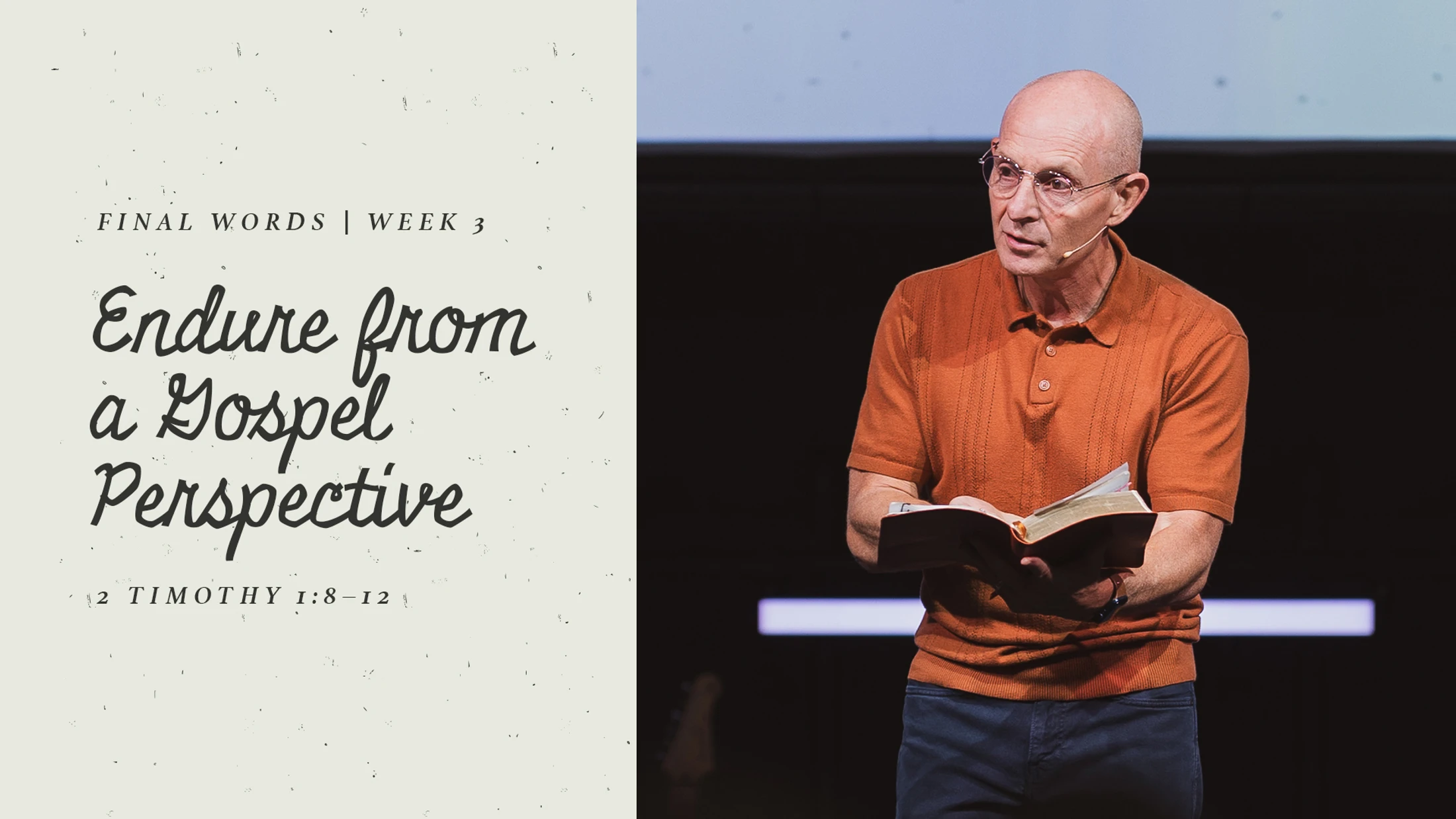
Paul's final letter wasn't just for Timothy. It's for you. It calls you to endure, to stay rooted in God's Word, and to live with bold faith in a drifting world.
These are his final words, and they still speak today. Second Timothy chapter one. Take your Bibles and let's go ahead and locate that portion of Scripture here in this room.
Also, our video venue, Lamoni, Carlisle, Guttenberg, our brand new Hispanic campus launching today right upstairs at this very moment. Can we thank the Lord for that? Hallelujah. Amen.
About two and a half years ago, we just were having a conversation in the gym during one of our international dinners, and Pablo and I and some other Hispanics were like, are there more in our area? Could we reach out to them? Could we have maybe a Hispanic plant one year? And two and a half years later, God's launching a Hispanic campus right here. We're so thankful and grateful, and I want to thank you just for your heart, for sending and for multiplying. That's what it's all about, making disciples who make disciples.
Second Timothy chapter one. Put your eyes on verse eight. Let me see if I can give you a humorous ... Let's see if I can give you the essence of this upcoming paragraph in a humorous fashion.
Let's set the stage a little bit. Our son Brett, when he was around fifth or sixth grade, I'm not sure exactly, he was in class. I'm not sure if it was band class or if it was homeroom, but he was in with his whole class, and the teacher asked this question, how many of you are taking piano? Now, in our home, growing up, we required all of our kids to take at least six months of piano.
That was the law. You could take up to a year, but you had to take six months. We feel like it's probably the most basic and best way to learn entry-level music.
You learn notes, just a lot of things. So we said, hey, you're going to take six months for sure. You can go up to a year, and you can keep going if you want.
So Brett was in the middle of his six months. So the teacher says to the whole class, who all here is taking piano? So in that split moment, he's eyeing the room, and the only people who raised their hand were girls. So what do you think Brett did? He didn't dare raise his hand.
He's like, I don't want to associate with just a group of girls taking piano, because the guys that I associate with on the playground, we play football. So I'm not raising my hand. So he didn't raise his hand, even though he was taking piano at the time.
Now, if you ask him today about that, he'd say, you know, it was kind of a bad move, because the football players, what do you get, a few years? Maybe a good contract till you're 30, 35, and you're done. You can play piano your whole life, he says. But in that moment, fear got the best of him, and he distanced himself a bit.
That's the humorous essence of 2 Timothy 1, 8-12. Let's check it out. Your eyes are on verse 8, right? Here's what God's word would say to us.
It's coming out of verses 6 and 7, so try to remember last week the flow of the text. Paul says, so, again, there's the flow coming out of the fact that God gives not fear, but power, love, and sound judgment. He gives this through his Holy Spirit so that it shapes our spirit.
In light of that, so don't be ashamed of the testimony about our Lord or of me as prisoner. In other words, raise your hand when they call your name, right? Who here's a Christian? Hand up, right? That's the point. Paul says, don't be ashamed.
Instead, share in suffering for the gospel, relying on the power of God. Be sure to connect the word power in verse 8 with the word power in verse 7. Paul is continuing a thought here. This is how we are not ashamed.
This is how we suffer well. You could say this is how we suffer shamelessly through the power of God. Now, maybe you're wondering, okay, so what is the power of God? Where do I find the power of God? Well, he mentions it in one word a few words back.
Do you see where he says he's not ashamed of the gospel? Instead, he shares in suffering for the gospel? What does he do next? He now lays out for us the gospel. This is the power of God. Verse 9, he has saved us and called us with a holy calling, not according to our works, but according to his own purpose and grace, which was given to us in Christ Jesus before time began.
And this has now been made evident through the appearing of our Savior Christ Jesus, who has abolished death and has brought life and immortality to light through the gospel. For this gospel, I was appointed a herald, apostle, and a teacher. So three mentions of the word gospel, that's the power of God.
That's what fuels shameless suffering. Notice how Paul now concludes in verse 12, and that is why I suffer these things. But I'm not ashamed.
You can almost hear in his mind saying, Timothy, I'm not ashamed. I can't hint. You can hear that, can't you? Just in the ambiance of the text.
But I'm not ashamed because I know whom I have believed and I am persuaded that he's able to guard what has been entrusted to me until that day. Now in your series, God, I want you to draw a simple diagram to help us understand this text. It's not hard.
We don't need to spend a ton of time analyzing every word, defining things. We do that sometimes, but this is just very clear. It's clear through a simple diagram that verse 8 and verse 12 are like the bookends to this paragraph.
They're about suffering. You can see them in the text, can't you? You see verse 8? He talks about suffering for the gospel. He's encouraging Timothy not to be ashamed.
In verse 12, he says, I'm not ashamed. That's why I suffer these things. There's a common theme on both ends of this paragraph.
Let's talk about that just for a few minutes because Paul here, in essence, is saying to Timothy, and this is just very practical and plain. He's saying, Timothy, I need you to own up to your identity and responsibility. Timothy, quit distancing yourself.
Quit trying to shy away. Quit pulling away from what's rightfully yours. And that is the responsibility to be a courageous and fearless pastor.
And if that calls for suffering, then you suffer. You can't act like you don't know me, and you can't act like you're not a Christian in this moment, Timothy. Now, that may be hard to hear because we have great, and we should, we have great thoughts about Timothy.
Nothing is meant to denigrate him, but I think if you just take the text honestly at face value, Paul is saying, Timothy, if there's any sense in you in which now you're going to kind of pull away from knowing me or that you know the Lord, like, that's the spirit of fear. That's not what the Holy Spirit gives you. And I'm encouraging you, don't be ashamed.
If you go to verse 12, he says, I'm not ashamed. You can just hear this mentor and prodding, can't you? Timothy, own up. Don't push back from the table.
Own your identity and responsibility. That's what's happening here. It's not hard to figure out.
You can see it, and you can hear it. Now, notice something in this text that I think is insightful. The temptation was for Timothy to fear.
But how do you know if someone's fearful? The answer is they begin to create distance. It's hard to spot fear, but spiritually, when you see distance, disassociation, like an unwillingness to kind of own, then what's driving that is fear. And what you may hear in your small group when you check in with people who just haven't been there lately, haven't shown up, they're not kind of owning who they are, what they do, what they committed to, you may hear, hey, listen, Todd, man, the work schedule's been crazy.
That may be true. That may be on the surface legitimate. You may hear, man, my kids have got games every weekend.
It's just crazy. And so they're turning their hobbies into idols. That could actually be true.
But perhaps what's below the surface of their expressed reasons, and maybe for some we could say excuses, what's below the surface is perhaps an increasing fear to be associated and identified with God's people and God's gospel. So we say things like, yeah, I'm just really busy. All right, I'm just not able to work it out.
When really insightful or say this, do I really want to be associated with this? Because it looks like it may cost me something. I based that on what I think happened in Timothy's life. I think Timothy watched Paul for the years that he traveled with him pay a heavy price for the gospel.
And when left alone at Ephesus. The temptation was. Maybe I don't want to pay that price.
Maybe I don't want to be associated with this group if it's going to cost me what it costs them. Maybe this isn't worth it. And you can look at that and say, man, who would do that? I'll tell you who would do it.
A lot of 21st century American Christians who scan the horizon. And wonder, is that really worth it? And so they start pulling away. Creating distance when what's really going on is they're just simply afraid of suffering.
What we need in contrast to the opening humorous illustration. Is more of the one that I'll share with you now. One of your own members.
She comes to the 830 service. She works in the world of pharmacy. Emily Porter.
A few weeks ago, Emily was at work. And her environment is such that there's various stations around. Like work cubicles.
But this kind of open. And for some reason one of her workers was taking around this post. I think that this person found.
And the post was simply a pretty clear statement of the Christian sexual ethic. I don't know who posted it. I don't even know what it said.
But in Emily's conversation with me. It was a very accurate to the point. Relay of the Christian sexual ethic.
And this person who somehow stumbled across it. Couldn't believe that someone would even post this. Much less believe it.
So they went station to station. Kind of asking folks. And you know laughing.
So it started four or five folks away from Emily. And she could hear the person saying. Have you seen this? I mean can you believe this? Do you believe this? And then they'd go to the next person.
And Emily said. My heart taught I was counting the footsteps. I could count down.
Like it's going to be me in a minute. And all of a sudden. Hey can you believe this? Have you read this? I mean do you believe? Hey can.
Who believes this? Can you. Can you. Do you believe that? And she said it was five.
Four. Three. Two.
And suddenly. This person's at Emily's station. And says.
Emily. Have you seen this post? I mean can you believe this? Do you believe this? She goes. My heart was racing.
I said. Holy Spirit. Help me with what to say.
And she said. Todd. I just looked at the person.
I said. Actually. I think that's true.
And I do believe that. But. I won't mistreat you or disrespect you in any way.
And that person looked at her. And said. Okay.
Thanks. And then went to the next workstation. When.
That's what we need. Amen. I mean.
She owned her identity. Identity and responsibility. In that moment.
Beautiful story. So proud of Emily. Just in that moment.
And I think she was probably had a heart rate of like 155,000 probably. Right? Nervous. She's not looking to offend someone unnecessarily.
She's not trying to cause turmoil. She's not seeking animosity. But in that moment she knew.
I do believe that. That it's what I hold to. And she owned it.
Man. Praise God. When they said, and this is metaphorical, no offense Brett, who here is taking piano? She said, my hands up, right? Let me ramp this up even more.
I just learned this week of an interesting story about an evangelist and pastor, E.V. Hill. He was a pastor in the 60s, 70s, and 80s, 41 years at one church in L.A. In his prime, he was pastoring and serving when racism and discrimination and a lot of issues surrounding that were just heightened in Southern California. He was a leader in making sure that justice was really pursued and solving a lot of issues around race in that area.
He had his enemies though. He received multiple death threats. One of them in the middle of a week was that, you won't preach Sunday, you can expect your car to explode.
I think the story is that he got this around a Wednesday or Thursday and so it caused some apprehension for sure. The story is that at some point he shared that with his wife. He got to Saturday, he went to bed, he was nervous.
He got up Sunday morning, got ready, and his wife was in the kitchen, they were talking. He said, well, I'm going to go start the car. True story.
She looked at him and said, I already did. That's the kind of people you want around you when things get tough, don't you? You want to associate with those kind of people who would endure and suffer for the gospel and Paul is into Timothy. Timothy, don't distance yourself because you're afraid.
You stand strong with me. You just bear up under this. Let the Holy Spirit shape your spirit so that you're not fearful, but that you have a spirit of power and love and sound judgment.
That's what will help you not be ashamed and be willing to suffer for the Lord and with us. If that's your heart, maybe you're asking now, well, how does that occur? How does one do that? That's what 9 through 11 is all about. 9 through 11 is simply the fuel.
You could say the books between the bookends. It's the gospel and it's the gospel that enables us to have the courage and the fuel to suffer well, to not be ashamed. In fact, let me just put it to you in words we used last week.
It's the word of God, the gospel being used by the spirit of God. Remember I told you they're inseparable partners? That's what's happening here. Between the bookends is the word of God being used by the spirit of God to make sure that we are fueled to be unashamed, not to pull back or distance or disassociate, but to own our identity and responsibility.
Between the two bookends, I want you to put the word gospel versus 9 to 11. The slide will change. We'll show it to you.
Let me just read this for you. Can I just rehearse this with you? Most of you will know this. Praise God.
It should just make your heart sing even louder in a few moments because here's the news that really builds allegiance and action. Here's the wonderful announcement of what God has done for those who believe, what God has done for us. Paul says, he has saved us and he's called us with a holy calling.
It starts with God. It's his work. He's taken the initiative.
It's not based on our works, the next phrase says, not according to our works. Nothing that I do earns or produces anything that God notices. God doesn't say, hey, God, I've started a business.
It's been successful. I've helped a lot of people. God says that doesn't help you spiritually at all.
You can pick your person, pick your occupation, pick your good work. That's not why God has saved you and called you. It says here, he has saved us and called us with a holy calling, a pure, a set apart calling, according to his own purpose and grace.
The word purpose simply refers to God's end game. What is God up to? What's the story of the Bible? Here it is in a nutshell. You know this? I've been here 21 years.
Today starts year 22. I've preached this since day one, but God's end game is people from every nation, language, tribe, and tongue worshiping him. That's the revelation scenes.
That's what's going on. So the Bible is about that. How is that going to happen? That's the next word.
That's the next word. It's the grace of God. It's a gift that God gives.
He gives and he grants repentance and faith to people so that they believe and begin to worship him. At the end of time, there will be gathered around God's throne multitudes of people from every nation, language, tribe, and tongue worshiping God. That's his purpose and grace.
None of your works have contributed to that. That's not why God's doing it. It's all God from start to finish.
He's the Alpha and Omega. He's the author and finisher of our faith. This is God's work.
He's the sole owner of salvation. It says here, this is the gospel. He saved us and called us, not by our works or according to our good deeds, but according to his own purpose and grace.
This was given to us in Christ Jesus before time began. How did God make this known? How did God accomplish this purpose through grace? It was through the person and work of Christ Jesus, the incarnated son of God who lived visibly in time and space on the earth as a real man, but as truly God. This was the manifestation that God loved us.
He sent his son to be the sacrifice for our sins, and that's what he did. He lived, he died, and he rose again. It's evidential.
Notice the word in the text. This has now been made evident through the appearing of our savior, Christ Jesus. Paul uses some good words.
He says, God's intent was to fulfill his purpose and grace through the second person of the trinity, God the son. When God the son appeared, we knew him as Jesus. He was also our savior.
He was the Old Testament promised one, the Messiah, so he's called our savior, Christ Jesus. That's the one who lived 33 years, perfect holy life, crucified, buried, raised again by the power of the father. That's why only Jesus can save.
Only Jesus is the mediator of God's grace, which leads to God's purpose. When he died and rose again, the Bible says here that he abolished death and he's brought life and immortality to light through the gospel. The sense is that immortality is the same as eternal life.
What is now brought to light? What is seen? What's exposed or revealed? That only Jesus gives eternal life because he conquered death. That's what it says. He abolished death.
When Jesus lived and died and then was raised again, it was clear he conquered death. He's Lord Jesus Christ. Now for someone to receive forgiveness of sins, there's only one person that can do that.
It's the Lord Jesus Christ because he died for our sins and was raised again for our justification, the Bible says. Your works don't matter. Your hero doesn't matter.
Mine don't matter. My hero doesn't matter. Only one matters.
His name is Jesus Christ. When anyone believes in the name of the Lord Jesus Christ, they can be forgiven. They're saved.
They're given eternal life. Hallelujah. Amen.
That's the gospel. Before I just say a few more words about that, can I just ask you, do you believe that announcement? I didn't bring you a to-do list. I didn't say God will be happy with you if you ... I brought you news.
That Jesus Christ in time and space has come in the flesh. He gave his life. He suffered.
He died. He was raised again. The Bible declares that all who believe in Jesus Christ receive eternal life and forgiveness of sins.
Do you believe that news? The minute you do, you're born again. You're saved. That gospel fuels Christians.
It's good news to all who hear it. Those who believe, that's the gas in their tank every day. This is why Paul shares this in between these bookends of suffering.
He's saying, Timothy, you know what you need more than anything right now? You need to fill up on this 100 octane fuel. You need the gospel because for you to endure and suffer shamelessly, to really have the courage to own your identity and responsibility, you don't need me to kind of encourage you to pedal faster or hold on tighter. You need to hear what God has done through Jesus for you.
That's what fuels and empowers endurance and shameless suffering, our identity and responsibility. We own that when the gospel's front and center. In fact, Paul says here, that's why I was appointed a herald, an apostle, and a teacher.
Paul knew at least this. I think he knew two things, but I'll say the first one here. He knew at least this, that the gospel matters for others.
You see how at the end of this explanation of the gospel, this beautiful presentation of the wondrous mystery of the gospel, Paul says, I've got a responsibility to proclaim this, to herald this, to preach this. He knew there were folks who needed to hear it. That's what his job was, his responsibility.
But it's not that this is just another thing in a menu of options. The gospel is exclusive, and here's why, because there's only one Jesus Christ. Now, that isn't saying other folks haven't suffered.
Other folks haven't been martyred. They have been. They have been.
But hear this, church. No one who's ever suffered or martyred, suffered for the sins of the world. Nobody.
The Bible says that when Jesus suffered and died because He was God in the flesh, that when He suffered and died, He bore in His body the sins of the world, 1 John 3. So can I say to you with incredible biblical accuracy and confidence, nobody has ever suffered like Jesus because He suffered for your sins. He took your place. He was sinless, but He became sin for you, 2 Corinthians 5, 21, so that you would know the righteousness of God.
So not only is Paul realizing the gospel matters for others, he's raising Jesus up to be the supreme beautiful treasure of our life because no one has suffered like Jesus, so only Jesus can save, and no one can secure you like Jesus. Do you see the very last verse? This is why He's not ashamed, He says. I suffer these things.
I'm not going to back away from them. I know whom I believe. I'm persuaded.
I'm convinced He's able to guard what has been entrusted to me until that day. He knows that the person really in charge of the gospel, in charge of who He is and what His calling is, it's God, and God never fails. God is completely, 100% reliable.
He fulfilled all of His promises in Jesus. He'll take Paul and make sure he gets safely home. So Paul's got an identity and a responsibility.
He wants to fulfill that, but he knows all of that is in God's hands and God will never fail. So he's saying, Timothy, I know whom I believe. I'll stay faithful.
I'll endure shamelessly. I need you to follow suit. Get in the boat with me.
The gospel will get us there. God's got both in His hands. So this whole text is really aimed at filling up Timothy's tanks with the beauty and power and wonder of the gospel so that Timothy, instead of shrinking back or acting like he doesn't know Paul or like, I'm not sure if I want to preach that.
He just pulls right up to the table. I know those people. I believe that gospel.
My hand's up. This is the point of the paragraph. You wonder, well, how does that work? It's because, listen very carefully, listen with every ear and eye.
The gospel of God is the power of God. Paul's not trying to get complicated, verbose. He's not trying to prove his intellect.
He's simply rehearsing here to Timothy what he said in Romans 1 16. Can I read it to you? Listen to this wonderful heart massaging verse. Paul said, I'm not ashamed of the gospel because it is the power of God for salvation to everyone who believes.
Where do you get power to endure well and suffer shamelessly, to own your identity and responsibility? You get the power of God from the gospel of God. That's what he did here. Can I just ask you to join me in doing that? Will you, for the next few minutes, join me in remembering the gospel tangibly and sensorily, if that's even a word.
We're going to taste things that remind us of the suffering of Jesus. We're going to bite into a piece of bread that will remind us of the suffering of Jesus. We're going to drink some juice that remembers the suffering of Jesus.
And I want this to be the moment in your week when you pull up to the gas tank. Now, listen, church, listen to me. And the Holy Spirit, the Holy Spirit refills your life.
He refreshes you. He replenishes you. He stirs again.
I'll use the words in 1 Timothy, 2 Timothy 1, 6. He kindles you. He stirs. He breathes on the embers again.
He fills up your tank so that you don't leave. In the next seven days, you're fearful. You're pushing back from your identity and responsibility.
Instead, man, you are owning. You're owning who you are, what God's called you to do. That you are saved by the gospel.
You want to share the gospel. You're going to have this sentence when you leave. Here's the longer version of the simple sentence, our take home truth.
You're going to say this today, that the Holy Spirit, yes, he shapes me through the power of God's gospel to suffer for the sake of God's gospel. That's a simple way to express these five verses. That the Holy Spirit uses the word of God to shape my spirit so that I'm willing to own my identity and responsibility.
In other words, the power of God's gospel helps me suffer well. So now this is a little long. It's kind of wordy.
It's on purpose. I wanted to make sure I got in at least every aspect from the text. I do like to try to be as accurate as possible.
But sometimes even accuracy can make it hard to remember even though it's actually true. So I think because we know each other's hearts, we know our context, you've heard the message. We're not speaking in a vacuum.
Can I just shorten this knowing that you know what I mean by the lack of some of the words? Can I just do that? Can I trust you with that? I think there's a shorter way to say this that has a better punch. It's this right here. The Holy Spirit shapes me through the gospel to suffer for the gospel.
And if you're wondering, church, hear me well. If you're wondering why you keep distancing yourself, why you keep asking, is it really worth it? Maybe you're not rehearsing the gospel to yourself enough. Maybe you just don't read the scriptures enough.
The gospel's enough. Maybe you're here once a month in communion just, you know, 10, 12 times a year. Do you see why this matters every week when we gather? This is a tangible, sensory way to fill up your tank.
And the Spirit of God will take the Word of God and rekindle you afresh. Who doesn't need that? So church, will you take a posture of prayer with me in a moment? Will you bow your heads with me? And can we ask God in this moment, through the Lord's table, through His table, through this spiritual meal, to rekindle afresh the heart of every believer by just filling us up with the glorious and wondrous, beautiful truth of the gospel.