
Dead to the World's Elements (Part 4) | Colossians 2:20–23
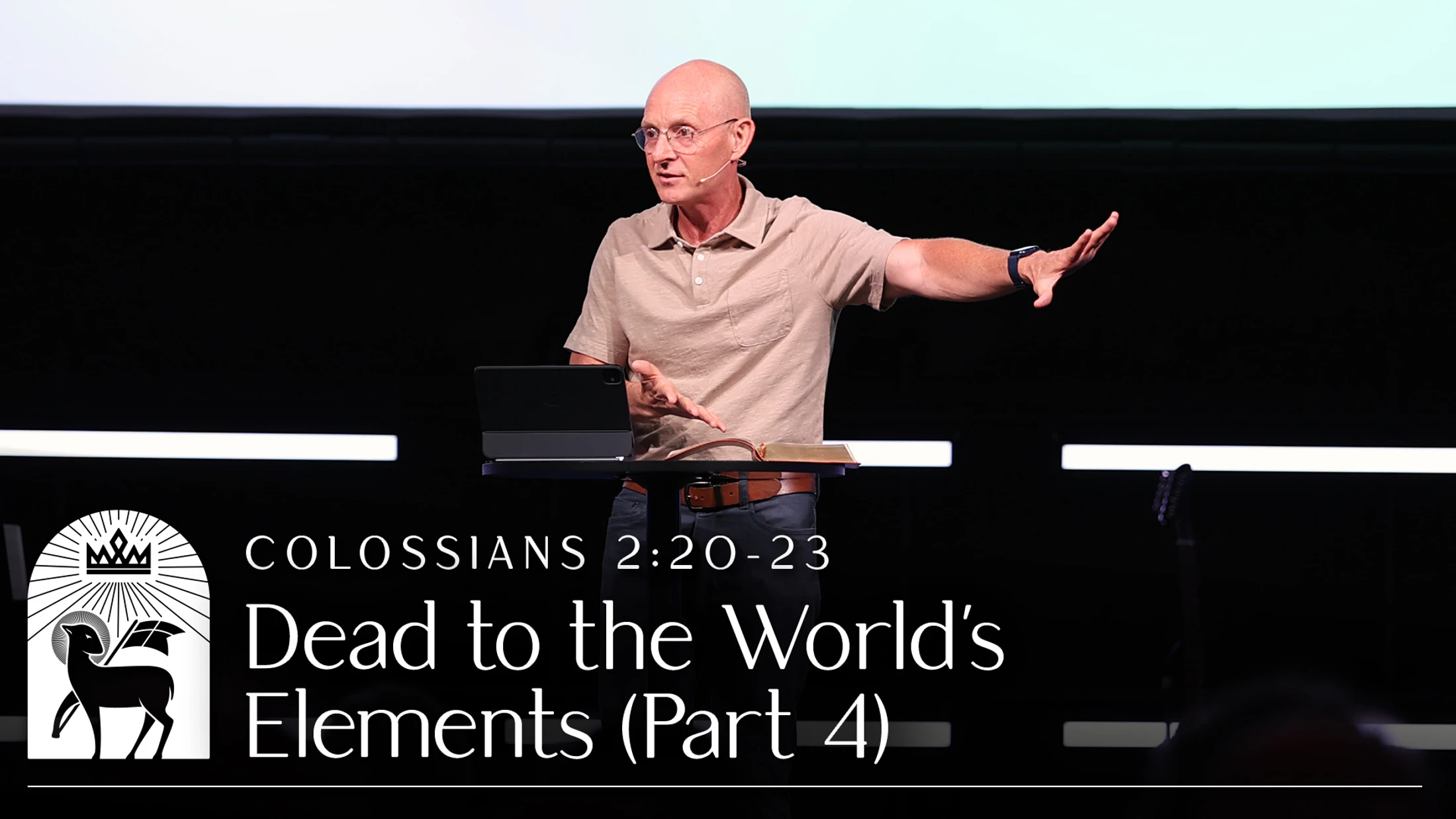
Because you’re “dead,” don’t search the graveyard of man for continued life from God. Listen to the final sermon from Colossians 2 from Pastor Todd and learn more about our "Christ Alone" series at https://firstfamily.church/christ-alone.
Well, let's get ready to get under the word. And as we do, I want to welcome in our live streaming venue. So glad they're able to help us by taking their turn up there.
Good to have you in this room as well as other campuses joining in. I especially want to welcome our kids today, our elementary kids. They're joining us in the service today.
They've got their kid sheet with them. You've got your journal and we've all got our Bibles in all of our locations, our Bibles are in our laps right in front of us. So let's get after it, shall we? Fantastic set of songs to put us in the right frame of mind and posture.
So let's continue worshiping. Allow me to frame what we're about to see in this morning's text by recounting for you one of my more embarrassing moments as a youth pastor. We were wrapping up a week at camp in Cedartown, Georgia.
It's Camp Antioch. We rent the whole place and pack it full of kids and we'd staff the entire thing from the cooks to the counselors. So we were wrapping that week up, had the place cleaned, the bus was loaded, the counselors were counting kids.
Everyone's there. We're in the bus. We had this older 66 passenger school bus, but it was automatic and at that time I was also the bus driver.
And so we jumped in the bus, I hopped in the driver's seat and go to start the bus and nothing happens. Remind you, I've got a load of junior hires and senior hires and they're worn out, they're frazzled, plus a ton of workers and counselors. We're ready to get home and the bus isn't even making us a peep.
Because I don't know a thing about buses, I open the hood thinking I could see something obvious, right? Some of the counselors get off, we're looking together, we're acting like we know what we're doing. We can't find a thing wrong. We try the jumper cables, we look at the starter, we check the oil, you know, we don't know what we're doing, but we're trying to find some way to start this bus.
Finally, I thought, well, I'm just gonna go ask the camp director. If he knows anything, maybe ask him why this is happening. It has been sitting for a whole week.
Maybe it's the battery, we didn't know. So I go get Bill and I said, Bill, would you happen to know why our bus isn't starting? A little frustrated and he comes out, I step aside, he climbs up in the bus and he plops down in the seat, kind of scans the dashboard, then pauses, stands right back up and looks me right in the eye and he said, Todd, it's in drive. It'll never start that way.
Then promptly walks off the bus back to the camp. So I sit in the driver's seat and sure enough, then I put it back in drive, starts right up, kids laugh, counselors laugh, and we crawl home. Now that story is embarrassing, but I'm glad that we had the courage to ask why and I'm also glad that Bill had the courage to state the obvious.
And so in a similar sense, that's what's going to happen today. We're gonna look at Colossians 2 and we're gonna see how Paul rhetorically asks why and then how he bravely states the obvious. So turn your Bibles to Colossians chapter 2. Would you put your eyes on the final four verses of this chapter? Verses 20 to 23.
Some review for you while you're doing that. This is the fourth message in a series of messages that began back in chapter 2 verse 8. And those messages in this section of Scripture regards being taken captive by, quote, the elements of the world. That's used twice in this section.
And in this section, Paul is warning the Colossian believers not to fall prey to dangerous false heresies, worldly philosophies. He's saying stay rooted and faithful to Christ. Don't be pulled away to empty notions.
These things dismiss the exclusivity and necessity of Christ. Now this was happening through one of two dangerous extremes, maybe both, legalism and mysticism. We talked about them for about two to three weeks.
One adds through extra deeds. We saw in the text, it's a legalism about diets and days. The other, it subtracts through self-denial, such as asceticism and secret access practices.
These are two sides of the coin of Gnosticism. It was creeping into the early church, the one here at Colossae, and it's tried to disguisingly invade their body. And by the way, it hasn't stopped since.
It's just been repackaged. If you want to know more about that, go hear those three messages and you will hear some clear specific references to how Gnosticism still tries to show up today. Essentially, the Apostle reminds them that because Christ has died and conquered all these worldly elements, then they too are dead to them.
Say that phrase with me, dead to them. And this is why the beginning of Colossians 2 verse 20 starts out with an 11 word assumption. I mentioned this as I ended my message on verses 16 through 19.
I promised you that I'd extrapolate more on that this week. And that's what I intend to do today. Further expound on the profound simplicity of this truth of being dead with Christ.
Why and how Christ's death and our death in Christ is the way to avoid falling prey to worldly elements. Now, I suspect you'll have questions as we work through these four verses. So on your weekly is our text number for questions.
I'd encourage you to text me some. I won't answer them live today because of time, but I'd love to address them either personally or on the podcast. I know that some will arise as we talk about various things.
So feel free, keep your phone handy, text in questions. It's how we grow and learn together. Now you'll notice speaking of the text, the flow of the text.
Our message will follow the flow and tone of the text. And the tone of this text, frankly, is somewhat of a mildly frustrated tone, somewhat like the camp director's attitude towards me. Paul is asking why, but he knows he shouldn't have to.
And so in response to that, he states the obvious. See if you can spot it with me as we read the entire passage. Colossians 2, follow along with me.
Verse 20, if you died with Christ to the elements of this world, I want to pause there and say that the word if is also the word for sense. Now, not the exact word in the Greek language, but the grammatical construction of certain phrases means that the readers would see this as a positive condition, like something that already is. In fact, some translations have the word sense.
This happens multiple times in the New Testament. Just know that he means here, since you died with Christ to the elements of the world, it's an assumption, it's a fact. As believers, this has occurred.
So then he asks this question. Why do you live as if you still belonged to the world? Why do you submit to its regulations? Two times he asks why, but he knows he shouldn't have to because they're dead to the world. But yet they're living like they still belong to it.
So he asks them twice, say it with me, what question? Why? Now, verse 21 begins an example of some of those regulations. And notice that in this six-word phrase, it does escalate. He says some of these regulations, they look like this.
Don't handle, don't taste, don't touch. In other words, don't get your hands around it. Don't ingest it.
And then he says some of these regulations, they say don't even, you know, touch it. Get as far away as you can. So you can sense what he's talking about here are external commandments.
He calls them next regulations in verse 22. Do you see that? And they refer to what is destined to perish by being used up. Now, what does he mean by that? He's simply saying that these kinds of commandments, these regulations that the world invents, these practices that false teachers want to commend to you, they all address things on the outside that eventually will perish your body.
They're external only. They're just made to deal with what's seen. And that's going to pass away.
It's going to die. They don't deal with what's inside. That's his point.
These are human commands and doctrines. He closes verse 22 by saying, now verse 23, although these have a reputation for wisdom, meaning they don't really contain it, they just give the appearance that they have it. In fact, he says that next.
He says these have a reputation for wisdom by promoting self-made religion. Notice the emphasis there on man. False humility, meaning it's actually not a humble tactic or approach or method.
It just appears to be. It's actually proud. And that's what happens when man makes methods or invents religions or develops habits that's supposed to solve problems, but they're only just addressing the outside.
It builds ourselves up. We think we're the genius in the room. So it's self-made religion, false humility, and severe treatment of the body.
Again, external, what's on the outside, what you see. He said, these things, they are not of any value in curbing self-indulgence. It's quite an amazing set of verses.
So let's first see and do what Paul did. Can we? Let's ask and probe further into this question. Why? He's asking, why are you submitting to these false teachings and these man-made externally driven approaches to spirituality? Here's the answer.
Because they were being tricked. They were being fooled. False teachers were saying things and claiming things that made them feel like I must be missing something.
Now, I want to admit to you, I think there may be some other answers we can deduce from the context. For instance, maybe there was jealousy going on. These false teachers asserting what they had experienced in their worship of angels.
So other folks were like, well, I don't ever experience that. I want that. Perhaps there was coercion.
The legalists would say, if you don't obey my rules, you're really not in. Perhaps there were questions. Maybe some of these folks were new believers.
They were curious. What's my next step? How do I grow closer to God? And suddenly the legalists and the mysticists would jump in and give them their man-made ideas. Maybe they were just honest cravings.
Like, I really want change in my life. How do I see that happen? The false teachers pounced on that opportunity. I think you can derive those from the context of the book and this section, but I think the one that is most textually accurate to the text at hand is this.
They were being fooled by deceitful words and claims. This is seen in verses 16 to 19 where both the legalist and the mysticist are mentioned and how they would claim certain things or demand other things. Now, let me just address what I think is a common experience based on what I read in the text here.
I do believe these folks were believers, at least the bulk of them. Every book probably has a mixed audience to some degree. But for the most part, Paul's writing to believers.
And though they were believers, it appears they were thinking that their experience, because it was different than other so-called Christians who had different experiences, namely the false teachers. They were false. They were pseudo.
They weren't real, but they were claiming to be real. I think these genuine believers were looking at that and they were wondering should I experience that? Should I try that? Maybe I'm missing something. In other words, they were beginning to lose their focus on Christ because of comparison with others.
Seems pretty relevant. I remind you that comparison always kills. And it's one of the false teachers' best strategies for deceiving the church.
And so this is happening in that environment, and I think it's a tempting scenario to a lot of us at times. At some point in our spiritual journey, we may wonder, am I missing something? Should I experience what they claim to have experienced? Should I get that or do that? Let me further explain. Follow me.
God convicts you and draws you to himself at a moment in time. And you respond in repentance and faith and you receive salvation, forgiveness. You receive a new nature.
You know you've been freed from deathly habits. That true change in your life is occurring, has occurred. Like you know, this is true.
That real deep down reformation is what's in store, not only with your deeds, but with your desires. These are all things you know but when you don't see it quickly or when it's harder than you thought, often people tend to give up. Because we don't see a quick u-turn in our deeds.
And so we take the bait of quick change artists and false teachers who offer something that actually isn't true, but it appears to be true in the moment. We resort back to old patterns that are comfortable to try and fix things faster. We turn to external solutions so that we look better in the moment rather than waiting on internal transformation so that we actually are different over the long haul.
So what they were experiencing, we experience as well. That reality says this to me. That true change starts inside first.
This may be one of the main thoughts Paul is driving at in these four verses. That real change from God starts inside first, happens over time, and usually at a slower pace than we want. Sorry to break the news to you.
And when that occurs, we often get frustrated and resort to man-made teachings, false philosophies, heresies, invented religions, because we want to look better in the moment as opposed to being different over the long haul. I'll take different over better every day. Now that reality is why we're often ripe for what the Colossian believers, I believe, were being tempted by.
External approaches, man-made regulations, false notions, deceitful philosophies, all these things dismiss and diminish Christ and these can all be categorized by the phrase mentioned twice between 8 and 23, the phrase elements of the world. I define them most specifically as external practices and man-made religions, things that only address the outside. Now they're described specifically between verses 8 and 19.
Here between 20 and 23, they're just generally described again. But do you notice in your text how they're described? Look at your Bibles with me. Verses 21 to 23.
I'll just read them off to you. Regulations, human commands and doctrines, self-made religion, false humility, and severe treatment of the body. You should underline every one of those and realize that all of those are pointing to to our body, things we do on the outside.
They're external phrases and words focused on our image and our effort. Let me just continue to camp on this point a bit. This is the world's answer to mankind's deep desire to see true change and experience true life.
The world will always say to you, start on the outside and do it yourself. And sometimes like those in Colossae in the first century, even Christians can fall prey to strategies that are merely externally focused on man and not internally driven by God. Let me give you an example of one.
I've debated this all week, but I think it's appropriate. In light of last week, dealing with something delicate, I'll do it again this week. Alcohol is one of these.
You thought I'd mention a religion or a cult, but how many people who are Christians try to deaden pain and numb themselves so they don't feel what's going on instead of actually dealing with what's inside? Alcohol is an external man-made approach to trying to find something that actually God gives. True joy. The ability to deal with difficult things, to endure and last.
I personally don't believe it's wrong to drink alcohol. I stand where I think the Bible stands. It's wrong to be drunk, but most people think they're not drunk when they really are and they use alcohol to get a buzz or a sense that they feel better.
It's just a numbing false feeling that will go away and you're left off worse than you were before. Do you see how this is a man-made approach? It only deals with the outside. It never really solves anything on the inside.
It makes you feel better, but it doesn't really make you different. You're choosing better. I want to urge you to choose different.
It is to this spiritual crisis, not the alcohol in this text, but the general approach of choosing external approaches to solve internal issues. It is this crisis and dilemma that Paul rightly asks the why question. Why do you keep submitting to these old rules and regulations? Why do you adopt man-made practices and approaches when you're actually dead to them? Those things should not attract you.
Now notice as I said before that this question of why, Paul knows he shouldn't have to ask it. It's wrapped in an assumption. Do you see it there at the beginning of verse 20? Since you died with Christ, so Paul knows that they don't have to submit to these regulations, give in to these external approaches, adopt these man-made religions to try to look a certain way or achieve a certain level, and yet they're drawn to them.
And he's curious why they're drawn to these external solutions when they've died with Christ, to those things that rely on appearances and self-made actions. Church, hear this. Clearly their death with Christ is the answer to the problem.
Yet they're avoiding it. They're not embracing it. They're not acknowledging it.
Something about their death with Christ isn't registering. I think that's also common among Christians today. Christ's death and our union with him in his death doesn't register to a lot of us.
Unfortunately, we persist in living in sin and under obligations from others that we shouldn't. So can I just kind of navigate for you a little bit about this idea of death with Christ? Death with Christ to sin. What is meant by that phrase? Let me see if I can help you a little bit by giving you three things.
Jot these down in your journal, kid's sheet, back of a napkin. Jot these down, would you? Three things that we know about our death with Christ. Number one, we have died positionally.
We've died with Christ and to sin. Now this regards sin's penalty. So get these key words, okay? We've died with Christ positionally, meaning we are not under sin's penalty.
I would encourage you read Romans 6 and Romans 7 today sometime to further cement these three things. At the cross, Jesus took your penalty and he died in your place. That is the wages of sin.
It's death. But Jesus died and took all of our sin. He became sin for us, the Bible says.
So to all who trust and believe in Christ, they're in Christ. His death applies to them regarding the penalty of sin. You'll never pay for sin's penalty if you're in Christ.
Hallelujah! Because Jesus paid it for you. You have died positionally. That's how God sees you.
This is why Paul could say you were dead to sin, but alive to God. Number two, we have died practically. Now don't tune me out.
It's only get tougher, but hear me out. We have died practically. This regards sin's power.
Now hear this, flock. You don't have to sin. I know that I do and I know that you do, but let's not lower the bar of what Christ's death accomplished practically.
We don't have to sin. We are not under sin's dominion and power. That must obviously mean then a third thing.
We haven't died physically to sin. So you catching this? We've died positionally with Christ to sin. We've died practically with Christ to sin, but we haven't yet died physically to sin.
You're here listening and breathing. You're watching it on one of our venues. Guess what? You haven't died physically yet.
So that means you are still dealing with sin's presence. Not great news. I understand that.
This is why Romans 6 and 7 talks about the fact that sin still remains. We deal with the flesh. Paul talked about the battle of his old nature and new nature.
So this is the current reality that we deal with sin's presence even though it holds no power over us and will never we won't pay its penalty. We have to deal with its presence. And so sometimes we forget it has no dominion over us and we sin because we're tempted.
It's near us, around us. Our nature that's old is still in us. So even though we don't have to sin we still sometimes do.
Let me see if I can illustrate this for you through an analogy that I want you to flip in your mind. As I share this be aware you need to flip it. It'll make sense trust me.
But maybe you've heard of a thing called a shock collar. Just you know different things you could use for your pet to learn to teach them either not to bark or not to veer off into areas they shouldn't go. And it works like this.
Basically if it was a fence or if it was a collar if they barked or they crossed a line it would send a signal a frequency and then it would gently shock the animal. And that animal then would hopefully stop that action. And the goal was then to take the collar off and the animal still thinks I'm under that authority.
So they don't cross the white flag. So they don't bark at certain times. We tried this with our dog Riley years ago.
It was a terrible terrible experience. Because we we were having problems with him barking all the time. And so we bought a collar that when he barked would go off and hopefully he would learn if I bark I get shocked I shouldn't bark.
But the problem was it was on the same frequency as our cordless phone. This is back when people had cordless phones. And for about two days the phone would ring and Riley would be yelping in the backyard.
You know it would ring again. And you and I were like man what is up with Riley that thing doesn't work at all. You know we're thinking right? I don't know how we figured it out.
But at some point we realized I think it's not Riley's timing. I think there's a frequency issue. So we took it off and didn't use it.
But you get the point right? You train this animal with a device that says you're under authority. You're leashed. You're into control.
And then when you take it off he still thinks or she still thinks they are. That's how some Christians live. Like I know Christ died.
Freed me from sin. Paid my penalty and has does not have dominion over me even though it's around me. So because it's around me I think it still has a leash on my neck.
And so then Satan pulls the imaginary leash and what do you do? And the collars off of us. Sin's leash is gone, but we act like it's not. Because of Christ's death and your death in Christ you do not wear Satan's leash.
You are free from the authority of sin. You're not free from its presence yet. So it demands the Holy Spirit control you, not your flesh.
You will fight it. It will be a battle. But I would be pastorally negligent to say to you, well you got a little quota for sin.
Don't worry about it. I'm responsible to teach you theologically you are not under sin's power and may God help us and sustain us and empower us as we fight hard against it. Amen.
This is what Paul was saying here. Those elements do not hold power over you. They can't change you where it matters most and though sometimes we're tempted to think that they can.
Those worldly elements like sin, they're lying. They're not true. They only have a reputation.
They only give an appearance. They're not true. They don't work.
And this is what Paul boldly says at the end of verse 23. Move there with me, would you? And notice how he states this most beautifully bold obvious truth. It's the last phrase in 23.
All eyes on it. He says they, speaking of these worldly elements, these man-made religions, these external approaches, all that he's talked about 8 to 22. He says they are not of any value in curbing self-indulgence.
Everybody knows that but nobody wants to say it. Every alcoholic, every addict, every shopaholic, every cult member, they know this is really not changing me. But nobody seems to have the guts to say it.
I'm glad Paul stated the obvious. All of these things, they are of no value in curbing and restraining what's really going on inside. You see, the key words here would be the words self-indulgence.
It speaks to what's inside of us and this is the real problem. And Paul blatantly lays it out for us here in these two words, self-indulgences. It literally means fleshly cravings, sensual appetites.
He's simply saying what everyone knows, the real problem is in here. It's what I want. It's what I'm craving.
It's not what I'm doing. That's what you see. That's what gets me in trouble.
But I wouldn't do that if I didn't crave it so bad. Paul says all of man-made, all of the religions that are man-made, all of these external approaches, habits, tactics that we invent that produce false humility, that are just rooted in pride, that give appearances and have a reputation, they don't work to change your cravings. You see, when Paul talks about these worldly elements having a reputation or the appearance of changing people, here's what he's saying, that there are times you see an external snapshot of someone's outward actions and you could think for a moment, oh, wow, they're really changed.
But you're only seeing what used to be called a Kodak moment. You're seeing a still shot, probably edited, perfectly set, you look great. Proof positive was our trip to Wisconsin years ago.
We were leaving a campground, four kids, and there was a lot of arguing in the car. I'll just say fighting. It was not a good morning to pack up and leave.
We were frustrated. I think we were frustrated with each other and the kids. But we passed the campground sign and we hadn't got a picture yet.
So guess what we had to do? Get a picture by the sign. So guess what we did? We jumped out of the car, stood by the sign, and guess what dad said? Everybody smile. So on that picture, you're like, wow, they had a great trip.
We probably did, but that exit was not great. It was a Kodak moment. It was a still shot of what appeared to be true.
But in the moment, it actually wasn't. You know what this is like. It's called the magic of the church parking lot.
Some of you will argue incessantly. The minute you park and turn your car off, you step out. Hi, everyone.
Good to see you. And you're just like this perfect little Christian man or woman, right? And five seconds ago, you're, well, I won't say what you're about to say to your spouse. We all know these moments where we have an appearance or reputation.
And yet we wonder, what's causing that? Why are I different inside? Paul is saying all of these man-made approaches, self-made religion, it holds no value. To changing what's here, like what you really want to see is an x-ray. I don't want to see a Kodak moment.
I want to see an x-ray. Like what's going on inside? This word value is quite intriguing. He says that all of these worldly elements, they are of no value.
They don't bring anything to the table. The word there is a financial word. It's used to describe how children should treat parents.
When it says, children, obey your parents. And then he says to honor your parents. Same word, value your parents.
I believe personally, obeying them is what you do when you're under their authority. Honoring or valuing them is what you do even when you're out from their authority. It's a financial word because kids at some point have to bring their financial resources to the situation perhaps.
They have to contribute something of value to the care of their parents. That's how you honor them. He's saying here, worldly tactics, external approaches, they don't bring anything to the table.
They contribute nothing to life change. They're of no value to restraining the fleshly nature. To stopping what cravings are causing us then to act in ways that are not healthy or helpful.
So because Paul is the one guy who can state the obvious, can we jump on board that train and can we be equally clear and not obfuscate in this moment? Listen very carefully. Band-aids don't work when you need heart surgery. External approaches don't work when it comes to changing the internal core motivations of a person.
Physical patches don't correct spiritual problems. Man-made solutions don't correct God-sized issues. Outward actions don't create inward appetites.
Make no mistake about what God is stating here. You can't fix the inside by dressing up the outside. As you've heard before, a pig is still a pig even with lipstick.
What does work? Death and resurrection. The gospel of Jesus Christ. Death with Christ and being raised with Christ.
That's what works. And it starts on the inside then moves to the outside. Remember two weeks ago as we finished verse 19, I urged you to act dead because you actually are.
Well this is the way to battle those worldly elements. This is what we're expounding on today in this text. Act dead because you actually are.
You will not endure its penalty and you're not under its power. And it's Christ's death and resurrection, specifically in this text, His death, we'll get to the resurrection in chapter 3, but it's these things that bring us life, watch this now, internally, eternally, and most assuredly over time externally. Christ's death separates us from all the pseudo promises of worldly elements.
In fact that's what the word death here actually means. It means to be separated from something and to something else. And so Christ's death does this.
It changes our desires, not just our habits. Christ's death deals with our affections, not just our actions. And it continues to do that as we are in Christ and He sanctifies us.
And this is why I pastorally and strongly admonish you today with this simple truth. A sentence that I think summarizes these last four verses, the final message in this four-part series through 8 through 23. That because you are dead, don't search the graveyard of man for continued life from God.
Now I use the word continued on purpose because this is written to believers. It's primarily aimed at those who are following Christ. And for some reason they were resorting back to old habits and listening to false teachers who promised there could be more or different ways.
And he's saying none of those work for the change you're looking for. So if you start with God, then don't suddenly go back to old ways, the graveyard, and look for life. You stay with God.
It's much like Galatians when he says to those believers, you started well, why aren't you finishing well? You started with Christ, stay with Christ. And church, I just want to say to you with extreme clarity, there's not a single man-made religion, there's not a single cult, there's not a single chemical, there's not a single drug that will change your life internally. Only Jesus Christ has the power to change you from the inside out.
It's called the gift of salvation. Start there and stay there. So let me land this plane and close by saying to all of us listening and watching, probably every person in this room needs to do one of two things.
There may be a few exceptions, but I would say probably all of us need to do one of two things. Either, number one, realize you have died with Christ and live like it. You follow me? Realize you've died with Christ and live like it.
Frankly, the core implicit point in this closing section is that Christ's death and your vicarious participation in it through repentance and faith, that's the real solution. You don't need to look for something more. You need to live in the reality that is.
So to those in this group, yes, you are genuinely born again. You know your story, you've seen God's power, but yet you think too often like someone who isn't. You keep returning to outward fixes for internal issues.
I want to urge you again to recall the gospel, rehearse your testimony, and rest in Christ's death as fully sufficient for the life change needed that you're craving. In other words, watch this church, live saved. How the church would powerfully be different if we would live saved, like the collar's off and the leash is gone.
Guess what? It is if you're a Christian. So let's live like it. Or, if that's not the group you're in, here's what I think you probably need to do.
You need to die with Christ today. You need to be saved, genuinely repent of unbelief, and turn to God alone in faith, trusting in Christ's death and resurrection as the only way you can be forgiven by God. The only way you can die to sin and be made alive is through the work of God.
And in that moment of belief in Jesus Christ as God's Son and your Savior, God will change your heart. He'll give you what you cannot create or give yourself, a new nature. He'll give you new appetites, new affections, and they will grow deeper and bolder over time.
It's what we call sanctification. But none of that's possible without a new heart, without divine surgery from God. And only God can do that.
That's called regeneration. And it's a work of the Holy Spirit of God. When the gospel goes out and He breathes on the hearts of people, gives them faith to believe, and they turn to this irresistible grace and trust Christ for what they've been looking for, true inner change.
I'm convinced there are folks watching, listening in this room or other venues who need to be saved today. Would you trust God alone for your salvation? If in this moment you're feeling great conviction from the Holy Spirit about all the ways you've tried to fix your life and nothing's ever worked, you're like, yes, I know, nothing's curbed by self-indulgence. But now you realize that only God can.
He made you. He can restore you, save you. I would encourage you in this moment, right where you're seated, whether here or upstairs on our campuses, wherever it is, just ask God right now to save you through Jesus.
A prayer of saving faith would sound like this. Prayer doesn't save us, God saves us. Amen? But we express our desire to be saved in these kinds of prayers like, God, I believe and know that I'm lost and away from you.
I can't return to you on my own. I repent of trying to do that. And God, I turn and trust only Jesus's work for me in his death and resurrection.
And God, you said you'd save anyone who simply believed that Jesus alone died and rose again. So God, I'm taking you at your word. I confess with my mouth that Jesus is Lord and believe in my heart that you raised him from the dead.
So God, would you save me? No, God will keep his word to you and he'll give you what you're looking for. New life. He'll take you out of the graveyard of man.
He'll rescue you. He'll redeem you. He'll forgive you.
That's what people need. To all of us in all of our locations, there is more next week as we look at being raised with Christ. But for now, just know this.
Dying with Christ is the only way to see new life on the inside. On the cross, Christ defeated sin. And for all who trust him, he instills in us a new nature and affections by which we can battle the old one.
This is what Romans 7 talks about. He does more than change what you do. And he does more than change the want to do what you do.
He actually changes why you want to do what you do. It's a beautiful thing that God does over time. And this change does not happen from the graveyard of man.
It comes from the cross of Christ. Hallelujah for the cross.