
Fruit of the Spirit: Gentleness and Self-Control
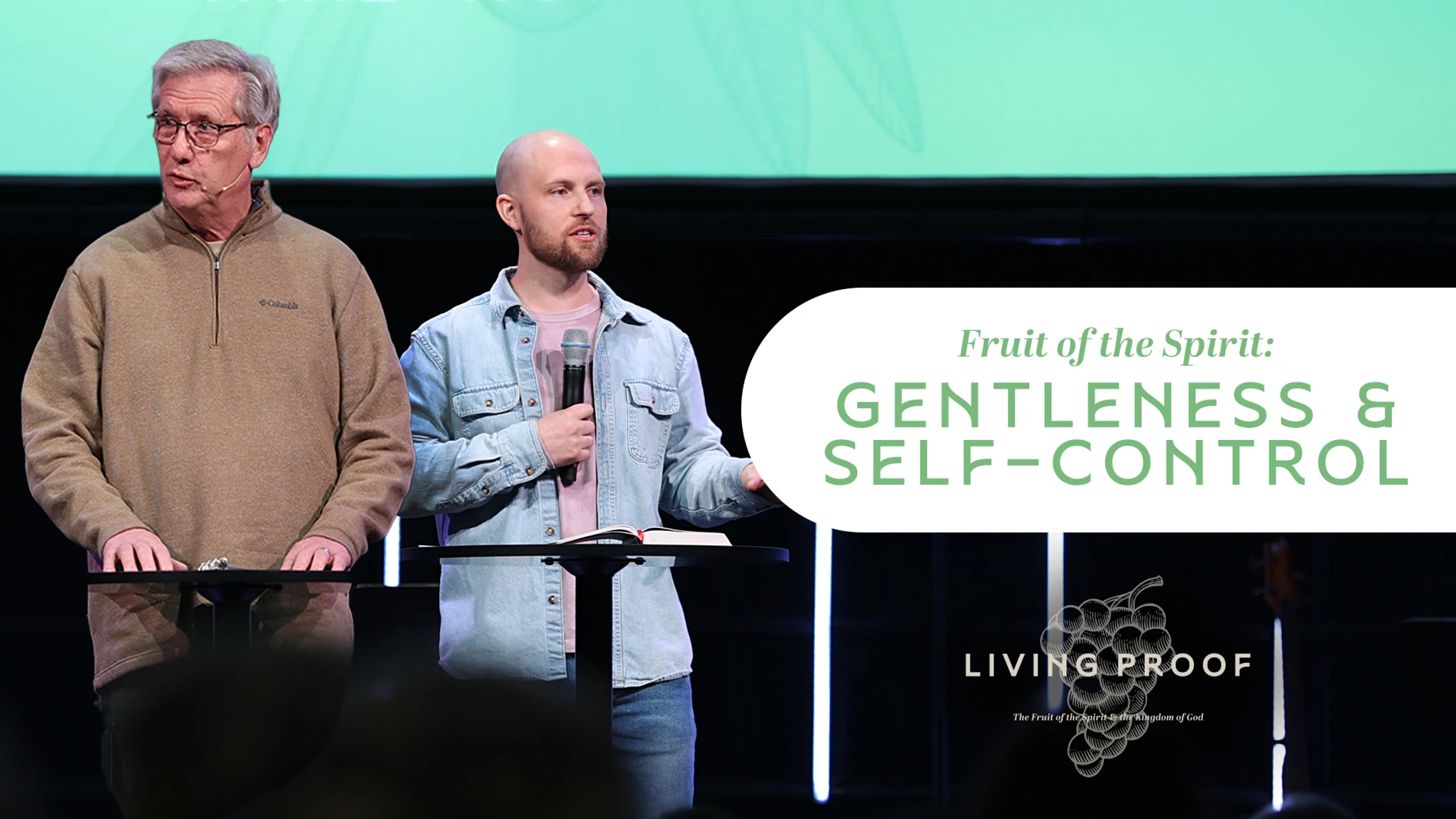
Gentleness is power outwardly under control for God's glory; self-control is power inwardly expressed for God's glory. Listen as pastors Todd, Scott, and Brett lay out the last two fruit of the Spirit for us from Galatians 5.
Let's take our Bibles and let's open them to Galatians 5 and dive right in. This is week six in our series, Living Proof. So let's get our eyes on the text for yet another time.
We are specifically in verses 22 and 23. So put a finger there and let us together round third base. We're kind of coming to the end of this short series.
Next week will be the concluding week. This week we look at the final two aspects of the Holy Spirit's fruit. They are specifically gentleness and self-control.
And so we want to maintain a focus, yes, on the Spirit's fruit, but we don't want to lose what should be the centerpiece of that focus. And that's this, that the fruit borne by the Spirit is more about the Spirit than the fruit. And the church says, Amen.
The Holy Spirit's work in our life. Now, as you know, also, this series has been co-taught by all of our elders. And so today we have the privilege of hearing from two of our newest elders, Pastor Scott and Pastor Brett.
And they'll be unpacking these last two elements of the Spirit's fruit. When they're done, of course, I'll join them and we'll take some questions. Here's that number for you.
It's also in your FFC weekly. You can text any questions you have. We'll try to tackle at least a few of them live, Lord willing.
And so before Pastor Scott kicks off his portion, he'll be tackling gentleness. Brett will be tackling self-control. I want to bring a verse before you that I think shows a beautiful intersection of these two elements of the Holy Spirit's fruit.
It's in the person of our Lord and Savior, Jesus Christ. And it concerns his most pivotal moment, the cross. Notice how in this verse we have both of these Holy Spirit produced elements showcasing themselves perfectly in Jesus.
It's John 10, 18. You can turn there if you want, even while you keep a finger on Galatians 5, or you can just follow along on the screen with me. But here's what God's Word said to us.
No one takes it from me, speaking of his life. This is Jesus speaking. But I lay it down on my own.
I have the right to lay it down. I have the right to take it up again. I have received this command from my Father.
Interesting, isn't it? In this singular verse, you have both concepts of laying something down, which is a very gentle, sacrificial posture, giving up. At the same time, it connects that to the fact that he has the right to do this, which is the word for control, authority, dominion. Like, I'm exercising my power to do what your soul gently and graciously needs, saving.
Amen, church? What a beautiful verse that shows these two in the life of our Savior. No wonder Peter would call him the bishop and overseer of our souls. And so these are the traits, the fruit that we're going to see this morning.
We draw them specifically from Galatians 5. So with this verse as an igniter for our hearts and minds, let me read for you our target text, even as Scott joins me on the platform. Back to Galatians 5. Here's where we're drawing all of our teaching for the series, at least in its root form. It's Galatians 5, 22 and 23.
But the fruit of the Spirit is love, joy, peace, patience, kindness, goodness, faithfulness. Say the next two with me. Gentleness and self-control.
The law is not against such things. Pastor Scott? Well, hello, everyone. My name is Scott Searzann.
My family has been coming to First Family for about 14 years or so. I got saved back in 1983 while living in Austin, Texas. I am originally from the Urbandale area.
I am one of the newer elders, and I'm excited to serve with the godly men leading this church. If I've never met you, please come up afterwards. I'd love to meet more of you.
My wife is Carol, and we've been married for over 43 years. It's up there. I can't see it there.
We have been blessed with four children. They all are married. And we technically have six grandchildren, but one is still in the hopper.
I've been in the construction industry most of my life, and I'm technically retired at this point until I became an elder, I think. So our passage is Galatians 5.22-23. I'm going to read it again. We should all be very familiar with it by now.
But the fruit of the Spirit is love, joy, peace, patience, kindness, goodness, faithfulness, gentleness, self-control. Against such things there is no law. Well, very recent, after I became an elder, I was given this assignment to teach on gentleness.
And I have to admit, this old construction guy thought, wow, that's kind of a softball word. And I've got a question for you all to think about. What do you think of when you think of the word gentleness, the fruit of the Spirit gentleness? Especially in our culture today.
I've been asking a few people this question the last couple of weeks. And I wonder if some of the answers I'll tell you here match kind of what's in your head right now. Softness.
Sweetness. Tenderness. Kindness.
Old grandmas. Babies. Timid.
And even some weakness. And I've also asked, what's the opposite if you would think of gentleness? And I've heard words like sternness, aggressiveness, weakness, temper, harshness, anger, and reactiveness. These are actions that our flesh wants to use, wouldn't you say? There's a much deeper and broader meaning of the word, I've found out.
The word gentleness is translated as meekness in some versions of the Bible. They are essentially used interchangeably in a lot of different passages. So on our screen here, you should see the meaning of meekness and gentleness.
I'll read it for you. Power under control, submissive to the power of the Holy Spirit, having strength to show kindness, mildness, with goodness of heart to others. From here on out, I'll be just using the word gentleness.
But keep in mind that meekness and gentleness are used interchangeably. So power under control and submissive to the power of the Holy Spirit. Did you think of that part when I asked you to think about the word gentleness? I can't say that I did initially.
I ran across the human story recently that I think illustrates power under control rather well. Again, it's not a Christian story, it's a human story. Three young men hopped on a bus in Detroit in the 1930s.
They tried to pick a fight with a lone man sitting at the back of the bus. They insulted him. He didn't respond.
They turned up the heat of insults and insulted him more. He said nothing. Eventually, the stranger stood up and walked towards them.
He was bigger than they had estimated from his seated position, much bigger. As he walked toward them, he reached into his pocket and handed them his business card and then walked off the bus. As the bus drove off, the young man gathered around the card to read the words Joe Louis Boxer.
These guys weren't too smart, were they? They had just tried to pick a fight with the man who would be the heavyweight boxian champion of the world from 1937 to 1949. The story reminds me of a verse in Proverbs. Proverbs 15.1 A gentle answer turns away wrath, but a harsh word stirs up anger.
So gentleness. We all have some sort of human, we might say fleshly powers over some people. Joe Louis had a lot of physical power, but we also might have things like our intellect, our ability to manipulate people, our physical strength, our temper.
That's a common one, right? Our ability to intimidate people. How about ignoring others, like giving them the cold shoulder? There's many controlling types of human powers used in negative ways that would not be gentle. As I've talked to friends the last couple of weeks, I've been asked this question.
What about people that are just naturally gentle? Some people, Christians and non-Christians, can have personality traits that are similar to the characteristics of the fruit of the Spirit. But they're not necessarily the fruit unless they are submissive to the Holy Spirit. If they're just human traits, remember that acting in a gentle way, the motivation must be obedience to the Holy Spirit and the Spirit's leading in our lives.
If it's not, then it's just personality traits, and probably there's hidden selfish motives in it like so many of us humans have, right? When we interact with people, we need to submit down our human fleshly responses. We might call them human powers, right? We need to lay those down to God and embrace the power of the Holy Spirit and do it boldly so God can use us in people's lives in a gentle way. Who doesn't really enjoy being around a very gentle, purposeful person? I encourage all of you to think about one area of human fleshly power that you've used in your relationships that have caused more negatives than positives.
We all have them, and probably there's a lot of commonality in this room. I'd like to challenge the married couples. Husbands, I'm going to go with you first.
Husbands, when your wife wants to discuss an area that you are uncomfortable with, do you respond with the fruit of gentleness or do you get frustrated and angered? Wives, when your husband brings up a subject that you both have neglected to discuss for a long time, probably because neither one of you want to touch it, do you look to the Holy Spirit and submit to him and respond to your husband with gentleness? When these types of encounters happen, just take a moment and look to the Holy Spirit for guidance, and he will empower you to listen and to respond in gentleness. Those are some human sides of it. Scripture shows us many examples of where gentleness is used in difficult circumstances.
In Galatians 6-1, it reads, Brothers, if anyone is caught in any transgression, you who are spiritual should restore him in a spirit of gentleness. Keep watch on yourself, lest you too be tempted. In this situation, it's going to correct somebody's behavior.
Now, I don't know about you, but anytime I've done that, that's generally not a very easy conversation. And we can be on guard, but what we want to do is we want to submit our human fleshly responses, and we want to embrace the power of the Holy Spirit and talk to these people in a gentle way, because God commands us to be gentle in those situations. 2 Timothy 2, 24-25, And the Lord's servant must not be quarrelsome, but kind to everyone, able to teach, patiently enduring evil, correcting his opponents with gentleness.
God may perhaps grant them repentance, leading to a knowledge of the truth. Here is a situation where when we see somebody that's teaching wrong biblical truth, we want to go and correct them. Well, again, those are tough human interactions.
And so what we want to do, again, is we want to submit our will, our humanness, and we want to embrace the power of the Holy Spirit, and he will empower us to communicate to people in those tough situations. Another example in 1 Peter 3, 15-16, But in your hearts, honor Christ the Lord as holy, always being prepared to make a defense to anyone who asks you for a reason for the hope that is in you. Yet do it with gentleness and respect, having a good conscience, so that when you are slandered, those who revile your good behavior in Christ may be put to shame.
So, again, we're supposed to defend our faith with gentleness and respect. Now, sometimes that's real easy. One-on-one, somebody comes up.
Why are you different? It's pretty simple to talk. But sometimes somebody might come up in a crowd and actually attack you for your faith. We're still supposed to treat them with gentleness and respect.
And in those situations, that takes kind of that inner time to just submit your will and ask the Holy Spirit for the power to really use you in their lives at that point. So, the biggest example we have in Scripture is obviously following our Lord Jesus Christ. In Matthew 11, 29, Jesus says, Take my yoke upon you and learn from me, for I am gentle and humble in heart, and you will find rest for your souls.
Well, Jesus tells us to learn from him. And then he just says, I am gentle. So, he wants us to be a people that are gentle and not reactive.
In this situation in Matthew 27, 12-14, when he, Jesus, was accused by the chief priests and the elders, he gave no answer. Then Pilate asked him, Don't you hear the testimony they're bringing against you? But Jesus made no reply, not even to a single charge, to the great amazement of Pilate. So, in this situation, Jesus is being accused of things that he is not guilty of.
And yet, he did not reply. He was gentle in that situation. Jesus had all the power under heaven available to him.
But he submitted his power to the will of the Father so that he could sacrifice himself unto death as payment for our sins. Are we not thankful? If you'd read with me this partial take-home truth, Pastor Brett is going to finalize it in his teaching. Gentleness is power outwardly under control for God's glory.
And that's really what's the most important part, is God's glory. Well, this is the first fruit of the day. Pastor Brett is going to come now and walk us through the final.
Thanks, Pastor Scott. That was a very encouraging and challenging word on gentleness and the fact that it is power. Because I've heard it said before, if you think meek means weak, try being meek for a week.
For those of you that don't know me, my name is Brett Stiles. I get to serve as an elder here and get to be on staff. My wife, Meredith, and I have been married for almost 15 years.
And these are our three boys, Anderson and Maverick and Duke, and our almost one-year-old daughter, Landry. And we have been calling FFC our church home since 2016. For the rest of this morning, we are going to look at the capstone fruit of the spirit, self-control.
And what we're gonna do is we're gonna pick right up and finish out that take-home truth at the start today. And then we're going to look at God's word and see why that take-home truth is true. We're gonna let it prove it to us.
And the reason we're gonna start with that is because over the last couple years of getting to speak regularly in middle school youth group and high school youth group, a 12 or 13-minute message would be a personal record low for me. So I don't wanna go long and risk missing this important truth. And the reason it's gonna be a continuation of the take-home truth is because as we studied this and thought about it over the last couple weeks, we realized that self-control and gentleness might be two opposite sides of one coin.
That gentleness is what you see on the outside from a person who is self-controlled on the inside. So what we first learned from Pastor Scott just a few minutes ago, gentleness is power outwardly under control for God's glory. And now the second half of that, self-control is power inwardly expressed for God's glory.
Now, like I said, we're gonna take that piece by piece and let the Bible prove to us why that's true. And the reason we're gonna let the Bible do it is because we believe that it's God's word that does the work in our lives, not just clever things that people sit in an office and write out and then we are like, oh, that's kind of cool and motivated for 27 seconds. And so because we believe that the word does the work and we also believe that every word of the Bible is inspired by the Holy Spirit, we believe that every word matters.
So what we're gonna do is we're gonna look in Galatians 5.23 at this actual word in the original, self-control. This word self-control in the original, I'm not gonna try to pronounce it because I'm guaranteed to butcher it, but this is how it's defined in the original. It's defined as a person who masters or has power over their desires and passions, especially sensual appetites.
Now that's not that groundbreaking. You're like, okay, yeah, it makes sense. Here's what's really cool about that though that I learned this week or in the last couple of weeks and has been very instructive for me is that the root word of that word self-control is actually the word for power or dominion or might.
And it's the same word that we actually read a lot of times when we say the benediction on a Sunday morning. And we say, you know, glory and power and dominion forever and ever. And there's multiple places where that is in the Bible.
Same word. So the source, the root of this self-control is the genuine power or dominion of God. What's also really interesting is that this word for self-control is rarely used in the New Testament.
Most of the time that self-control is used, we have one word, a couple words for self-control, but mostly it's the word self-control over and over in the Bible. It's talked about elders and deacons and wives in different instances. It just says self-control.
This word for self-control is not used in those other instances. This is unique because it's saying, just like we've been learning for the last seven weeks, the power to control, to have reign, to have dominion over your desires is only accomplished through the genuine power of God. This is not something that you can man-make.
You can't work hard enough or have enough good habits or have enough routines or have enough checklists to accomplish control and dominion over your fleshly desires. So that's the first thing that's key that we know, that self-control is genuine power that the Holy Spirit produces in you. More than just self-discipline or clear-headedness or sober thinking, it is the dominion, the power of God at work in you.
But it's not just power for power's sake. There's a specific place that it has to take place for it to actually matter, and that's the second part of the take-home truth, is that it is internally expressed. And it's internally expressed because as we all have probably lived and experienced because we're living, breathing humans, the battle is on the inside.
It might feel at times like it's on the outside, but the reality is the true battle in all of our lives is in here. So the need, the place where it most matters that you have the power of God is in here, internally expressed. Paul actually lays this out a little bit earlier in Galatians in chapter 5, but verse 16, he says, so I say walk by the Spirit and you will not gratify the what? Desires of the flesh.
For the flesh desires what is contrary to the Spirit and the Spirit what is contrary to the flesh. They're in conflict with each other. They're at war.
There's war inside you so that you are not to do whatever you want. But if you're led by the Spirit, you're not under the law. The acts of the flesh, the acts of the flesh which come from fleshly desires are obvious.
Sexual immorality, impurity, debauchery, idolatry, witchcraft, hatred, discord, jealousy, bits of rage, selfish ambition, dissensions, factions, envy, drunkenness, orgies, and the like. I warn you as I did before that those who live like this will not inherit the kingdom of God. So it's serious because he ends there by saying if this list is the pattern of your life in the long term, you're proving that you're not saved.
That you don't have the Holy Spirit because the desires of the flesh are what categorize your life. In Proverbs 25, we know that it says that a person without self-control is like a city without walls. And even though walls and borders are a lot in our news, a city with no walls or a city with walls isn't really like a thing for us.
You don't drive over to Chicago and it's just like huge wall to get in. So that doesn't mean much to us. But for an Old Testament reader, when they would hear a city with no walls, what they hear is a city ripe for destruction.
Because a wall is the only way you can keep out the people that want to see you destroyed in the Old Testament. So what that's saying is a person with no self-control is ripe for destruction, quick to ruin. Anyone see that today in our culture? It's all over, right? You'd have to be closing your eyes not to see it.
Desire, completely unrestrained. You can do and be and say and live however you feel like you want to live. And while that seems like freedom to most people, what that actually is is a one-way ticket to devastation.
And we see that. And unfortunately, some of us have lived that. So that's why we need this power internally.
It's kind of like water. I think you could make an argument that water is the single most destructive force on the face of the earth. It's actually what God used to destroy the entire world, water.
This is a picture of the tsunami in India in 2004. This is what water, completely unrestrained, free rain will do. That was a city at one point.
Now it just looks like a pile of trash. That's the power, the destructive power of water. But get some control over water, put it underneath dominion, and it becomes what? Nourishing, life-giving, cleansing.
Complete opposite. But what does it hinge on? Water in and of itself is not bad. It's not like we see water and all the damage that it's done over the history of the world and say like, ah, that bad water.
No, water is not the problem. Which way it goes based on who has the control, who has the rule, who has the dominion over the water, makes it, is it gonna destroy or is it going to give life? It's not a whole lot different in our hearts. You have desire that God has given you and your flesh, yourself, wants to see that acted out in a destructive fashion and the Holy Spirit wants to see those desires reigned over and lived out in a God honoring fashion.
Because the original word has a leaning towards sensual desire, let's just take that as an example. So sensual appetites, that's all I'm, we're just gonna leave it at that. Sensual appetites, fulfilled in an uncontrolled, self-ish manner, lead to eventually the devastation and destruction of your life and most likely the lives of the people around you.
But that desire fulfilled and lived out in the way that God designed it. One man, one woman married for a lifetime. Is life giving? Literally, it gives life and it is God honoring.
And it all hinges on the internal expression of the power of God in your life to have dominion over that desire. Only capable through the Holy Spirit. Now before we go on to the last part of the take home truth, I wanna give one, I will try to give a gentle warning in light of what we talked about this morning.
But I wanna give you one warning. And that is that if you are here today and that's you, you've got sensual appetites or desires that you know are unrestrained and you're okay with that. Maybe you think, well, I got a lot of those other fruits, like I'm doing pretty good.
It's just this one, I don't really have control over my sensual appetites and they kind of run rampant, but nobody really knows about it. Like it's not hurting anybody. I wanna tell you, you are not the exception.
You might think you are, but you're not. And when the Bible says that someone without self-control is like a city quick to ruin, it will prove itself true in your life. In the negative and in the positive.
And if that's you here today, I wanna encourage you that you're in the best place you can be because you're surrounded by people who love and care for you. And there's no better place to bring that out and say, that's me. I have no control.
And I'm worried that my lack of control, my lack of Holy Spirit power over my desires is gonna devastate my life. And I wanna see that changed. Bring that out, get it in the light today.
Find a friend, find a small group leader, find an elder and just get that out there. Because that is the first step in the road to seeing greater and greater victory and rule through the Holy Spirit over those things in your life. And just like I said, the Bible will prove itself true in your life in the negative and in the positive because some of you, your experience is exactly that.
You came and you brought it out and the Bible proved itself true in your life in the positive and that the Holy Spirit changed you and that you're not that way anymore. He has, through the power of God, given you rule and dominion over those desires. And the best part is the last part of the take home truth.
Because we could say, you know, he gave you that rule and reign over your desires for you so that you can benefit and have control and have a great life. And we could say, but it's for others, you know, so that your friends and your family and your spouse and your kids are loved well. And that's true.
But ultimately, it's for God's glory that you would be a self-controlled person through the power of the Holy Spirit so that God gets glory in your life. So that as it says in Philippians, that you would walk worthy. And that's the final part.
It's power. It's internally expressed, the place where it really matters. And it is pointed at glory for God.
Because you could be, and there's people in this room, I'm sure, very man-driven self-discipline. You could eat right, work out every day. I never miss the gym.
I got my finances in order. I'm never late. I'm actually 15 minutes early everywhere I go.
And yet inside, you could feel like a moment away from devastation at all times. Because it doesn't work to craft a bunch of external discipline and then let it trickle into your heart. It's the other way around.
None of those external disciplines are wrong, but they have to flow out from internal power of the Holy Spirit. Or else they don't really matter a hill of beans. And they also point to the wrong person.
If I have built for myself this external, disciplined, seemingly, you know, I got it all together. Who gets the glory from that? Me, right? You look at me and you say like, wow, that guy's got it going on. And I get the glory.
And let's be honest, like we like that. The glory of just man-driven human willpower self-discipline comes to me, comes to you, comes to whoever it is. But when a person, like Scott said, is characterized by one of the things on this list, maybe anger, outburst of anger, and their kids, that's how they know them.
Their spouse knows, don't bring that up, I'm gonna get screamed at. Their coworkers walk on eggshells around them. Anger characterizes their life.
And then all of a sudden, over time, they respond in gentleness to their children. They gently speak to their spouse. They gently resolve conflict at work.
They gently bring correction where it's needed. Who does that give glory to? Because we all know, and all of us know and have experienced those fleshly desires and have lived how long you can get control over those in your human strength. Maybe like two months before you're, and you might feel like, I'm making some good progress here.
And then something happens and you go so far back the other way, you feel like, did I even do anything? But when genuine long-term change happens in these areas of fleshly desires, God gets that glory. Because people see your life and they know there is no way that person could be changed in that manner on their own. Everyone knows someone like that, who at one point you thought, that person is so far from God, I have no idea how they could be reached.
And maybe there's a period of time and you see them again and they're just changed. And you're like, is God not amazing? That is the end game of genuine spirit-produced self-control, that God would be glorified in you, in your life. So let me ask you as we close, just a simple question.
Which one of those two characterizes you? Are you an outwardly disciplined person who seems to have it all together? They got all the T's crossed, all the I's dotted. A lot of people look up to you. You got a lot of influence.
But inwardly, you're like a toddler. You have no ability to control what your flesh tells you to do. The phone of temptation rings, you pick it up every time.
That's on the inside. Is that you? Would that characterize you? Or are you someone who is seeing greater and greater victory over the way that the flesh, flesh and self aren't that far apart. It's like flip the word around and it's right there.
The way that your flesh wants to see those desires fulfilled. Are you seeing greater and greater victory in those areas? Not because you have some great willpower, but because the Holy Spirit, through the dominion and power of God, is growing and producing that in your life. Which one are you? Where do you lie today? And if you find yourself over here, I would just really encourage you and implore you to ask the Holy Spirit, to repent and ask the Holy Spirit to fill you and empower you and lead you to a place where he is growing the power of God in your life.
To have control over the way in which your flesh wants to see your desires fulfilled. Self-control. It doesn't mean it's control that you do.
It almost could be flipped around to control self. It's power, genuine power of God. It's internally expressed, the place where it really matters.
And it is for God's glory, what ultimately is important. Pastor Todd and Pastor Scott are going to come up. We're going to take some questions here as we close before we go to communion.
Scott and Brett, thanks for keeping us focused on the source of the fruit, not only the fruit. Appreciate your emphasis on the Holy Spirit. Two questions did come in earlier in the week.
We'll start with those two. And do we have any more that came in from this service or last? We have one more, so we'll try to take all three if we can. We'll start with one that came in, Scott.
They were curious, is humility and gentleness the same thing? I would say that they're close. I think you have to be humble, which is be lowly, be under God, to really ask the Holy Spirit to set your own will down, your fleshly desires down, and look toward the Holy Spirit when you're dealing with people. And then you can show them the gentle actions.
But I think it's good to be humble so that you're open to doing what God wants you to do. You were talking offline that sometimes it seems that humility might be like the precursor for almost every bit of the Spirit's fruit. Yeah, I would say that there's so many commonalities as I've studied this between all the different fruit.
They all go back. You can't do it in a human way. So no, they're not, but they're really close.
There you go. Yeah, good. Brett, one question came in.
Then is all desire bad? Well, let's just start, no. Desire in and of itself is not bad, kind of like we talked about water. Water is not inherently wrong.
It can have devastating and life-giving effects. So desire is not bad. God has put desire in you.
But where your desire is fulfilled is going to be the determinant on whether it's bad or God-honoring. And I think it's Proverbs 13. It says, A desire achieved is sweet to the taste.
So there is an aspect where God knows that the things that He's put in you, fulfilled in the right and God-honoring way, that is sweet to us. And so no, their desire in and of itself is not inherently bad. How we fulfill it, as well as perhaps the source of that desire.
You know, Satan tries to tempt us with evil. So it's a good point. Desire is almost like a factual concept in some sense, but how you fulfill it and its source are important to consider.
So that's good to hear. Let's take the third question. What does it look like to confront sinful behavior with gentleness? So I'm going to start with you, Scott.
You're the most experienced in the platform. Right. That's a nice way to say oldest one, right? But maybe let's think about our homes.
I mean, you owned a company for years, started it, very successful employees. There may be some experiences you could share how this worked for you. So confronting sinful behavior in gentleness.
So again, like we talked about in the scripture, it's confronting anything that's contrary to God's will. He wants us to do that and he shows that he wants us to do it in a gentle way. So again, I think it's just submitting to God and the Holy Spirit, letting the Holy Spirit lead your conversations.
I think the main issue, if you go into any kind of relational discussion, like in this situation, you know, sinful behavior, if you go in gently, they see God. If you go in harshly, then they feel condemned by you. You know, where if you're gentle with people, then they're more acceptable to what you have to say.
You still want to maybe, you're still going to point out truth to them that there's wrong, but it's not in a condemning way. It's in a helpful way. Would you say that maybe two things that might help with that? And I think these could be misused, so I'll be careful here.
But I tend to think, and you confirm or even correct this, that questions can be helpful initially. It could look like you're trying to trap them. That's not the goal.
But often a question is a good way to begin a conversation. And I think also time, like if you're just not sure if there's some sinful behavior, maybe backing up and giving it a day, like, did I see what I think I saw or did I hear what I think I heard? Is that really true? I personally have found that if I can give anything 24 hours, if I'm allowed that much time, usually a day helps me have a better reaction or conversation. Now, maybe make that better or correct that maybe? Questions and time.
Yeah, I would say questions are great because you want to have an understanding of where that person's at. So if you just kind of look at the outside and you just see their behavior and then you're just addressing that, you're not really digging to find out what's the motive. Where have these, where's their head at in this? So I think that, and their heart too.
So it's kind of like by asking questions, you really know more about the problem and the issue. And then I think in a gentle way, you can then help them see that that's wrong. So I think questions are super important so that you understand where they're at.
Brett, you're on the other end of the spectrum. You're one of our youngest and four young kids at home. Perhaps you see some simple behavior.
How do you approach this question knowing your situation? Yeah, that's interesting you say that because I thought about this specifically in light of parenting. I actually had a conversation with someone after last service and we were talking about gentleness in confronting behavior and how does God come to us as a father? If we have like a wrong attitude, he doesn't say, get that attitude under control and then leave us to it. Self-control, he produces it.
He comes to us and says, I'm going to empower you to change that. So for me in parenting, it was honestly kind of convicting when I see the sinful behavior in my kids, how often do I just kind of cast it on them to say, hey, you need to change that in your own power because it's a front to maybe my authority or even if it is genuinely sinful or how many times do I come to them alongside them to say like, obviously I'm not the Holy Spirit so there's differences there, but how can I help and empower you to see this changed? I feel like that is a much more gentle approach than just kind of casting off and saying like, you better get that attitude changed before I have to come back there. Don't make me come back there.
You've heard that phrase, right? Sure, lean on that, Scott. So it's been a while since I've parented, at least older children. So I think that gentleness, I know that we believed in spanking for bad behavior, but you know what? We were challenged from a fellow mentor many, many years ago to never spank a child in anger.
That was a huge thing for us and a hard thing, you know, because kids when they're misbehaving and whatever, it can kind of get your emotions going. But again, it's very similar. It's kind of like spanking in gentleness, you know, which we did the physical action, but it was in love.
We separated, went to the bathroom, we talked about why the punishment, blah, blah, blah, took care of it, and hugs and kisses and out the door and forgotten. And so I think that there's some correlation there. One phrase comes to mind that I think we all would know, but it leans in here, and that is in Ephesians when we're instructed to speak the truth in love.
It might be one of the best phrases to kind of wrap around this question is if you can approach the situation with God-like love, speak truthfully, but lovingly, you'll probably find a roadway to this answer, confronting sinful behavior with gentleness. So great questions, guys. Thanks so much.
I appreciate it so much.