
His Presence, His Purpose | Exodus 3:1–10
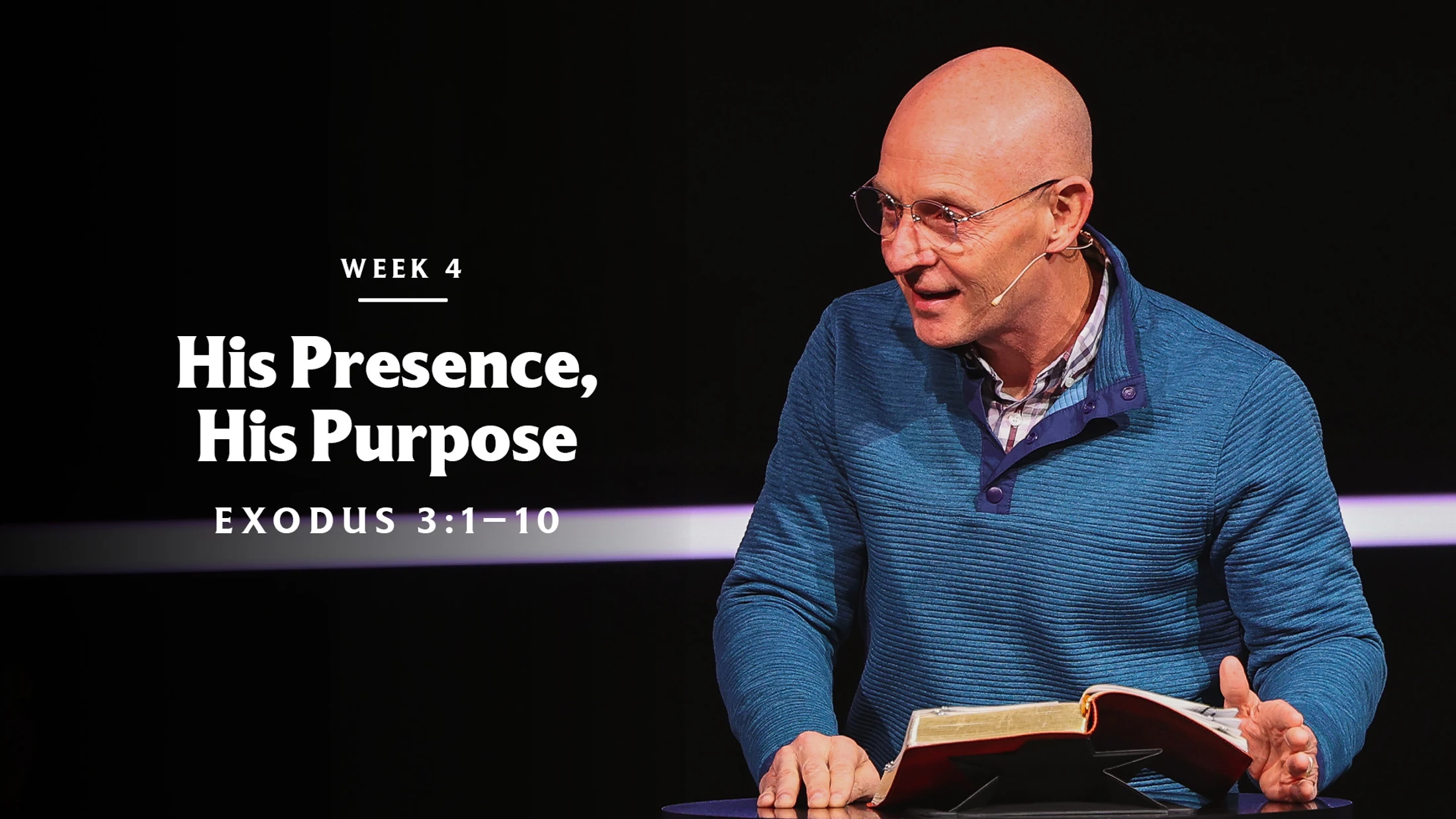
God’s revealed presence carries redemptive purposes—He is personal, missional, and invitational.
Listen to week 4 of our series in the book of Exodus. Learn more about the series here: https://firstfamily.church/exodus
Exodus tells the story of a God who isn't distant, but moves toward his people in power and mercy. God reveals himself as I Am, leading Israel out of slavery and into the life-changing reality of his presence. Well, let's continue if we can this morning in our series through Exodus.
Go ahead and take your Bibles, would you? Have your series guide handy as well. Well, we'll jump into Exodus chapter 3. Let's set some groundwork for that as we get going. I suspect most of you here have experienced a fire alarm, probably not a new concept.
Maybe it was an intentional fire drill, so you knew it was coming, but you still went through the motions. But in your mind, you know it wasn't legit, right? You're like, well, we're just making sure we practice what we need to do if we get a real emergency. Or maybe you were surprised by a fire alarm, but it wasn't real, like the day Josiah Noel, when he was three years old, pulled the fire alarm at Nevlin.
We were about a three-year-old church. He was three. He's sitting on my left over here, I think, right, Josiah? Right there.
He's always been a tall kid, so he saw this red thing and thought, what does this do? He pulls it, and so there was only maybe 120 or 30 of us probably in those days, maybe 150. We all exited and realized it wasn't legit, it wasn't real. Fire drills, they're not uncommon, but when you hear one, you really have about three seconds to make a decision.
Is this real? Is it not? What will I do? If it's real, and maybe some of you have experienced a fire alarm, and it was about an actual fire, in those moments, everything changes, and a lot of things go through your mind. Where's the exit? Where can I go? How fast should I go? Who's with me? All these questions. In other words, you move and you respond, you act, because in that moment, that fire drill serves as a summons.
It's calling you to move and go. That's Exodus chapter three. It's a summons to Moses, and it involves fire.
Can I show it to you? Exodus three. We're going to look at the first 10 verses. In this room, all of our campuses, Lamoni, Carlisle, gathering there in Guttenberg, our cornerstone campus.
Here in this room, let's all put our eyes on this text. Let's take some time now to see these 10 verses, Exodus three, and as we look at them together, I want you to know up front, here's what you're going to see merge. Here's the principle, our presence principle, that you'll notice surfacing throughout our reading of the text and exploration of its verses.
Let me read it for you. Here it is, our presence principle for today, that God's revealed presence carries redemptive purposes. He's personal, missional, and invitational.
Straighten to the point. Will you read it with me? God's revealed presence carries redemptive purposes. He is personal, missional, and invitational.
So I think you'll see this clearly in the text. Follow along with me. Exodus chapter three, verses one through 10, is God's word to us.
Meanwhile, pause, transition word, look back at verses 23 to 25, while God's people, the being ruthlessly oppressed, crying out to God and groaning in the middle of all of that, while all that was happening, back to verse one now, Moses was shepherding the flock of his father-in-law Jethro, the priest of Midian. What a contrast, and it's intentional. He led the flock to the far side of the wilderness and came to Horeb.
It's also Mount Sinai. It's the mountain of God. Then the angel of the Lord appeared to him in a flame of fire within a bush.
As Moses looked, he saw that the bush was on fire but was not consumed. So Moses thought, I must go over and look at this remarkable sight. Why isn't the bush burning up? When the Lord saw that he had gone over to look, God called to him from the bush.
By the way, that's why it wasn't burning up. It was the medium for a message from God. Here's how he starts, Moses, Moses, here I am, he answered.
Verse five, do not come closer. He said, remove the sandals from your feet for the place where you're standing is holy ground. Then God continued, I am the God of your father, the God of Abraham, the God of Isaac, the God of Jacob.
Moses hid his face because he was afraid to look at God. Then the Lord said, I have observed the misery of my people in Egypt and I have heard them crying out because of their oppressors. I know about their sufferings and I have come down to rescue them from the power of the Egyptians and to bring them from that land to a good and spacious land, a land flowing with milk and honey, the territory of the Canaanites, Hethites, Amorites, Perizzites, Hivites, and Jebusites.
And so because the Israelites cry for help has come to me and I have also seen the way the Egyptians are oppressing them, therefore go. I am sending you to Pharaoh so that you may lead my people, the Israelites, out of Egypt. Ten verses that really serve as a summons and no doubt fire is involved.
The alarm bell has rung, so to speak. Let me look at three actions in this text with you. You can call them movements, maybe even intentions.
Three observations I want you to notice. Just six words this morning. First two words, revealed presence.
That's the first thing I want you to see. It's really verses one to six. Notice in here that this is when God reveals his presence to Moses.
Now I would say to you probably when you think of Exodus 3 and you hear Moses the burning bush, that's a dramatic event to you. In fact, many unbelievers know about the event. They've either seen Prince of Egypt or they're aware of it, maybe through a visit to a VBS or something.
This is a dramatic moment, unforgettable, but I want you to notice that the text does not begin that way. In fact, the text, at least verse one, starts very intentionally non-dramatic, very understated. That's why I think Moses uses the word meanwhile because he shows God's people under great distress and he says, but meanwhile, Moses is just tending sheep.
And he uses an interesting word in the Hebrew, he says, on the far side of the desert. Don't think cartoon, instead think exile. This means like the backside where someone's forgotten.
It's really a word that leans towards obscurity. So do you see the contrast in play here? And so he's intentionally beginning in an undramatic, normal, ordinary way to show that this is the kind of moment in which God intervenes and often where he speaks. Look at verse two, the angel of the Lord appeared to him in a flame of fire and as Moses looked, he saw the bush was on fire but not consumed so he goes over.
This is interesting because this is when God speaks to Moses. This is when his presence is no longer just omni but it's manifest. God reveals his presence in this moment and it's not that Moses discovers God.
Understand this important distinction here. God discloses himself to Moses. God takes the initiative.
Moses wasn't looking for a burning bush. In fact, I believe the text seems to say that he thought something was wrong like a desert phenomenon or something intriguing in that fashion. But when he got there and saw it wasn't burning up, he realized something different was happening and that's when God spoke to him.
The initiative here is entirely God. And notice that God does communicate through a fire. Interesting way to communicate.
Fire in the Old Testament especially really signifies a couple of things. First of all, it says a lot about God's holiness and yet also about his mercy because the fire should consume everything and yet we're told that in several places like Genesis 15, the initial Abrahamic covenant, Exodus 19 when Moses goes up to the mount, both of those contain fire and the person and the people are not destroyed because they keep their distance and yet God is seen. He's manifest through fire.
He's holy. It's always the word associated with these experiences so you see here's this holy God that if we get too close, we're toast and yet he does come close. There's a distance admittedly and yet there's not a distance because he's inviting us in so it's a paradox in some way and yet this is a beautiful moment that God's holiness is blazing in front of Moses and God is revealing himself intentionally on purpose and yet he says Moses don't come any closer.
Take off your sandals. It's holy ground. So fire represents this unique combination of God's holiness and yet his mercy.
He's coming near us and yet we know we don't deserve it and this is unlike anything we've understood or seen. This is God and so Moses does that. He takes his sandals off, he listens, he actually answers here I am.
It's interesting that in this moment God not only reveals to Moses visually who he is through a fire but then he verbally declares who he is. Notice what he says. I'm the God of your father, the God of Abraham, the God of Isaac, the God of Jacob.
I remind you of this. God here is not introducing himself for the first time. It sounds almost like hey Moses here's our first introduction.
No I'm sure Moses knew of God. The people knew of God. Their history is filled with God's promises but it had been many years, centuries.
So perhaps they were forgetful. Maybe they had dismissed it. So God here now is reminding Moses of his promises.
This is a beautiful moment when God reveals his presence to Moses. And I am all for, I'll use this phrase here, I want to be careful how I word this. I'm all for Abba moments.
God is our Papa. God is our Daddy. Those are the first syllables a child would have said in the Greek culture.
Abba. Alpha, beta, gamma, delta are the first letters of the Greek alphabet and so often a child in that culture in the New Testament that's how they would say Dada or Abba. So in that text when that's used the author is saying to us that's how close God is to us.
It's beautiful. But at the same time God's holy, merciful. He's not like just a big man upstairs.
The one I hate the most is that he's your co-pilot. Like I hate that phrase. He's not like your big buddy.
I'm drawing this from Moses' first response to God when the fire is not consuming the bush but it could. He's that powerful. He's that holy.
It could consume Moses. It doesn't. But yet Moses doesn't take this lightly.
He realizes that God is manifesting his presence. It's amazing that God would do this. He must love us and he's intentionally disclosing himself to us and yet he's God.
So I just want to challenge you in moments when God's omnipresence is manifest in your life at times when it's very close and very real and very heavy. Don't take those lightly. They're precious and they're dear but they are potent and powerful.
God's presence always is when it moves from omni to manifest. I would say to you as well that you should expect God to show up in your life in this way. I can't guarantee you when or always how but I will tell you this from the text.
It does seem that God often does this in what we feel are everyday moments. Moses didn't climb the mountain looking for God. He didn't build a fire thinking God would use it.
He was out doing what he did every day on the backside of the desert where he thought nobody knew he existed. But God knew and he showed up. My personal opinion is this, it's in those kinds of moments, the very ordinary times of your life that you think who knows I'm where I'm at, what I'm doing, that God meets you in all of his power and his presence.
What does he do in those moments? Based on this text I think in those moments he shows you his redemptive purpose. That's the second couplet of words. Beginning in verse 7 we see this, Moses' encounter with God is for a distinct and divine reason.
This is explained in verses 7 and 8. In fact when you look at verses 7 and 8 and notice all the covenant language that's used, your eyes are on those two verses right, I'll just read for you the phrases that are covenant oriented. Look at this, I have observed, I have heard, I know, I have come down to bring them out, to bring them in. This is very reminiscent of chapter 2 verse 25 in which God knows and hears and enters into this moment when his people are suffering under oppression.
And so it's this covenant language showing covenant action. I think of all these phrases the most significant, at least in this section, may be the phrase I have come down to rescue them because this is the plainest moment in which he says my omnipresence has always been true but now my presence will be manifest. I have come down to rescue my people.
This is very incarnational language. I hope that as you read this, brothers and sisters, what you're doing is thinking about the ultimate fulfillment of Exodus which is Jesus Christ who came down to deliver his people from bondage, who was God in the flesh, holy, yet human, close, touchable, and yet divine supernatural. So even in this moment of Exodus, you can see it pointing to the ultimate fulfillment, very Christological, very Christ-centered.
I have come down to deliver my people. Notice, in fact, the full trajectory of this coming down, this language in verse 8. He rescues from Egypt and oppression. He brings them up out of that land and he brings them into another land.
So we learn from this, something we learned in the very first week, that redemption or deliverance is really, it's not just extraction but it's also restoration. It's not just deliverance, it's also relocation. So this is what God is doing and he's letting Moses in on this now.
Moses, here's why the bush is on fire. Here's my message to you. Here's why I'm calling to you because I have a redemptive purpose in mind.
I hope you remember a couple weeks ago the podcast that I made was about the phrase, he brought them out to bring them in. I explained on the podcast the email I got from my father in which he just shared that with me. It was very touching, very moving.
I shared that. This is that all over again. He says, Moses, I've come down to rescue them and to bring them out and to take them somewhere else.
You might be reading this and thinking, Todd, that sounds great for ancient Israel. Jews of that day, but what does that have to do with me? Do I just clap for them? Do I rejoice for them? Don't forget, like I said, this same God who came down to rescue those people then has sent his son. He has come down in real time and space to rescue you.
The coming of Christ the first time, the incarnation, that's what it was all about. God's redemptive heart to redeem to himself a people from every nation, language, tribe and tongue. Anyone who believes in the name of the Lord Jesus Christ is in that people.
They're in that redeemed group. That's explicitly what the New Testament says. I love Paul's simplicity in Acts 16.
Some folks have asked me sometimes, Todd, why do you always say just believe on the name of the Lord Jesus Christ? Because that's what the Bible says. And we could extrapolate the theology and doctrine of predestination, election and sovereignty. I love that.
Amen. But in the moment of crisis, when someone's wondering, do I even know God? What's going to happen to me? Here's what Paul said. One sentence, believe on the Lord Jesus Christ and you'll be saved.
I love that clarity and simplicity, don't you? So I say to you this morning, Jesus Christ fulfills Exodus in every way. And if you're looking for deliverance from your bondage to sin, you know you've never believed in Christ. You're looking for ways to earn God's favor through your works, your name.
You're trying to merit it on your own. It's a frustrating treadmill. You feel the weight of never being good enough and you're wondering when will this end? It has ended in Christ.
He's done everything you can't do. He lived the perfect life, died a death in your place, met all of God's demands against sin, was raised from the dead after he died to prove that it was sufficient. And now he invites all, all who would believe to do exactly that.
Believe on his name and he promises in return, in return for your repentance and faith, God says, I'll forgive you and make you part of my family. I would call on anyone here who's yet to believe in the name of Christ to do exactly that. Believe on the name of the Lord Jesus Christ and you will be saved, delivered, freed, forgiven.
That's what Israel experienced and that's what millions today are experiencing every single year as they trust on the name of Jesus Christ across the globe. Isn't that a beautiful thought? That as God's message continues to go out, millions believe and they're delivered, they're freed, they're brought out of sin and brought into a relationship with Christ. Well, as personal as that is, that message, as this typology is, the shadow to the substance, as personal as that is, as much of a continuity as we see in that, which is beautiful, there's something even more personal and even more staggering and that's this, it's the last couplet of words, responsive participation, because God chooses to achieve his redemptive purposes through the means of human instruments.
Don't you love verse 10? Moses only says, here am I. Then God tells Moses who he is, speaking of God, he declares himself visually and verbally and then he says, Moses, I'm sending you. And you know, God didn't need Moses. You're aware of that, right? He could have, with a thought, freed his people.
I mean, with a syllable, with a breath, he could have dismantled the entire Egyptian army. But for some providential, sovereign reason, God chooses to use human instruments to accomplish his divine purposes. Let me share with you the most unbelievable one.
God himself became a man. Holy God became human to show you that he accomplishes his divine purposes through human instruments. It's sobering and staggering.
Yes, verse 10, I've come down to rescue them and go, I am sending you. So this fire that captivated Moses, it now commissions Moses. It's quite amazing.
I think in this moment we realize what really dignifies our obedience then. What really elevates our service. It's not that we're great.
It's not that we're fantastic. It's that God is holy and awesome and powerful and great. And in his holiness and might and power, he still chooses to use human instruments.
So our obedience is dignified because of God, not because of us. Now, Moses at first takes issue with this. You notice that the next few verses, we're not getting them today.
Travis will cover this next week. But in like 11 and 12 and beyond, he begins to protest this, doesn't he? Like, hey, listen, I'm not sure I'm up for that. There's a whole history there, I'm sure, right? With what he did in the past.
But he's protesting God. And I love what happens next. Travis will explain more.
But God does not answer his protest with like, don't worry, Moses, I'll give you skill enhancement. He doesn't say, I'm going to give you a seminar or I'm going to give you some leadership training. He says, Moses, don't worry, I'll go with you.
In moments like this, it's not our competence that accomplishes God's purposes. It's his companionship that does. It's his power in us, the Holy Spirit.
This is why the Great Commission, the first promise after the command is not about our skill or our competence. It's about Christ's presence. He says, and lo, I am with you always to the end of the age.
The surest promise that you can be sent and live on mission for God's redemptive purposes is God's very presence, which was just revealed to Moses. So God here is just, in one sense, almost repeating and echoing himself. Moses, look at the bush.
I'm with you. I'm here. I'm speaking to you.
I'm going to go with you. The same is true today. We are not to just sit safely on the sidelines once we've been rescued.
We are to get in the game. We're to join God's mission. We believe this so strongly.
It's really part of our strategy. Celebrate the gospel. Can you finish with me? Grow in community and serve the mission.
And we intentionally at First Family, if you're new here, you'll want to know this. We don't just say serve a mission. While we admit and say there are many good missions, we're not saying those are necessarily wrong.
We do say this. There's one that matters most. It's God's, the making of disciples of all nations.
And so we lean every ministry, every dollar, every life against the wall of God's mission. We're not saying other missions don't exist, but we will admit and say, and we'll own this, there's one that matters most. Every other mission must really highlight and kind of accentuate that one.
Every part of your life, the latter of your life must lean against that wall. That's why I say to you often, don't quit your job. God's not called you to the nations in a physical way to go.
Then do really well at your job and help us send more who will go and who are called to go, right? We need very successful folks in vocational ministries, vocational businesses. We need that. God's mission needs all of us, all of you in every single capacity, every single way.
Because that mission matters most to all of us. I just want to encourage you. These six words, I'll show you a review slide about these six words.
There's so much more to say here. It's just a fabulous passage. But these six words, I think in a real way will kind of encapsulate most of its theme and thread.
That God does reveal his presence. His revealed presence has a redemptive purpose. It's not just for spectacle.
It's a summons. And that summons requires a responsive participation from us. To join God in his redemptive purpose.
That's why out of these six words, one sentence naturally flows. Our presence principle. So with the text kind of underneath our feet a little bit, will you read this again out loud with me? God's revealed presence carries redemptive purposes.
He is personal, missional, and invitational. Now with that in front of you, I want you to hear something. That was true for Moses.
And in many applicational ways, it establishes a pattern for how God works. I want to be careful here. But let me lay out for you really other people in scripture and history who experienced the same pattern.
Isaiah. He saw the Lord high and lifted up. His first response was, woe is me.
The Lord's question to that was, whom shall I send and who will go for us? And out of that manifest moment of God's presence, Isaiah said, here am I, send me. Let's fast forward a few hundred years to a fisherman. Who was trying to reel in a catch that astounded him this day.
The boat was sinking. The nets were breaking. He realized this wasn't a fishing trick.
This was the man on the shore. That he was God. He knew him as Jesus.
But it was God. Only he could do this. And he gets out of the boat, swims to the shore, falls on his face and says, get away from me, I'm a sinful man.
And what does God say to Peter? He says, no, get up from now on, you're catching people. Think about Paul. Formerly known as Saul on the road to Damascus.
You talk about a fire. That light was so bright it blinded him. He spent three days in Motel 6, somewhere in that area.
Till a friend sent by God came, opened his eyes. And here's God's commission to Saul after those three days. He says, I'm sending you to them to open their eyes so they may turn from darkness to light.
These are three people in the Bible who received clear, manifest moments of God's presence. And knew it was not just a spectacle. It was a summons.
A summons to be on mission with and for God. It's true in history. I'll just give you a few names.
There's many we're not going to mention. We can go back to the early fathers. Augustine.
Who through a child's voice, a child one day said to him, take and read. Had the scriptures. He did and the word of God ignited his heart.
He became a pastor and theologian that shaped centuries for sure. From a simple encounter with God's word, which was encouraged by a child. Speaking of a normal, regular day.
Martin Luther, same thing. Encountered Romans 1.17. And was under great conviction about his inability to be perfect. God revealed to him the grace of God and Christ in that moment.
And he became really the father of the reformation. William Carey. He read Christ's command to make disciples of all nations.
And in a very individual, personal moment. He realized this was not just historical background. This was a current calling upon his life.
He became what we now refer to as the father of modern day missions. Hudson Taylor. Spent his entire life and work in inland China.
Because he felt the weight and saw the need of many folks who had yet to hear the gospel. And he knew this is what God wants and this is what I'll do. Someone like Corrie Ten Boom.
God revealed his presence and her suffering. It was sustenance for her. She became a real testimony and a beautiful proclamation of forgiveness across an entire continent that was very wounded.
So different settings, different centuries even. But do you see the common thread and pattern? God reveals his presence in often what we think are normal, ordinary days and ways. But the moment that happens, that becomes an extraordinary day.
An extraordinary moment. God's call, commission and his manifest presence becomes really our summons to make sure our life is now adjusted and amended. So that every bit of it leans into God's mission.
God reveals himself. Redemption advances and people respond. And that's the same thing that God is accomplishing and pursuing today with the people in this room and at every campus right now.
I want to say to you, God wants to give you a burning bush moment. I don't know if I actually think that's the best way to say it. I'm being very pastorally transparent with you.
I think that was in one sense a one-time moment. There was no scripture. God had yet to be with his people.
He had simply heard, knew and was aware. He was there. This was the moment in history when God became manifest in this way.
So I don't think you should expect that again. But can I say to you applicationally and can I say to you metaphorically, God does manifest his presence still. There are times in particular moments he's seen and felt his presence through his Holy Spirit is known.
And it's heavy, it's glorious, it's powerful. And it's usually in a very routine moment when you were least expecting it. God shows up and surprises you in those moments.
That's when we realize my whole life. It needs to be recalibrated so that I'm pursuing God's redemptive purpose, not my plans. His presence assures us this is possible.
And so we willingly participate with what God's doing around the world. That's the moment I'm asking you to consider. Are you leaning every part of your life against the wall of God's mission? I did not ask you if you felt called to preach.
I didn't ask you if you felt called to go to the mission field. I think in this room, in other rooms, there are people who would say yes to both of those. We need more preachers.
We need more pastors and more missionaries. But we also need really good business owners. Really good bankers.
Really good assembly line workers. We need just solid Christians in every area of life who say what I'm doing right now, the whole reason I'm doing it is so God's mission of redemption advances. Imagine a church full of people and that was the goal.
That's a multiplying church with a sending heart. That's what we're after. And I think when I say have you had a burning bush moment, that's what I'm asking.
A moment when you realize my whole life must be about God's purposes, regardless of what my vocation is. In that moment, there will be people who will say, I should go somewhere where there's very little gospel access. And this church will help you get there.
It's a process. It takes some time. And that's good.
At the end of the day, when you're sent, we'll be with you. There are people who will say, I'd love to plant a church. Organize our small group for maybe a campus in a part of this area that there's no real strong, effective church.
There's lots of ways that can express itself. I'm just saying to you, don't hear me say, is Todd asking for more pastors and more missionaries? Yes and no. I'm asking for more Christians to realize that God's presence is with us.
And there are moments when it's so heavy that it should change our entire trajectory so that no matter what we do, it's leaned against the ladder of God's redemptive mission. That's what I'm asking. Do you live that way? Yesterday I was around about 50 Hispanics who I would say to you are living that way.
We hosted what's called a sending lab for Hispanic church planters in Iowa. As you know, we're heavily involved not only in church planting within our state, but we want to help other folks in our state mobilize their church to plant churches. And so we do sending labs across our state.
We're doing four this year in conjunction with the Baptist Convention of Iowa, also Send Network. We're working together with them closely. We have another arm called the Hispanic, it's called Send Network Espanol, and it does this with Hispanic pastors.
And so they were needing a location. We said, you can use our building for sure. We have an old warehouse.
Just come in. Enjoy it. Over 50 showed up.
Some from, I think, Storm Lake, Nevada, other parts of Iowa. And they asked me to come just share a word of welcome on behalf of our church. And so I did.
And when I walked into the upstairs and I saw that hallway, you see the middle picture there? Part of the day is they get tear sheets, and they do exercises to really kind of capture their personal vision, their church's heart, and how they can express it and where they can plant. It's a whole day of just trying to center in on what's the next step if you want to plant a church, from your church or with your church. That hallway was jam-packed with Latinos.
And I didn't understand a word they were saying. The whole thing was in Spanish. But the minute I saw that hallway, I had yet been in the room.
The minute I saw that hallway, my heart was humbled and moved. That here's over 50 Hispanics in our state willing to do whatever they can. And most of them, by the way, they don't work at a church.
Most of these pastors have other jobs. They're co- or bi-vocational. But they just know we've got an increasing amount of Hispanics in our state.
Many of them don't know Christ. They only know Catholicism, ritualism, not relationship. And so they're just gathered to learn what can we do in this state to see more churches planted.
That's God's redemptive purpose in action. I was so humbled. So I went inside the room to share a few words.
And I just tell you, I left there. I went home. I picked up Julie.
We had a few errands to run. And I said, man, these are the kind of things that just jazzed me up. I left there so stoked.
And it wasn't about the tacos. I love tacos. But it wasn't about the tacos, I promise.
And I just left there thinking, first of all, I'll tell you two thoughts I had, and I'll be done. I first thought this. I'm so thankful for you all.
And I mean this for our campuses here, a church that considers multiplication normal. I'm so deeply grateful to God that he has moved us to that place. That you're not surprised when we announce another church plant or a campus or sending a partner.
They're emotional, but you're not surprised. You're not like, hey, hey, hey, who approved this? They're like, of course, this is what we do. I love that about you.
And yet, at the same time, my heart was like, we have got so far to go. We've got a long way to go still. Till every single member, whether in this campus or other campus, till every single member, says every bit of my life will be used for the advancement of God's redemptive purpose.
That's why you got the Who's Your One card. So I just want to ask you. And I hesitate to word it this way, but I've explained why.
So I'm just going to go ahead and say it. Have you had your burning bush moment yet? When God's presence was so clearly manifest that it changed the entire trajectory of your life?