
Living Christianly in a Politically Charged Culture
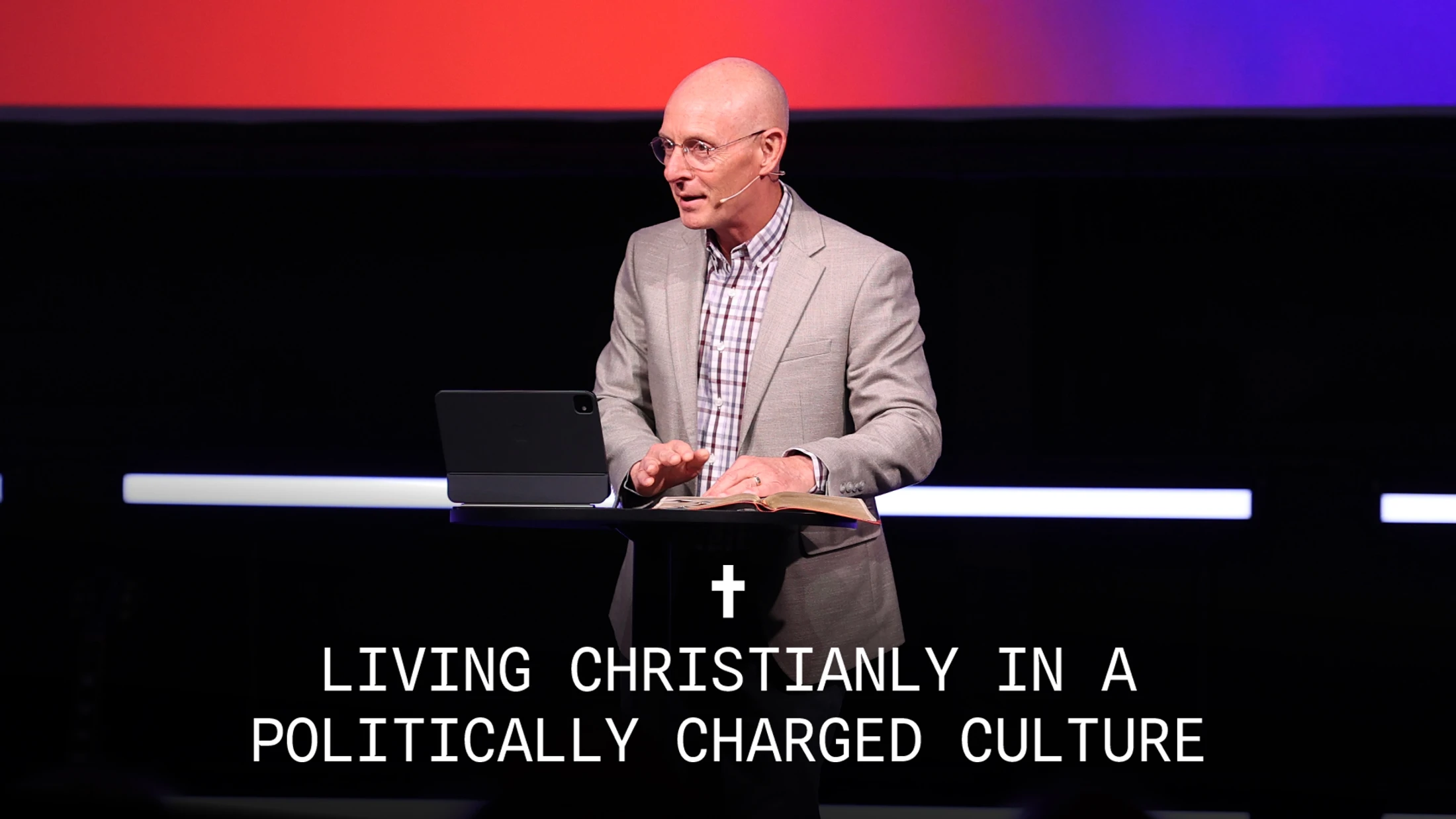
"I will live Christianly in this politically charged culture by worshipping only God, not excusing sin, and enduring whatever price I may pay for remaining faithful to Christ Jesus the Lord." Listen to this special standalone sermon from Pastor Todd in light of our current political climate.
And as we prepare to get under the weight of the Word, because it's the Word that does the work, I want to just welcome in all of our campuses that are joining us. Our live streaming venue upstairs, thank you so much for handling that responsibility when it's your assigned time as a small group. Our Carlisle campus and of course our Guttenberg gathering.
So glad everyone's tuning in, your Bibles are in your lap. You'll need them in a few moments for sure as we'll look at several Scriptures. Before I begin, let me apologize for something that I did while preaching a few weeks back.
I unintentionally maximized an issue that I should have actually minimized. Now I usually do pretty well at that, but on that week I didn't. It involved my view on an end times aspect, as well as a Great Commission aspect.
And the part I apologize for is this. In the middle of that, I said, quote, I challenge you to bring me a better option. And in all frankness, that's not the pastoral posture that I desire.
I don't have any desire to be that kind of pastor to you. I think we should challenge our people. But on secondary issues that can be different on, we need to show more grace and humility.
I didn't in that moment, and I apologize to you. I trust you'll forgive me for unnecessarily stoking the fire of opinions in areas where we can have different opinions. What I should have done is I should have stoked the fire on this core doctrine.
We believe in Christ's visible, personal, and future return. On that we all agree as members of First Family. In fact, here's how it's worded in our Confession of Faith, the document that we agree to as members.
We believe in His personal future return in power and glory. Amen. Sometimes within that there are differing views on timing and so forth.
And I think when I offered up my perspective on a related issue to that, I didn't have the grace and humility that I should have as your pastor. I still hold to those views, but I want to do so in a way that admits there are other views in play as well. So I trust that you'll accept my apology and that you'll forgive me.
Now I bring that up today authentically because I think it is one of the traps that we're looking at today as well. That there may be times in the course of our biblical discussion today that we may actually disagree with each other. And I want us to do so with grace and humility.
My personal opinion is we'll find way more areas to agree on today. But because this theme and this pause we're taking in Colossians to address this specific topic does contain some landmines and potholes, I just want to be aware that this could happen not just between me and you today, which I don't think actually will very much. It may happen with someone on your row or even someone in your house.
Because when we talk about living Christianly in a politically charged culture, we are going to touch on areas and issues in which people have different opinions. So let's look at God's word about this. And where we disagree and we can, let's have grace.
But let's also do this. Let's not let those things sidetrack us from what we do and must agree on. The kingship of Jesus Christ and our allegiance to him and worship of him above everything else.
That's what I know members of First Family agree on wholeheartedly. I think you probably agree on this as well, that it can be a tall order not only to live Christianly in a politically charged culture, but to talk about living Christianly in a politically charged culture. Conversations get escalated, opinions get ramped up, and it seems to happen every two to four years as we inch closer to November.
The culture becomes a pressure cooker. It becomes a kitchen full of pressure cookers, doesn't it? And it gets hot in those kitchens. So allow me to help with that today.
I want to lean in regarding this topic of how to live Christianly in a politically charged cultural kitchen. And I want to do it today before it gets even hotter in November. In fact, did you know that in the Bible there are a number of political passages? There's a number of scriptures that talk about political situations.
In fact, here are 10 of them. I'll show them on the screen to you. Make a note on a piece of paper on your sermon note sheet.
10 scriptures. There are more, but here's 10 that I've chosen that I want us to look at. We won't read all of them, so I would be sure to write them down.
We'll read parts of some, the whole of others. But we're going to draw some principles from these passages that help us live Christianly in a politically charged culture. So get your fingers loose and ready to do some walking through the pages of scripture, okay? Because I want us to deal with this now.
Yes, it's the Sunday before. Many of you will celebrate your national citizenship. Nothing wrong with that.
But I want us to do it now before November and before the 4th for this reason. I want you to value your spiritual citizenship even more. I want you to prioritize your citizenship.
That you are first and foremost a permanent citizen of heaven. And while you have an earthly temporary citizenship and you do relate to those in these geographical borders, you're going to spend eternity with folks from all across the globe who are in the same spiritual family you are. That should have our focus about how to live Christianly in a politically charged culture.
In fact, it's that spiritual citizenship that actually motivates us to live on mission for the city of God while we're in the city of man. Kudos to Augustine. So your Bibles are in front of you.
They're in your lap. Let's walk through a few of these passages, can we? Exodus 2, we won't read anything out of that one. Just know that it's the first one I've selected because it details Moses's birth and then childhood in Pharaoh's house.
I mean God's deliverer of his people was raised in the Egyptian dynasty. In fact, it's to these very people who raised him that he went back and demanded the deliverance of his people. So if you're looking for a politically charged environment and culture, just read Exodus 2. All the King Tutankhamens, some of them are in play here.
They interacted with God's people and God's leader. That's a politically charged environment. Regardless of what you say about all the things in Exodus 2 theologically, we can at least say this, that would have been highly ramped up if you're Moses.
Daniel has another one of those highly charged political situations. God's people Israel had been taken captive. They're being punished for their idolatry and continuing sin.
They're spending 70 years in exile. One of the kings in that time was Nebuchadnezzar and he made a statue and demanded that everyone in Babylon bow down to it. At the time Israel was exiled in Babylon.
Many of them were. They were to follow the same orders. Now how many did and how many didn't we don't know.
We only know that in this text there were three Hebrew men who said we will not bow to the idol you've made. Verse 14 tells us Nebuchadnezzar's response to them once he found out this occurred. He asked them again, Shadrach, Meshach, and Abednego, is it true that that you don't serve my gods or worship the gold statue I've set up? And then he gives them a second chance in verse 15, warning them that if you don't worship it, you'll immediately be thrown into the furnace of blazing fire.
And who is the God who can rescue you from my power? Well, verse 16 gives us their response. They replied, Nebuchadnezzar, we don't need to give you an answer to this question. If the God we serve exists, then he can rescue us from the furnace of blazing fire and he can rescue us from the power of you, the king.
But even if he does not rescue us, we want you as king to know that we will not serve your gods or worship the gold statue you set up. Love their posture of humility with conviction, don't you? They're willing to pay the price. So this is just another example.
We won't go into all the details or even teach it theologically. I just want you to observe in the Bible, there are political situations between God's people and the political entity in charge. Matthew 22 may be my favorite.
Just a few short verses beginning in verse 15, the Pharisees are sending some of their minions to Christ to trap him with a financial question, but it's also a civic question and a legal question. They're trying to come at him in various ways. They ask him, is it lawful to pay taxes to Caesar or not? He perceived their malicious intent and he says to them in verse 18, why are you testing me, hypocrites? Show me the coin used for the tax.
And they brought him a denarius. Whose image and inscription is this? He asked them. They said to him, Caesars.
Then he said to them, give then to Caesars the things that are Caesars. Speaking of the coin with his image and give to God the things that are God's. Speaking of the people and the image of God stamped on all creation.
When they heard this, they were amazed and they left him and went away. It's clear that we're only to give our lives to God because his image is stamped on us. But he's also saying you probably need to give your money to Caesar.
There's nothing wrong with that in that sense. So interesting passage, isn't it? Culturally charged, politically ramped up, no doubt. In this there are the names of Caesar.
There's the Pharisees. So there's religious, political ruling authorities. Very interesting.
Look over at Mark chapter one, an overlooked verse. We hardly ever think about this being a political verse, but it most assuredly is. It's very simple.
The beginning of the gospel of Jesus Christ, the son of God. You say, why is that political, Todd? It seems almost like an introductory setting of the context. Oh, that's exactly what it is.
Because ruling at the time of Christ's birth, according to Luke chapter two, verse one, is Caesar Augustus. He was called Caesar Augustus for one reason. He thought he was the son of God.
So when Mark opens his narrative of the life of Christ, inspired by the Holy Spirit, he begins by saying, here's the gospel of the real son of God, Jesus Christ. In fact, historically, did you know that in modern day Turkey, there is a building they've excavated and discovered that was built around 6 BC during the reign of Caesar Augustus. And inscribed on that building are these words, I quote, the birthday of Augustus has been for the whole world, the beginning of the gospel.
So when Mark writes his gospel, he's taking a direct aim at the political entity who's claiming to be deity and say, no, let me share with you the gospel of the true son of God, the Lord Jesus Christ. It's a political verse as well as other things too. Again, Luke chapter two and three, they lay out for us much of the same kind of setting in regards to Christ's birth.
You see in Luke two, that it was Caesar Augustus who gave the decree that the whole world should come to be taxed. Now remember, Caesar Augustus is the first emperor of the Roman empire. There were other rulers before him.
They were over the Roman Republic, but it wasn't until Caesar Augustus that all corners, so to speak, were under the empire's rule. And yet I find it so comforting that it was this very ruler that God used to give the decree that would fulfill old Testament prophecy. There's no ruler, no matter how great they are outside of the control of sovereign God.
Luke three, interesting, there are seven references, excuse me, seven names of rulers mentioned in these first two verses. Again, Luke's just setting the stage, letting us see exactly the political and cultural kind of ramped up nature of the environment in which he was born. And he was born, lived, he died, was crucified, he was buried and raised in this very environment, politically charged, occupied territory, excessive taxes, tributes.
This is going on while he lived as a kid, as an adult, he served, he ministered, he died, he rose again. And then Peter comes on the scene and he gives one of the very first messages post ascension in the same kind of politically charged environment. We're not sure who was emperor.
It was not Augustus Caesar. It could have been Caligula, could have been Claudius. It was probably not Nero yet, but one of these emperors is in charge.
And I want you to hear this. When Peter preaches in Acts 4.12, there's no other name under heaven given to people by which we must be saved. That's Acts 4.12. Here's what he's challenging.
He's challenging the Roman empire's view that it was the name of the Caesar by which people are saved. In fact, did some research and history shows us that when the Roman empire would bring a kingdom or a tribe or a location under their submission, and they agreed then to be under the Roman peaceful rule, according to Rome, they would post an announcement within the city on a post or a gate. And here's what that would say.
There is no other name under heaven by which you can be saved, saved for Caesar. Often it would say Caesar Augustus, perhaps the one in charge, but their point was to make sure that that colony, piece of land, tribe knew there's one name you've got to worship, Caesars. Isn't it interesting? So when Peter stands and declares to all those Pentecosts, there's only one name by which you've been saved.
It is theological and historical, but it's also highly political. He's challenging the ruling political entity who had deified themselves and says, your name doesn't save, only the name of Jesus Christ saves. And I want to say to you just in a, just a momentary pause here, this is true today as well.
And if you're trusting anything else to save you, a political entity, a political party, a platform, a human, you know, political Messiah, there is no other name under heaven by which you can be saved other than Jesus Christ's name. He alone saves. And he calls all men and women everywhere to repent, to believe the gospel of Jesus Christ, God's son.
Turn from their sin and follow him. Ask him to save them from their sin because of Christ's death, resurrection. The Bible promises that all who believe in the name of Christ will be saved.
And I call upon you to not worship or trust anything else to save you, but only Jesus Christ. This is what Peter preached. So I can imagine that was a highly charged Pentecost day.
Don't you think so? Well, Paul would lean into this same thought as the church began to grow and mature. He wrote to them in the book of Romans, how to respond to those who were their ruling authorities. I think it's very intriguing that it was in the book of Romans.
This is the book to those who lived in the capital city of the ruling empire, probably at this time under Nero, the one who burned that city, the one who martyred Peter and Paul more than likely. He says in Romans 13 to submit to the governing authorities. It's kind of an odd way to begin a chapter on that to folks living in that city, isn't it? But he's highlighting our responsibility.
He says they're God's authorities. They're God's servants. They're to protect those who do good, punish those who do evil.
He says we must submit to them because of their position, also our conscience. And this is why we pay taxes, because they're God's servants. They're attending to these tasks.
In verse 7, it's a beautiful close. He says, pay your obligations then to everyone, taxes to those to whom you owe taxes, tolls to those to whom you owe tolls, respect to those to whom you owe respect, and honor to those to whom you honor. He's not letting the Christians out of an obligation to engage and interact civically.
And yet he knows it's a highly charged culture. So he's expecting them to stay in it, but not be of it. He further amplifies some of the posture to take as believers in these kinds of cultures by saying in 1 Timothy 2, we're to pray for all those in authority.
And then he says this for kings. So Paul expected the church, the believers to pray for the ruling political entities. He prays that they would do the right thing so that we can live a tranquil and quiet life.
He calls this good, how it pleases God, because God wants everyone to come to a knowledge of the truth and be saved. I think what Paul's getting at is this, pray for your civic leaders that they'll rule well. They'll rule in a Romans 13 fashion so that we can have peace because the gospel can advance in times of peace.
Now, this isn't saying that it doesn't advance during persecution. He's not saying that. He's just saying that it's okay to want peace instead of persecution.
Like, you know, the Old Testament people of God were asked to pray for the peace of Jerusalem. They were asked to also work for the prosperity of the city in which they were living in exile, Babylon. So there's a sense in which God asks us to pray and work for peace and prosperity.
And yet if our faith is on the line, we should not succumb and give in. We should be willing to endure the persecution that may come from that. I find a lot of solace in this, that let's be unafraid to pray for peace and to work for the kind of environment where the gospel can get good traction and move freely among neighborhoods and communities and societies so we can bring the message of Christ, God's Son to all who will listen.
Peter echoes much of what Paul said and much of what was lived by the early Christians in his epistles, chapter 2, verses 13 to 17. I won't read all of that. Just notice he actually begins much the same way, calling for submission to every human authority, whether to the emperor or to governors.
So he's saying that even among the hierarchy, if they're ruling over us civically, let's have a posture of submission, do good. He says when we act this way, it silences foolish people. In other words, when they're slandering us and when they're maligning us, when we continue to have a posture of humility and submission, when it's not violating God's word, it actually speaks volumes to these people.
And then he closes with a very interesting verse. He says, honor everyone. This is verse 17, love the brothers and sisters, fear God, honor the emperor.
And I taught you this when we talked through first Peter. Just notice again that I think what he's doing in this verse is kind of an under the radar kind of jab at the emperor, because he asks you to do to the emperor what you will do to everyone. Honor everyone.
Then he says, love the brothers and sisters and fear God, probably speaking of the church and God. And then he says, honor the emperor. So the emperor is the same as everyone.
He's making sure the church knew he's not God and he's not to be worshiped, but you are to honor him. He's like everyone else you would honor. I think it's kind of a, kind of use the phrase, a sneaky shot.
My point is this, not to try to explain all of these theologically or even all the application of points. I just want you to see, here's 10 passages. This is just a few of them that are in the Bible that are written in politically charged cultures and environments.
So guess what? We are not the first. You're not the OG to go through an environment where you feel like, man, it's tough living in these times as a Christian. Oh, you're just the next one in line.
So I take great heart in that as well. God has equipped us and given us what we need to actually live Christianly in a politically charged culture. So I want to draw three principles from these texts that will tell us how to do that.
And after each principle, here's what I want to do. I want to give you a resulting application. So hang with me.
We'll look at these three things and their application. Number one, living Christianly in a politically charged culture means I will honor our leaders but I will not worship them. Matthew 22 brings this out most explicitly.
It's the point of several passages. And so when we read this, we are quick to agree. And yet we often forget something, that the early church was persecuted, not because they worshiped Jesus.
But watch this, it's because they worshiped Jesus only. I have no doubt that in that culture, as in ours, they'll give you a seat at the table, as long as you make them equal to who you worship. You see, the persecution came because they would not worship the political state.
This is why they were persecuted. And this is why they were martyred. Because they worshiped only one.
It was Jesus Christ the Lord. So fellow believer, let me just say to you, for the sake of stating the obvious, but I want you to hear it. And for the record, you cannot worship the state.
You can insert political entity, you can insert the government, you can insert any good or bad leader you want in there. You cannot worship the state. You can honor it, and we're supposed to, but you are not allowed.
You can't worship the state. The throne of your life must only be occupied by Jesus Christ the Lord. You are first, like I said, a citizen of a heavenly kingdom.
And that's your permanent citizenship. That's where your allegiance lies. That's where my allegiance lies.
We only worship God. Now some have asked, and rightfully so, well Todd, how do you know when you're worshiping something or someone else? Like how would you know when you're worshiping the state? It's a good question. Some have attempted to answer that by saying this, well if you say the pledge of allegiance, that's worship.
No pledge of allegiance. I have friends who hold to that view. Some have said if you sing the national anthem, that's worship.
No national anthem. They don't kneel, but they don't sing. So I don't hold to that view, but some have said if you pledge allegiance or give, you know, kind of like a nod to something other than God, then that's worship.
I don't believe that, but I will give an answer to the question the best I can. It's not a great answer, and some of you won't like it, but I want to humbly offer you an answer that I would urge you to kind of process through experience. My attempted answer is this.
You probably won't know who you really worship until you have a choice. I'll give you a personal testimony without the specifics. Over the years of my life since a Christian, I have really found out who and what my idols were when I had to make a tough choice.
Before the choice, I always would say, I worship God alone. Then suddenly in the midst of a choice between God and something I actually love as well, my idols were revealed. You see, our choices always reveal our idols.
Now watch this. And our choices are often not forced upon us until a crisis. You may not know who or what you really worship till your next crisis presents you with a choice.
You need an illustration? I'll give you five letters. C-O-V-I-D. Say it with me.
COVID. COVID revealed a lot about what the church actually believed and worshiped. I'll say more about that on the Extra Point Podcast.
And in that one sentence, I just upped our listenership tenfold, I'm sure. Todd's going to talk about COVID on the podcast? I am. I'll share transparently some things I wish I'd have done differently.
Some things I think our church will do differently in the future. I felt we navigated it pretty well. I learned a lot in that crisis when we were presented with choices.
So how do you know who you're worshiping? I think most of you think you know, and I think I know, but I'll just warn you, your next crisis will reveal choices and they could starkly reveal to you who you actually worship. Now some of you hear that and you're like, Todd, go get those liberals. You're spot on.
Take it to them. I can't wait till Tuesday. And yet the folks who probably feel that and say that, I sometimes, though they are sure they'll never worship a state in the future, it appears that sometimes they can't even biblically prioritize their life in the current present.
A team demands all their Sundays for months, and they give in in a heartbeat. A season shows up and it's their favorite hobby. They're gone for months at a time.
They abandon God's people, God's purposes. The smallest financial crisis, their givings to the church and to mission stops. You see, I'm convinced that individuals and families already worship other things, unfortunately.
Things like their kids, their kids' hobbies, their image, their toys, their freedom. So don't be surprised when the pressure mounts and gets more pronounced to see many people find a way to excuse clearly unbiblical choices in the name of a Christian value. It's happened before.
It could happen again. Now let me take that and make one resulting application for you. Here's the principle.
We can honor our leaders, but we can't worship them. So understand, here's the resulting application. The state is not God.
So I know you believe that. I want to take that statement, which is nonpartisan. It's not even political.
It's a theologically accurate statement. It's culturally relevant, but I make it not with the intention to prove any point on any side of the spectrum. What I want to do is ask all of you to think about how this impacts you in regards to where you are politically.
This isn't a political statement, but it has political implications. And so I want to speak after every application to my friends who have red hues and shades, and I'm going to speak to my friends who have blue hues and shades. I have friends in both camps.
So to my friends with red hues and shades, be on guard against the Messiah complex. That one great leader will solve it all. Now if we want to insert a name in there, and we're sure that if we just get people to vote for him, everything will be different.
I warn you against that mentality. To my friends with blue hues or shades, be on guard against a utopian pursuit. Like there's some kind of great society that if we all just could find it and agree together that we can get along, that we can coexist, we wouldn't even need many laws.
That's bunk. You see, neither of these work. Not a single leader or a great society, no matter how benevolent either is, is to be worshipped.
The answer to our issues is not a political answer. It's a spiritual answer. It's from God.
And when more people worship God, things in the society work better. So let's not worship the state. Let's not make them out to be the answer.
Let's honor them. Let's work with them. Let's engage with them, but only worship God.
So commit with me to live for one king, would you church? King Jesus. Let the symbol of your life be a lamb and a cross, not a donkey or an elephant or some hybrid of the two. Principle number two, living Christianly in a politically charged culture means I will engage strategically, but won't excuse sin.
I want two words to pop out that sentence to you, strategic, and then the word sin. Peter and Paul both do this in their epistles, as well as in some of their letters to the churches. They talk about strategy, but they also call out sin and encourage us to resist and to stand firm and not to sin.
So these things are things we should learn how to do together. Be strategic and not excuse sin. Let me give you a couple of other words that I've learned late that have helped me in regards to these two terms.
Jagged lines and straight lines. Jagged lines refers to strategy. Straight lines refers to not excusing sin.
A good book that kind of explains these concepts and has helped me a lot is the book, Students' Guide to Politics. I picked it up about three weeks ago. I was at a conference and I saw it and I thought, oh, I'm much more than a student in politics.
I'll pick it up and get a couple of nuggets for this sermon. When I read it, I felt like I wasn't even in kindergarten yet. It was delightful, informative, insightful.
I realized how much I didn't know. It's called a Students' Guide. It's very short.
You can read it in probably 30, 40 minutes. I would encourage all families to make their kids read this. It's very accurate and good.
It talks about jagged lines and straight lines and how they work. Let me give you an example of these. Immigration policies, business regulations, property tax rates, those are among the things that have jagged lines.
You can't draw a straight line from a verse of scripture to that issue. You can get to your view on that issue through a set of jagged lines, intersections, back to a biblical concept or a biblical principle, but you can't draw a straight line that says no civilization should charge more than 8% for property tax. I know some of you wish that verse was in there, but it's not.
There is no verse about property tax rates in the Bible, so people disagree on that. There are principles in the Bible that inform us regarding immigration policies, tax rates, business practices and regulations admittedly, and then people form opinions and strategies based on those. Those are jagged line issues.
Are you with me? But when it comes to marriage, immorality, gender, sanctity of life, slavery, justice and other core biblical matters, those are straight line issues. On these issues, we are to speak regardless of the effect they have and on whom that effect occurs. I say that because some people protect their platform or party instead of calling out what's actually wrong.
Things that exist in all parties. After all, politics is a messy process. It is a human, man-made invention.
It's not necessarily all bad, but it's not going to be perfect. It's an imperfect process at best. So to engage this well means you have to know what your jagged line issues are, and you need to know what your straight line issues are, and when the straight line issues are violated, don't let the color of your party keep you silent.
Call it out, period. Can I illustrate this for you through this application? Sin is not party particular. Now strategy is, isn't it? But sin is not party particular.
It applies to us all. And the illustration I want to use is the single greatest issue of our time, the issue of abortion. And I realize that while I'm sharing this, I have friends who in their past have had abortions, and they live under the grace of God in beautiful fashion, but I've also found this, and I would differ with some who would point me out on this aspect.
The greatest proponents of speaking about abortion publicly are often those who had one. They know the horrific nature of it. So I don't fear that someone who's had an abortion in this room is now living under God's grace and His forgiveness.
It's going to be upset at me for bringing it up. I think they're the ones who ask me, Todd, talk about it more. Don't let this remain a secret.
And this is an issue that I think is the greatest issue of our time. I think it's the underlying fundamental issue below every other issue. I've told you that before.
I'll maintain that. We could talk about other issues that have straight lines, such as financial corruption. Proverbs speaks about false weights, dishonest balances.
We could talk about the crisis of gender confusion. Genesis draws a very straight line. We could talk about the crisis that comes from hypocritical foreign policies and disregarding atrocities by one group and yet approving of others in multiple kinds of wars.
We could talk about the crisis that emerged from equivalizing immorality. Well, you did that, so it's okay for us to do this. I mean, Proverbs speaks to all of these issues with very straight line verses.
But here's what I believe underneath all of those and the devaluing of life even in those situations, it's more acceptable now because we've devalued life with those who are most innocent and in the greatest position of precariousness. An unborn child in a mother's womb. So hear this, and I know this is hard to hear and hard to say, but it takes voices to actually verbalize what's happening to wake us up often.
That what we're witnessing is the state-approved murder of our children. That's why it's the fundamental issue under every other issue. If you give way on that, you won't value the life of the elderly.
You won't value the life of those without parents, foster care systems. You could pick your issue, school lunch, Medicaid, Medicare, all these ways were to help people. If we can't value an unseen, at least to the visible naked eye, innocent child in a womb, who stands a chance later? You're all up for grabs.
And so let me illustrate for you how I want to call out evil regardless of their hue or shade. I want to give all civic leaders the opportunity to account. So to my friends with red hues and shades, former President Trump a few months ago gave a nod to 15 weeks as the okay place to end abortions.
Like if we can get to 15 weeks, that's good. He said, we can't get much more conservative or we'll lose the election. He reiterated this Thursday night in the debacle.
It's very unfortunate. It's unthinkable. And I'll say, I think it's immoral that someone would place votes above life.
If we lose an election because we're standing for the unborn, so be it. We don't want to be vague. It's unfathomable to me.
I lose words to talk about this issue. And so I think he's wrong. I think he was wrong a few months ago.
I think it was weak and cowardly. I think he's wrong Thursday night. What it revealed to me was this, that his morality is one of convenience.
Votes don't matter more than life. To my friends with blue hues or shades, our current president, president Biden and his party, they have made abortion their signature issue. That's hard to hear.
And if you're in the blue shade hue group and we're friends, I don't think it's factually incorrect for me to say that to you just check their platform. Now, here's what I think when I read that, that abortion is their signature issue, even at any stage says to me that they want to kill our offspring. I know they don't want to admit that, but the very ills that have come upon our society since 1973, 51 years ago, due to killing our offspring, regardless of the week or month, you say it's okay.
It's not okay. Here's what's happened. We have taken an elective abortions over 60 million babies.
And I've told you this before and I'll stand by it. And I want to say this humbly and with grace, but if I were not a Christian, if I didn't believe the Bible, if I was simply a pagan who wanted to live in a decent, safe country, I would oppose abortion for one reason. It's killing our future tax base.
No pun intended is deleting any future workforce. I think a logical mind could see we're losing our future generations who are going to pay for us later. And I'm not trying to be comical or lighthearted.
I'm saying the logical nature of murdering our children in the womb is astounding to me. Why the Democrats and our current president hold onto that. It's bewildering.
Now I have some opinions about why I think that is. And I've told you this. I think our sexual deviance and our lustful idolatry has bred us and led us into a state where we have, they want abortion to excuse all of their illegitimate and idolatrous sex.
A my sex, my way culture can't let go of abortion or they can't engage in this. So these are inextricably tied, but we have to, we have to speak out against the killing of our offspring at any stage. We have to, and I know I'm being heard by people who've had abortions in their past.
I'm telling you, if you knew who they were and you could talk to them, they would be the number one proponent of this point in our communication. And God's word draws a very straight line to the sanctity of life. And I'll hold all parties and people to those straight lines without exception.
Matters of morality don't have loopholes, even if your name is Trump or Biden. You're probably wondering, and rightly so on this application point, man, Todd, it sounds like you're disqualifying everybody because they're not perfect and we have nobody left to vote for. I'm actually not saying that.
I'm saying that we have to be consistent and clear. I can't force anyone to do anything in that. I can't make the law.
I can only engage to the point that I can engage. And my point of engagement is to make sure that I am crystal clear and consistent and that our church is crystal clear and consistent on the straight lines. I'll admit to you, too often lately, it appears we've not had great choices.
I might even say to you, we've not had good choices. But if you keep engaging on the jagged lines and not excusing on the straight lines, here's what'll happen. Then when you do vote, you'll have a clear conscience vertically and horizontally when you do vote for the lesser of two evils.
That is often what I think we're left with personally, the lesser of two evils. There is a man who words this better. He says we are often left with the one who will lessen evil more.
He tries to avoid the personification of this being Messiah complex driven and just saying which party candidate will lessen evil more. However you want to say it, I think you felt like, man, what am I left with? So sometimes it does appear we have the lesser of two evils, but here's where I stand on that. My opinion is that it is usually civically wiser to take the lesser of the two evils or the one who can lessen evil the most and keep the ball moving forward toward the goal line than to abstain, not engage at all and wind up being sacked and in worse shape nationally.
I, for one, am an absolutist on abortion. I think it should be against the law, period, at any point after conception. I do.
Now when you hear that, you're probably having a thousand questions. We can talk later. Just know this.
I know we're not there, so would I take six weeks, 15 weeks, 20 weeks? You bet I would. That's way better than nine months. But am I saying that I approve of 15 weeks? Not at all.
So I hope you're hearing my heart. This is what it means to engage and yet not excuse sin. I call this hard line incrementalism.
I have a hard line that I'm trying to get to, but I realize we'll probably only get there step by step. Some call it in your face incrementalism. One man I know calls it smash mouth incrementalism.
I like that the best. I didn't think of it, so I didn't want to use it. I had to tell you I give credit for it.
Here's the point. That kind of approach, if you were to adopt that view, requires that you do vote, which I personally believe, again an opinion here, is the second most basic way to engage. Now some of you thought I would say that's the first way.
It's not. The first way to engage is prayer. It's always our first and best action, 1 Timothy chapter 2. But the second way to engage is by actually voting.
Now if you've not voted, you're not registered to vote, or you would like to know more about that process, regardless of your color, red or blue, you know that you need to engage but not excuse sin. So members of our church, Steve and Carmen Boll, very experienced in this. They're going to be out by the cafe after the service.
I just want you to stop by there. They'll have some materials as far as cards and websites, how you can get access to voter registration, how to do that. Then you can make your decisions based on the Bible, straight lines, jagged lines, and you can be engaged in at least the most basic way possible.
I encourage you to consider that as you think about your jagged lines and straight lines and your responsibility to engage strategically and yet not excuse sin. Lastly, principle number three, living Christianly in a politically charged culture means I will endure the cost and not exit my confession. I won't be long here, but this is clearly seen in Daniel 3, as well as in 1 Peter.
We know that Peter was martyred by Nero. Philippians 1, Paul talks about his imprisonment for the gospel. That led to his martyrdom by Nero as well.
These people who went before us did not cave in the moment of pressure. And though I know it's been said that everybody has a price, these folks are early brothers and sisters and mothers and fathers of the church, of the believers, that they didn't fold. They didn't have a price.
They held fast to their confession. I'm praying that you will as well, that regarding your confession of faith, you will hold fast to that. And that confession of faith is simply Acts 4.12, Jesus Christ is Lord.
And whatever that confession cost you or me, so be it. It will be worth it. Now, unlike our brothers and sisters in the first century, which we've looked at here, and unlike other of our spiritual family and other parts of the world today, I personally don't think our situation involves martyrdom.
That's probably not the price you're looking at in your lifetime. Probably not. What you're looking at, and I've mentioned this before, is marginalization.
It'll come in three ways. It'll be personal. They'll make you seem like the oddest, weirdest, outside the norm person they can.
And many of you, to be frank with you, you give in here way too quick. You're so afraid of being unliked on Facebook. It's amazing.
You're so worried about being misinterpreted. You couldn't stand the thought of someone who's in a different group than you, thinking differently. If they didn't like you, it would ruin your whole day, even though you blatantly oppose them and disagree with them.
I just need to ask you to toughen up a bit. Personal marginalization is happening and will continue to happen. It's the landscape of living in this culture as a Christian.
A politically charged culture often means lots of misinterpretation. So just get used to it. Have a clear conscience, horizontally, vertically, and then don't worry if the culture says you're weird.
Who cares? God knows you're not. You answer to Him, stand on the straight lines, be gracious in the jagged lines. When the personal marginalization occurs, if that doesn't work well, they typically move to what I would call economic or financial marginalization, where it costs you more to follow Christ.
It's hard to spot this sometimes, but it does happen. That typically is just shy of what I call corporate marginalization, where you can't hold a job or open a business or make money because you hold to certain beliefs. We've seen this with the Colorado Baker.
We've seen this with some of you in your jobs. Your companies have asked you to sign things that you don't believe and that are unbiblical and you wouldn't agree to. I know people who've had to find new jobs because their company adopted such an agenda that was not even part of their business.
This is marginalization and it occurs in those three levels. Now, listen very carefully. What's behind this is a political ideology.
Hear me very clearly here. It's a political ideology that wants to usurp the authority of God. You see, the group behind this marginalization and I think ultimate persecution if it gets to that, it's secularism.
You could call it humanism. It's the deification of man over God. Oddly, they say one of their values is tolerance, but they can't tolerate you worshipping God alone, so they're going to make you pay for it.
That's the ideology, the political ideology, I would even say the demonic ideology behind a lot of what is going on. The deification of man, the lessening of God, secularism, they want you to worship the state and they're going to pressure you if you don't. When you don't submit to them, you can expect to be marginalized.
But as that occurs, understand this church, greater than a political ideology is the spiritual theology at work, God's gospel and God's plan. And just as God used Caesar Augustus' decree that everyone should come and be registered, thus fulfilling Old Testament prophecy, and just as God used Cyrus to free the Israelites to go back and rebuild the temple, God is using all kinds of leaders and all kinds of people to further His agenda and bring about His end game purpose. That spiritual theology, the gospel, God's plan is greater than political ideology.
It also promises this, that God will keep His children from stumbling and present them faultless before His throne. So you hold fast to your confession because that's the throne that matters. That's the judgment that counts, God's.
So let me leave you with a resulting application from principle number three. There is something worse than persecution from man. Some of you right now can't believe that.
You're just wide-eyed like, really? Oh, there is. It's separation from God. So to my friends with red hues and shades regarding principle number three, some of you think being canceled is the ultimate goal and you wear it like a badge.
You think the more you get sanctioned, the more spiritual you are. Being sanctioned is not the goal. Getting fired isn't the goal.
Getting canceled isn't what we're after. Yet some of you, of my friends who are in the blue areas, you're so afraid of being canceled. You just parrot the latest lunacy in the culture's talking points to avoid any criticism at all.
It's amazing what I read on Facebook sometimes. I'm thinking, are you that afraid of someone's opinion? I think you believe safety is the goal. It's not.
Trying to get sanctioned by every living thing and trying to be safe from every living thing, neither of those are the goal. The goal is faithfulness to Jesus, not fighting with man or fearing man. Faithfulness to Jesus is always the goal in every situation.
I'd remind you of two verses that helped me a lot in this. Romans 12, 18, as much as possible, live peaceably with everyone. Like he's calling us there not to be a grump, not to be a bad neighbor, not to be the guy that no one wants to be around.
Like as much as you can live at peace with people. Matthew 10, 28 though warns us that in doing that we can't just act like there aren't matters of morality, that there aren't straight lines. Matthew 10, 28 says this, do not fear him who can kill only your body.
Fear him who can kill both body and soul in hell. Let's be nice to our neighbors for sure. Let's do all we can to love well and be easy to be around, but let's fear God above everything.
That's what it means to be found faithful. And that's the end game bullseye. That's always the goal.
So if the worst thing happens, stay faithful. If the best thing happens, stay faithful. Faithfulness to our confession of Christ as Lord is always the center of the mark.
Which knowing that helps us kind of summarize things and land this plane finally, right? Here's just a simple summary. All three things put into one sentence. That to live Christianly means in this politically charged culture, I'll worship only God.
I won't excuse sin and I'll endure whatever price I may pay for remaining faithful to Christ Jesus the Lord. When we do this, then we're making living Christianly our aim, not necessarily living politically or culturally. And that is our aim, church, to live Christianly because we're citizens of the kingdom in heaven permanently.
We're only temporarily citizens of this one. So let's embrace these three things and live them knowing that we're, yes, in the world, but we are not of it. In a politically charged culture, let's make sure the flag we're flying over the land of our life is the flag of the Lord Jesus Christ, the only name by which anyone can ever be saved.