
Overview of Galatians 5:16–26
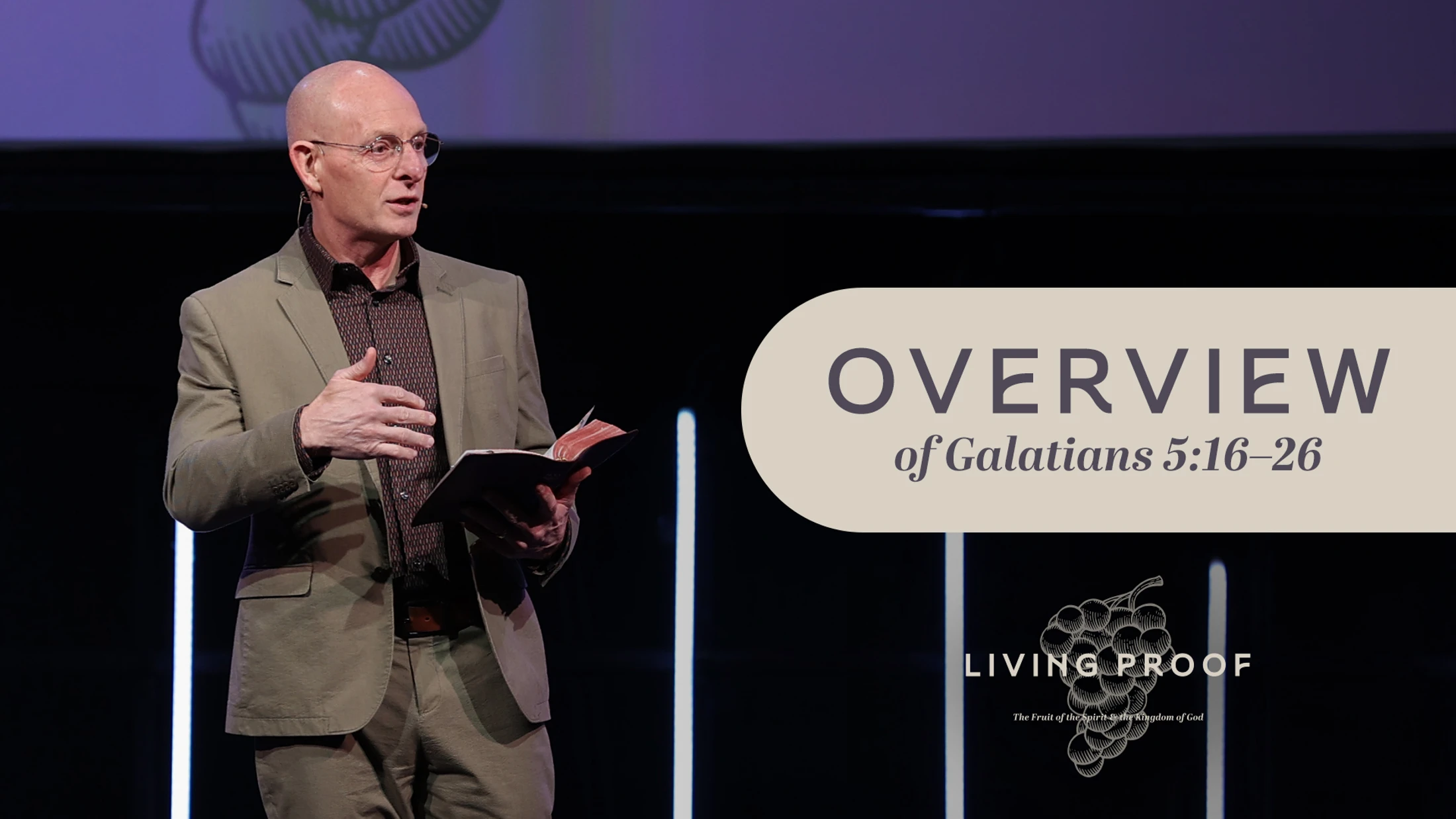
The fruit of the Spirit is first about the Spirit, second about the fruit. So focus on the root, not the fruit; the source, not the signs. Bearing the fruit of the Spirit is really about being filled with the Spirit. Listen to the opening sermon in our new series "Living Proof: The Fruit of the Spirit and the Kingdom of God."
Let's dive into our new seven-week series. It's called Living Proof, the Fruit of the Spirit and the Kingdom of God. My goal today is to tie those together and away from the text, that it will all make perfect sense and the Holy Spirit will continue to work in us and work on us, probing, sanctifying, pointing out, peeling back.
So don't grow quiet now. Let's stay engaged in worshiping our Trinitarian God, the only one who is worthy and holy. Amen.
I want to welcome in our live streaming venue upstairs as well, my different campuses. In fact, there's a one-week campus air quotes joining us today. Our sister church in Sheraton, Cornerstone Community Church in Sheraton, Pastor Paul, great friend of ours and of our church.
They have a service that can't be live streamed today because of some information about their partners that they're not willing to go out on the air. You're kind of familiar with that as well. So they called last night and said, Hey, can we just suggest our homebound and our folks who can't make it watch you? I said, you don't need to ask twice, give them the address.
Let's do it. And so they're joining us at 1030 today. So no matter what our location, let's find Galatians chapter five.
Can we let's get under the weight of the word and let it do its work in us this morning. Here's how we arrived at this week where we're beginning a new series from Galatians five on this topic of living proof, the fruit of the spirit and the kingdom of God. It started a little more than a year ago.
I was on my annual study retreat. It's really just a few days in a pop-up. I go there with my Bible and the calendar and just think through what does the next year or two of preaching look like at First Family.
I'll take our needs input from our staff, our elders, what God's spirit saying to us, to me. And so I just kind of lay out the next year. So it's rough draft format.
I'll come back, run it through the elders or staff. I kind of just get some feedback, but at some point we kind of finalize that. But it does kind of begin in my lap on that retreat.
Take it every year, try to stay two or three years ahead. And I was asking myself about a year or so ago in that pop-up camp for what would need to happen in 2024 for the work of God's Holy Spirit to be manifestly evident. My mind first said spiritual gifts.
We've been teaching on that for a number of years in a row, taking one passage that has those listed each year, talking about it. But even though I thought that first, I sense God's spirit saying, that's not what I'm poking you about. So I just kept praying, meditating, pondering.
This happens over a period of days, by the way, so it didn't happen quite as quickly as the story. At some point I realized what God was really impressing on me was this idea of fruit. And I went to Galatians 5 and began to read the verses about the fruit of the spirit and noticed that they really are evidences that people see.
I mean, that's what fruit is. It comes off a tree and you see it and you're like, oh, there's life in that tree. It's for the benefit of others.
And so just some more hours and thinking and read Galatians 5 as a chapter. Then I read all of Galatians multiple times, went back just to the few verses in Galatians 5, 22 and 23, then try to understand the fuller context. So all this is involved in just finally arriving at a place where I think it was pretty clear to me that it would be fantastic if in some time in 24, God's spirit would produce more of this fruit in our family.
That would be evidence that he's working in us and that we belong to him. And so we planned it and pursued it. And today we're starting that journey through the passage in Galatians 5, specifically two verses that contain the fruit of the spirit.
What we'll do over the next seven weeks is we're going to let this series be co-taught. I'll teach this week. Beginning next week, I'll share just a few words and then I'll be joined by one of our elders and they'll unpack for you a specific fruit for that week.
Maybe it'll be two and we'll go one elder, then another elder. That'll happen over the next six or seven weeks. After I share briefly and the elder then shares a little more extensively about that fruit, we'll both then on that week take questions from you.
That ought to be fun, right? So make sure your phones on those weeks are on. We'll have our text line open, of course, and we'll just take questions together from our congregation about that fruit, or if it's one or two of them. So that's what's ahead.
It's going to be kind of a co-taught series. I'll begin the week and the elder will follow with more extensive teaching. Then we'll take questions together.
All of that's to come. It'll be focused on Galatians 5, 22 and 23. However, my job today is to make sure you see the nest in which that egg of verses sits.
5, 22 and 23 that contain the fruit of the Spirit is within a context. So I want today to show you the context in which the text is found. So you're open to Galatians 5, right? You probably put a finger in your eyes on 22 and 23.
I want to ask you to back up to verse 16, where I believe the context for this specific topic begins. And I want to walk you through verse 24 today and see if we can understand more about why I'm linking the fruit of the Spirit and the kingdom of God together in this simple two word title, living proof. Let me read for you the entire passage.
I will take a few breaks along the way to make sure we understand some of the meaning and some of the section breaks that will make some clear observation, understand the take home truth and leave with a take home prayer. You ready? Galatians 5, verse 16. God's word says to us, inspired, of course, by God delivered through the human instrument of the apostle Paul, perhaps his earliest letter, incidentally written to a number of churches in a specific geographic region, the letter probably circulated among them.
He says in 516, I say then Paul's right there. We're going to take a break because you see the word then, right? When you hear that and some translations say this, I say then what you what you sense from the text is, OK, he's now going to make a thought that flows from the previous thought, but seems to be a result or even in a different direction. Like in light of what I've said now, I want to say this or because of what was previously mentioned, I want you to now know this.
That's the idea of the word then. So what is he said prior to 516? Essentially, that there are folks within these churches who are preaching a half to message. They have to message regarding how you get into God's family and how you stay in God's family.
They say you have to do certain works, namely in this culture, the first century, it was the work of circumcision. They were simply trying to extend Old Testament Judaism into New Testament times. So they were saying you have to do these things or you're not in.
I just simply say this. Most of Galatians prior to 516 can be summed up with this. There is a half to crowd out there.
They think it all depends on them, their effort and their earning. It's the half to crowd. And Paul now says, but in light of that, I want to now say this.
There is a want to spirit. He's moving from the half to crowd. You're going to illuminate for us and kind of help us understand more about the want to spirit that God gives.
So knowing that, let's keep reading. I say, then walk by the spirit and you will certainly not carry out the desire of the flesh. In other words, the half to people that you have to do certain things and they would even maintain this, that you have to do the wrong things as well because you can't help it.
It's just part of the way life is. I mean, they're maintaining that you can't help the evil. You can't help having to work for salvation.
All these half tos are just intermingled with all of their Christian thought. He said, no, there's a better way. There's a different way.
It's called the way of the spirit. And when the spirit gives you life, when you're walking by the spirit, you will certainly not carry out the desire of the flesh. Hold that thought right there.
Scoot down to verse 24. Verse 24, I believe is the other bookend to verse 16. Notice how it mirrors verse 16.
Okay. They're both statements. They're both assurances and promises.
Verse 24. Now, those who belong to Christ Jesus have, say it with me, crucified the flesh with its passions and desires. Do you hear some echo in those two verses? In verse 16, if you have the spirit, you will not carry out the flesh.
Verse 24, if you belong to Christ Jesus, you'll crucify the flesh. So carry out is one bookend. Crucify is the other bookend.
Saying that God's family, they have his spirit and they will not walk in the have to world of having to do the wrong things or having to do certain works in order to attain some level of righteousness. It's not about a have to. It's about a want to given by the spirit.
Those are the two bookends. They're bookends of clarity that if you belong to God and you have his spirit, you will not live in the have to world of doing wrong or of trying to earn your right. You will have the spirit of God in you.
It'll be a want to world. You will not want to do evil. You'll want to do righteousness and please the Lord.
So with those two bookends in mind, I want us to read what's in the middle. Go back to verse 17 now. Notice the first word is for so you can sense already grammatically he's going to explain what he just said.
So in light of verse 16, here's what verse 17 says, I'll read straight through for the most part now for the flesh desires what is against the spirit and the spirit desires what is against the flesh. These are opposed to each other so that you don't do what you want. I believe he's referring to Christians there where you there is addressed to the church.
I think what he's saying is this. You have a war inside you, even when you're walking in the spirit. And so at times it's difficult to do what you want to do, what you know you should be doing.
You have a want to, but it's difficult because you have this battle inside you. But look at the next verse. But if you're led by the spirit, you're not under law.
You don't have to sin. You don't have to give into the half to crowd. You're led by the spirit.
You've got the spirit of Christ in you. Verse 19. Now the works of the flesh are obvious.
He now is 15 works that the flesh pursues and produces that those without the spirit continuously habitually engage in sexual immorality, moral impurity, promiscuity, idolatry, sorcery, hatreds, strife, jealousy, outbursts of anger, selfish ambitions, dissensions, factions, envy, drunkenness, carousing, and anything similar. I'm warning you about these things that refers to the 15 and anything like of them. As I warned you before that those who practice it with me, practice such things will not inherit the kingdom of God.
That's a stark warning to the church. It should be an awakening prophetic call. Verse 22.
But the fruit of the spirit. So underlying fruit of the spirit draw a line back to verse 19 where it says the works of the flesh. These are now what he's contrasting in between the two bookends.
He's contrasting works of the flesh and fruit of the spirit. Here's the fruit of the spirit. It's love, joy, peace, patience, kindness, goodness, faithfulness, gentleness and self-control.
The law is not against such things. These are not prohibited and they're not things you have to figure out how to do in your own strength. These are spirit generated.
Verse 24. Now, those who belong to Christ have crucified the flesh. That's verses 19 through 21 with his passions and desires.
And the implication is they're bearing the fruit of the spirit. Just like verse 16 says, if you walk in the spirit, you will not carry out the desires of the flesh, meaning verses 19 to 21, implying you will instead be bearing versus 22 and 23, the fruit of the spirit. So this is the larger context.
Now you may be wondering in your head, and I think if you're not, you probably ought to be wondering this, Todd, I feel like you cut us two verses short. Like you didn't even go to the end of the chapter. Like, don't you see versus 25 and 26 still there? He just ended at 24.
I did. You're right. Men inserted chapters and verses.
Now, I'm not saying I'm smarter than the men who did that. I'm saying I tend to think the thought ends at 24. And I believe personally, 25 and 26 go better with what's in chapter six.
If you'll notice, in fact, in 25 and 26, he uses these exhortations like don't become conceited, don't provoke one another. Instead, chapter six says, restore each other. You see how these are connected.
So I would say that I'm probably 6040 on this. I tend to think the chapter probably ends its thought in verse 24 with these two book in statements. If you belong to Christ, you will not carry out the flesh.
You'll crucify it. And he lists these options in the middle. Then he begins another thought in verse 25 about how to treat each other as we live in the spirit.
Now, I'm not going to be dogmatic about that. But the real truth is the Holy Spirit's the theme through lots of chapter five and chapter six. So we have a common theme in these two chapters.
I'm just trying to maybe give a more micro kind of division. And I personally see it at verse 24. This is why your journals end at verse 24.
We didn't leave out two verses. We didn't forget there were two more in the chapter. We actually think maybe I should say I actually think this is probably the where this specific thought ends.
And I believe he repeats himself in 25 to move on to another thought, not distinctly different, still about life in the spirit, but how life in the spirit then reacts to those who are around us, specifically not treating them in provoking ways or conceited ways, but restoring them when they sin. So that's a little background, little P.S., we'll call it. Let's focus again now here on the meat at hand, 16 through 24, in which we find not just the specific references to the fruit of the spirit, but also what it's in contrast to.
And that is the works of the flesh. You see, that's what's sandwiched between the two bookends works. Or fruit, listen very carefully, these as far as your habitual practice goes, I'm going to say this boldly and bluntly, as far as your habitual regular practice goes, these are your only two options.
They tell you to whom you belong. Now, I know that I'm speaking to an American church crowd and some of you are going to kind of put up your defenses and resist, but we need to hear the first century scriptures on this issue. And so as you think about what's sandwiched between the two bookends, that the spirit is the avenue to not carrying out the flesh and crucifying the flesh.
If we think about that, then we'll understand that the real point of this passage, what's this, is the Holy Spirit. Let's talk about him for a little bit in these verses. You find that what's contrasted is the works of the flesh.
And the fruit of the spirit. These works of the flesh, there's 15 of them mentioned, and quite frankly, it's a very it's a chaotic kind of hurtful devilish list, if you read through it. In fact, it's plural and it's even more plural than we think because of the phrase and anything similar.
So at that, you shouldn't say, man, you should groan like, man, what's in Paul's head, what's in the Lord's head, like what's in this list? It's just these devilish, hurtful, demonic, chaotic, disorderly behaviors that bring disruption and pain and hurt. Those are works of the flesh. And the text.
Contrast those to the fruit of the spirit, which, by the way, is a singular word. You should note that in your journal, that works of the flesh is plural. Fruit of the spirit is singular.
In the most dramatic way, I can tell you this, and it may seem a little, you know, particular, but this text does not talk about fruits of the spirit. It doesn't. Textually, he says there is a fruit, there's a singular way the spirit exists itself.
Now, most commentators agree that the fruit of the spirit looks like various graces in our life. They would say that they are listed in a very orderly, helpful way. In fact, they would say that I see this in the text.
There's three triads, the first three, the second three and the third three. The first three point to what that our relationship to God and what he does in us. The second three to how we treat others and the last three to what goes on within us like ourselves.
I think it's a pretty good understanding of them. I wouldn't be dogmatic about that either, but it does showcase something that in the fruit of the spirit, there's a singular person doing the work within you. And it's evidenced in multiple ways.
Let me read you what the New American Commentary says about this contrast. I love the way they word this. The listing of the sinful acts in the catalog of evil was disorderly, chaotic and incomplete, corresponding to the random and compulsive character of sin itself.
In stark contrast, now the character traits contained in the catalog of grace appear in beautiful harmony, balanced and symmetrical, corresponding to the purposeful design and equilibrium of a life filled with the spirit and lived out in the beauty of holiness. I love that contrast, don't you? And that's what's being contrasted. That's what's being kind of looked at.
Works of the flesh through the spirit. Now, the question of the morning is this. What's the difference? Like what what makes the difference? And the answer is the Holy Spirit of God.
That's the thread through all these verses. And that's what takes you out of works of the flesh. That's who helps you not carry those out and crucify them and who then bears in you his fruit.
The real theme, the central character of this passage, and I want to say this to you, of this series is the Holy Spirit. This text shows me he does two things. He empowers us.
What he does in us is because he empowers us, he fuels us. Can I use the word energizes? He activates the believer. To pursue and to exhibit the fruit.
Not to live in habitual practicing of the works of the flesh. In fact, the text is so strong that it says you will not want to do these evil things. Instead, you will most certainly crucify them and not carry them out.
It doesn't say you'll never commit them. Hallelujah. Amen.
In fact, do you see the text here? He lists these 15 works of the flesh and he warns us that those who practice such things will not inherit God's kingdom. In other words, the normal routine, habitual display of your life is not these works, these sins. Are there lapses and moments? Are there stumbles and trips? Yes.
When I read this list weeks ago, I was like, man, some of those things, I'm guilty of those. I've sinned in those ways. And then I read on and I realized, I don't practice those.
And man, a smile came to my face and my heart rejoiced that I was so thankful the Lord had forgiven me, restored me. And that's not the normal, habitual way of living for me. It was a sign.
I do belong to God. It was a great, I'm one of his kids. Amen.
But here's the reality. And just hear this. It's pastoral mouth practice.
If I don't share this with you, if those 15 works of the flesh, if those sins characterize your life, if that's your habitual, normal, routine way of living, you're not a Christian. Those are works of the flesh, not through the spirit. And so you're not in the kingdom of God.
There's your connection. You see the living proof that you belong to God and are in his kingdom is that you bear the fruit of the spirit. And if you're not bearing the fruit of the spirit, but instead displaying works of the flesh in an habitual, ongoing, continuing manner, quit lying to yourself, quit saying, well, the Holy Spirit's having some problems.
No, you don't have the Holy Spirit. You're not born again. It's stark.
It's stunning. But this is the scripture. How do we know we belong to God? Because his spirit births in us, his fruit, these nine beautiful graces.
If those things are in an increasing fashion being displayed in your life, oh, perhaps not perfectly, but you do see momentum. You see trajectory setting type of behavior. You see an increasing desire and appetite.
You see unstoppable character formation. I have great news for you. The Holy Spirit lives in you and he's bearing his fruit in your life.
This is the point of the passage. Listen very carefully. Not the fruit and not even the works.
The point of the passage is the spirit of God. What you should be asking yourself right now is not, do I have that fruit? What do I have? Those works is when you look at those, you just instead ask this question. Do I have the spirit of God living in me? And this is no small question because I want to remind you of something.
This will affect us later, not just this week only, but in the coming weeks. When we say, do you have the spirit of God on you? We're not asking, do you have like a part of God? Do you have a lesser version of God? Do you have the unforgettable, uh, you know, excuse me, the forgotten God as Francis Chan called him inside of you. We often minimize the Holy Spirit like, well, we're just talking about the Holy Spirit.
I'm asking you if the third person of the Trinity, the third person of the Godhead, the Holy Spirit, who is fully God and living inside all who believe, I'm asking, does he reside in you? When you consider that, you'll know why he will bear his fruit. He will help you not carry out the forks of the flesh and crucify it and will bear his fruit. You'll know why, because God is in his people.
That's no minor or small matter. And so the context, the passage shows us something. This is our take home truth.
Drop this down in your journal, take a snapshot, cement this in your mind. That's a fruit of the spirit, which we're going to look at. It's the living proof that we're in the kingdom, that we belong to God.
The fruit of the spirit is first about the, say with me church, spirit. It's second about the fruit. So let's focus on the root, not the fruit, the source, not the signs.
Hear this bearing the fruit of the spirit is really about being filled with the spirit. Galatians five sounds a lot like Ephesians five, doesn't it? When Paul said, be being filled with the spirit. So as we are filled with God's spirit, the Holy Spirit of God, his breath, his power that will show up, it will be displayed.
It will come out. What God is doing on the inside will come out on the outside. When the power of God is in you and the Holy spirit, it's inevitable.
I'll admit to you and grant you that the pace of that display varies. And the church said, Hey, men do that. Some are slower than others, admittedly, but you cannot deny the fact of sanctification.
If you truly belong to God, it will occur. He will conform you to the image of a son. Romans eight 29.
Why? Because it's his power at work in you. And so the works of the flesh will little by little fall off. You will not be characterized habitually known by those and the fruit of the spirit will be born.
That's why the question is not, how can you find fruit and attach it with spiritual duct tape? So you look like a Christian. That's the wrong question. The right question is, do you have the Holy Spirit of God in you? And this text tells me the measuring tool is which list characterizes your life.
See, I think we've done with fruit, i.e. the fruit of the spirit. What we've done with gifts, i.e. the gifts of the spirit. We've analyzed them so much that we've almost disconnected them from their source.
And we've made spiritual gifts. I don't think this is intentional. I'm not sure it's every person.
This may be some baggage for maybe my past. All right. I'll admit that to you.
We've almost made spiritual gifts, something so detached from the spirit that we can just kind of put it in a spiritual suitcase and carry it around. And it's like an on-demand thing we have. Oh, I have a spiritual gift of teaching.
I'll teach right now. And we just start teaching and we think we're using our spiritual gift. Maybe we are.
Maybe God is so gracious, the Holy Spirit so powerful that in those moments, in spite of us, he anoints those times. I don't know. But as I read the scriptures more and more and for the last 20 plus years, I've been very intrigued by spiritual gifts and how they operate and what they are and how we receive them.
I just am sold. I'm going to stand on this first, that they are sovereignly distributed by the spirit as he sees fit. So I do believe all spiritual gifts are available to anyone.
And God will determine when and if you get one and when you need it. And I think opportunity and need determines that. And he sovereignly says, I need Brian to be my ambassador in this moment.
And he will supernaturally, through his spirit, give you a gift that will impact others for their good and his glory. I think that's how they work. Am I an expert in this? No, but I know this and I'm sold, committed to this.
They're not detached from the spirit. We don't just pack them up and carry them around and then unpack it when we want to. They're his gifts given to us as he sees fit.
So we have to remember they are spiritual gifts apart from the Holy Spirit. I don't have a gift. And the same thing is true for fruit.
We don't just walk around and say, you know, I need to be more joyful. So let me just find some joy somewhere and attach it and hope that everyone. OK, I'm joyful.
I'm working on this. I'm trying harder, pedaling faster. Give me a break.
Like an external addition. I'm gentle. Back off.
Right. I mean, pick your fruit. It's no pun intended.
You don't just go find it and duct tape it to the outside. This is born internally. It's the fruit of the spirit.
That's a source phrase. And so I just want us to, again, like we have with spiritual gifts for years, I want us to be able to think for these next seven weeks, while the fruit will be in view, the real issue is the Holy Spirit. That's who produces it.
I want to be more about the cause than the result. Amen, church. I'll be more about the product, excuse me, more about the producer than the product.
I want to follow the spirit. I want to keep in step with the spirit. I want to walk with the spirit.
I want to be led by the spirit. Those are all words used in this specific text describing our relationship with the spirit. And we have to admit this.
When we read this specific passage, we find ourselves having to hold two things. This is a dynamic relationship, but it's also static. In other words, there is a sense in which we follow the spirit relationally moment by moment, he's leading, we're following and we're kind of going one green light to the next.
We're watching him work in this moment by moment. And yet we don't have like less of the Holy Spirit. It's a static truth.
We have all of God's spirit in us. Now is all of us under his control? That might be a good question to ask, right? Which is why Paul would say be being filled. But there's a static doctrinal truth.
God gives all of his Holy Spirit to his people. He seals them with the Holy Spirit. And yet this static truth has a dynamic aspect to it.
It's it's it's a breathing kind of in and out. We just we follow. We see his lead.
We we're keeping in step with him. So you can say this. It's intuitive in some ways.
And yet it's very instructional, like didactic. There are certain things the Holy Spirit is as a person and that he does as the third person of the Godhead. And yet often as we have to read that and and conclude certain things, surmise certain things.
So if you struggle with like holding both these together, this could be an interesting journey for you. That's why I say to you, the Holy Spirit is a person and he relates to you. It's God in you, his power, his breath.
And so don't minimize what's happened to you now that you're a Christian. God has come to live in you in the person of the Holy Spirit. He wants to guide you, lead you, and he wants you to follow him.
Piper uses this illustration. I like that. It's like a locomotive.
It fuels the train. It leads the train like we follow. I like to add to that by saying it's also a light like often we have the fuel for our entire train in the locomotive.
But sometimes the Holy Spirit gives us one step at a time. So we take that step. It's fueled by the spirit.
It's a locomotive, but we have a light showing us what to do next. It's always us following the leading of the person of the Holy Spirit. And as we do that, he bears in us and shows from us his fruit.
Nine of those are listed in verses 22 and 23. If we will actively relate to and love the third person of the Godhead, participate with his leading, follow him, I'm confident this will affect every area, not only of our life personally, but of our life collectively. Let me just give you a brief set of scriptures that will show you how it will affect us and you.
Acts 1.8 proves the Holy Spirit will affect our ability to be on mission as we live. He's what empowers us to witness. So Acts 1.8 says the Holy Spirit will definitely affect our mission of living.
Colossians 3.16 says that the Holy Spirit will affect our congregational singing and our worship. It says that we are to speak to each other in psalms, hymns and spiritual songs. The best rendering of that phrase is songs from the spirit.
As you worship, who empowers your singing, your participation, your edification horizontally of other folks in the room? It's the Holy Spirit. And quite frankly, I think sometimes in our circles, we're more afraid of what the person beside us thinks than what the Holy Spirit is doing inside of us during times of worship and praise. The Holy Spirit would definitely affect our congregational singing and worship.
First Corinthians 12 says that it will affect our service to others because of spiritual gifts. Romans 8 proves the Holy Spirit will affect our willingness to overcome sin. Ephesians 6.18 proves the Holy Spirit will affect how we pray because we'll pray in the spirit.
First Corinthians 2 proves the Holy Spirit will affect not only how we preach the Bible, but how we hear and understand our capacity to actually grasp the Bible. And Acts 13.1-4 proves the Holy Spirit will affect our multiplying and sending capacity. This is why we need to appreciate love, pursue and ask God for the power of the Holy Spirit and be willing to keep in step with the Spirit, to follow and walk by the Spirit, to be led by the Spirit.
We're going to continually in our church pursue this direction. You know, we've done this a good bit in the past already. We've had times we've prayed over each other.
We're horizontal. We've asked you to, in the Spirit, to pray for those who expressed a need. We've had our elders meet over those who were sick and desire healing.
We pray for God's Spirit to give a gift of healing in a moment. We've had folks bring before us prophetic words, not only just in the past recent years, but even before we ever moved in this building, a prophetic word was given for our church in regards to what our building would look like. And it came true.
There's another story from the time. But the Lord has really just kind of been leading us and allowing us to walk and be led and keep in step with the Spirit. And I just want to let you know, I hope that we can continue to live in the flow of and in the leadership of the Holy Spirit.
I say it like this often, that we want to make sure that we have an increasing amount of prayer so that we can be aware of the Holy Spirit, cognizant of what He's saying to us, how He's leading us, what He's asking from us. And then as He leads the way, not being afraid to take the next step and follow Him. That's why this take-home truth really can be applied through a take-home prayer.
These are some words I say pretty regularly. I think our family would know that. Our staff probably does.
This is a simple prayer, nothing deep about it. But these are all words taken from the Bible regarding the Holy Spirit. Years ago, I just began to pray like, Lord, I'm just going to pray what the Bible says.
I feel like a novice in regards to the Holy Spirit, if I can be very frank with you. But I don't want to remain a novice. I want to grow in my understanding of the Holy Spirit and in my following the Holy Spirit.
I want to bear more fruit of the Spirit. So I just begin to pray this prayer. I want to share it with you today.
I want to ask you to not only pray today, but will you pray it at least once each day this week so that when we come together next week, we're not just thinking about the first fruit. We're thinking about the source of all the fruit, the Holy Spirit. Here's the prayer I'm asking to pray this week.
Holy Spirit, fill me, lead me, gift me, empower me, change me. In fact, I'll give you a chance to practice that over here, upstairs, other locations. Could you just say this prayer with me and understand you can actually pray this out loud with me right now.
You can ask God, the Holy Spirit right now to do this together. Church, Holy Spirit, fill me, lead me, gift me, empower me, change me. Will you commit with me to at least once a day asking God, the Holy Spirit, to do this with the desire being this, that over time he will bear his fruit in you and crucify the works of the flesh around you so you show more and more that you truly are a member of the kingdom of God.
Amen.