
Philippians 4:10–14
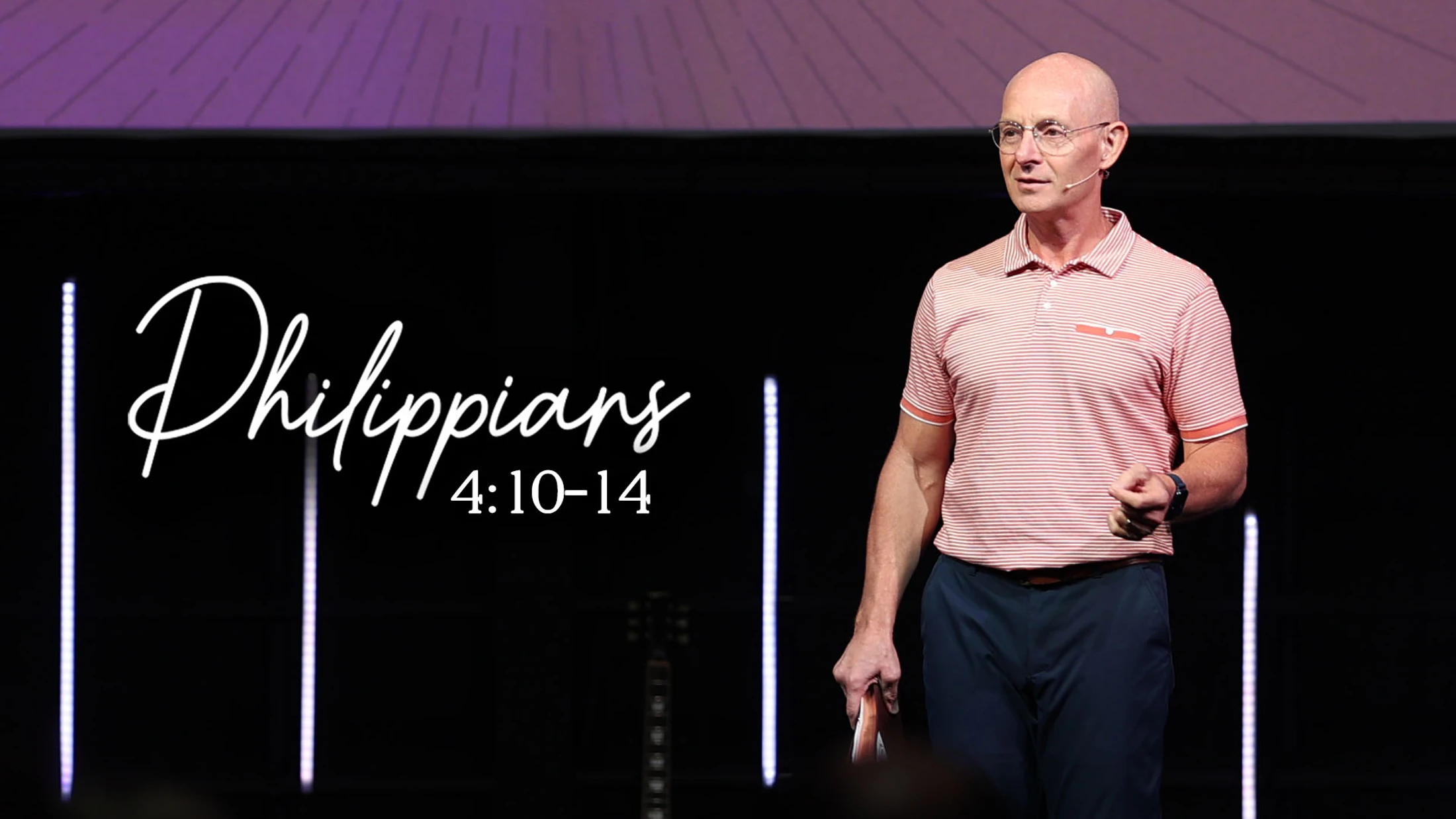
Christ, not circumstances, is the key to contentment. Listen as Pastor Todd digs into what the apostle Paul says about contentment and it's resulting applications from Philippians 4:10–14.
Well, your Bibles are ready, your journals are ready, it's Philippians chapter 4. And today we're going to be tackling a set of verses. Within that set of verses, I believe, is one of the most misunderstood and misused verses in all of the New Testament. You're going to see that today and you'll probably chuckle or grin because this verse has been used in a variety of contexts, I believe, maybe unintentionally, but wrongly.
It's been used wrongly in the NBA. It's been used wrongly in the NFL. It was even used wrongly by a redheaded second baseman on a junior high baseball team in Chattanooga, Tennessee.
This is the verse we quote when we wanted to make sure God was on our side and we got a victory. I think there's more to the verse and the paragraph it's in than perhaps just a momentary victory on a field or in a stadium. Let's find out, shall we? Philippians chapter 4. Instead of going right to verse 13, draw your eyes to verse 10, would you? Let me read for you verses 10 through 14 and let's see what it is that we are to do through Christ.
Follow along with me. Philippians 4 verse 10, I rejoiced in the Lord greatly because once again you renewed your care for me. This is Paul speaking to his most beloved church in Philippi and he's thanking them for their support that has now flourished again.
And the word renewed there means to flourish, to re-sprout. He said, in fact, you were concerned about me but you lacked the opportunity to show it. It appears that at some point the Philippian church, though they were the very first to begin to support Paul, for some reason weren't able to continue.
Maybe it was logistical, maybe financial, we're not sure. But they have now refreshed, renewed that support and Paul is thankful, I don't say this out of need, for I have learned to be content in whatever circumstances I find myself. I know how to make do with little, I know how to make do with a lot.
In any and all circumstances I have learned the secret of being, what's the next word, church? Content. Whether well-fed or hungry, whether in abundance or in need, I am able to do all things through Him who strengthens me. Oh, there's the verse that we love to pluck out and put on our list of achievements and goals and pursuits.
Paul says in verse 14, to close the paragraph, still you did well by partnering with me in my hardship. Let me walk you through these verses just textually for a few minutes, exegete them for you, give you the fullest understanding as I can in the amount of time I have, then make a couple of applications for us this morning. Notice first of all, I'm going to kind of walk you through this in a way that you can do this in your journals.
I see this paragraph really in three or four words. First of all, there is a compliment that he pays them. Highlight that in verse 10, would you? It's echoed in verse 14, so you might want to write the word compliment as the bookends to the passage.
He says in verse 10, I am rejoicing that you've refreshed or renewed your support or your care for me. And in verse 10, he says again, thank you for partnering with me. Remember the word partner is a combination of two words, it's the word fellowship with the word with.
And so Paul is saying, I'm glad that you have rejoined in fellowshipping with me in this way. And so he's just complimenting them on their continued partnership. And notice he receives joy from that, not just mere joy or low level joy.
He says he receives great joy. And you can begin to see the theme of the book again in this paragraph. It's the joy of gospel partnership.
Paul here is experiencing and expressing the joy he has and receives from their partnership. It's a compliment to them. But he noticed, notice this, that he then goes right to a clarifier because he's perhaps concerned that his compliment not come off in the wrong way.
Like man, was I really in need and you came through. He says, I don't say this out of need. The word need, there is another word for poverty.
Some of your translations will use the word want. And I think Paul's concern here is initially that they not think, well, Paul is just desperate. And so he's kind of working the situation.
He's leveraging us to get something out of us. He's saying, no, I'm not saying thank you because I need something. Now, that's what's in the text explicitly.
I would say to you, I think implicitly, as we read the rest of the text, he's saying, I'm not saying thank you out of greed either. I think we're safe to say Paul is saying here, my gratefulness, my compliment to you, I want to clarify something. It's not out of need or greed.
I'm not being desperate because I need something, but I don't want to be deceitful because I'm greedy. I found that that's really what you find in a lot of support letters and a lot of requests sometimes. And this is true of false teachers on the greed side.
They use language that's actually deceitful. They manipulate you. They're not really appreciative.
They're manipulative. Sometimes we find the opposite true when there's a real need. We use language to leverage and there's a lot of thank yous, but they really don't mean it.
They're just trying to get you to give. Paul is saying, I'm not at either ends of that. I'm not needy, so I act desperate and I'm not greedy, so I act deceitful.
I simply am grateful and I'm thankful that you're partnering with me again and none of my gratefulness flows from either extreme here. Now why can he say that? This is when his clarifier and the reason for his gratefulness becomes crystal clear. He says it's because he is content.
You see how the rest of the verse unfolds? For I have learned to be content in whatever circumstances I find myself. Paul here says that across the spectrum of situations, he is content. That's an interesting word.
We probably all have some idea of what it means. The etymology of this word and the strict definition would say this to us. It means to possess within oneself, and don't think new age-ish or humanistic here.
Just think word meaning. It means to have within yourself that which sustains you in spite of what's around you. To be independent of external circumstances.
In other words, not to be disturbed by your lot or your means or lack of it. There's a lot of words there, but do you kind of get the sense of contentment? It's that which gives you stability and consistency internally regardless of what's going on externally. That is what Paul's saying here.
Across the spectrum of situations, look what he says in verse 12. Whether it's me making do with a little, that's one end, or making do with a lot. And Paul here does not condemn those moments when there is a lot.
You don't find in this passage any language that would say, well, if you end up in a season where there's a lot, you should feel guilty. He doesn't say that. He just says that in whatever situation he's in, whether he's got a lot or got a little, he has learned to be content.
He's learned to be undisturbed internally, even when things externally are shifting from a little or a lot, from good or to bad. Look how he says it. He continues, in any and all circumstances.
Do you see that again? There's the spectrum of situations, any and all circumstances. It's almost as if he's saying, they're not a factor in my contentment. So he's not making one out to be better or worse.
He's not making one out to be evil or righteous. He's simply saying, all kinds of things happen to all of us. There are seasons of plenty and want, of abundance and need.
Those are immaterial. They're non-factors in my contentment, which is why he then was saying, I'm not speaking out of need or greed. I'm simply being grateful because I'm learning to be content.
Again, he says, in any and all circumstances, I have learned the secret of being content, whether well-fed or hungry, whether in abundance or need. I just think you ought to notice here that he does, in three different ways, kind of cross the spectrum of situations. I've mentioned that phrase several times.
I think it's important in this paragraph to understand. He uses the phrase little and then a lot. The phrase well-fed or hungry, and then the phrase abundance or need.
Three times, he shows the contrast, the extremes. And he says, regardless of where he finds himself, he is learning the secret of being content. Now, let's pause here for a moment and think about these words, learned, and then the words make do.
This is the real core of this paragraph, this middle verse or two. And Paul here says, I've learned to be content. The word learned there, it means to acquire knowledge about something through use or practice.
So when you hear that, you immediately think, this is not something I get overnight, right? You hear the word process in play, don't you? This is what Paul is aiming at and alluding to, that his contentment was a learned or an acquired—I'll even use this word—an acquired taste through use or practice. And all the church here said what? Amen. How many of you would agree? It's difficult to learn to be content.
You should say, amen. My hands up. My voice is heard.
It's not something we get quickly. It's not something we learn overnight. It is a process.
We'll take heart. It was a process for the apostle Paul. You're in good company.
He's learned it. And then he uses this phrase that what he's learned is how to make do. Now, that's a very interesting word.
I think only the CSB uses it. It's used twice here. He makes do with a little.
He makes do with a lot. I want to be very textually honest with you and tell you that that translation, the words make do are not actually in the original text, but neither are the other words supplied by the NIV or the ESV. Every translator has to supply some words here, because in the original text, the only words are these.
I know. I know how. And then it's the word either for little or a lot or for well fed or hungry or for abundance.
In other words, all we know is that Paul is saying, I know by practice and use how to be a based as King James says or to be in plenty. So what do you do with that? When you just have these few words, you have to supply the verb. Some translations use the word live.
I know how to live with a little. I know how to live with a lot. Some use the words.
I know how to be. King James says a based. I like this translation because it gives you the sense that something is having to adjust.
Someone is being adaptable. They're having to. I'll say the words with you make do.
Let me tell you why I like that phrase also, because that's the language we use. I mean, that's not like first century language. You can't get your hands around.
I've said that like, oh, just, just make do. In fact, I'd be frank with you. I think we're making do in some space issues right now until Easter.
It's not ideal to have eight of our small groups upstairs for a bit. But last week we humbly got under our situation and we said, what? Well, we can say with me, we can make do. That's how we learn something by use or practice.
We adapt. We adjust the things that aren't ideal. And Paul here says, ironically, and quite intriguingly, that he does this even when he's in times of plenty, which makes me think perhaps when Paul had seasons, when there was a lot, he was more generous so that he didn't get used to that.
And when things were lean, he tightened up the belt. In other words, there was action in every end of the spectrum for Paul, so he could learn what's this emotional consistency, inner stability, the ability to maintain a specific kind of path, regardless of what happened on the outside. It was a learned skill and it came through learning to adapt and adjust to things as they entered your life.
As I read these words this week, it made me think of Julie, my wife. She uses these words and has used them with our kids a lot. But she also has some other words she adds to it.
Now, Paul didn't use these words. My wife, though, she would say, oh, you can make do. And then she'd say, you'll be fine.
Those words just help you learn to be content. And sometimes at home, our kids would express, I don't want to say complain. They would express concern over a situation, whether it could be regarding food or temperature or schedules or discipline.
And at some point, Julie would almost always say, you'll be fine. In fact, she said that to me last week on something. I was complaining about something and she just stopped at the counter and looked at me and said, you'll be fine.
Now, I'll admit to you, the pitch of that changes at times. Sometimes it's like this. You'll be fine.
Sometimes it's like this. You'll be fine. You can kind of get the sense of like the intensity of that moment when she's saying, adjust, adapt.
You're not going to die. It'll be fine. Get some inner stability, learn some consistency, even if things are changing all around you.
Don't let your circumstances control you so much. That's all in that phrase. I think that's what Paul's aiming at when he says, I've learned to make do.
I've learned to live. I've learned to be consistent and stable, adaptable, even when things around me are changing. This is really what contentment is.
It's learning to maintain a consistent internal temperature and posture that isn't contingent upon all the external circumstances around us. Is that hard? By all means. But is it possible? Yes, it's a learned skill.
The question is, how does one learn that? How is that possible? How do we really get our hands around contentment? Well, therein lies the wonderful verse that's often misunderstood and misapplied. Paul says, Christ is the secret to learning how to live in a contented fashion. Verse 13 just jumps off the page at us, doesn't it? It's this peak of the text in which he says, I'm able to do all things.
And you just circle all things in your Bible and just draw a line to what he said between verses 11 and 12. That's the all things. He's saying, I've learned that all things across the spectrum of situations, I can be content in every one of those through him who strengthens me.
Admittedly, some translations say Christ here because some of the manuscripts say Christ. We know that him refers to Christ and it's Christ who is strengthening his family to be content in every situation. Personally, I love the way the NIV translates the word all things.
It's one word in the Greek. It's two here. I think the NIV says this, I am able to do all this.
If you have an NIV, you're nodding right now. I love that use of that word because it more directly points to the context of the paragraph and we get Paul's heartbeat. All that I talked about, the times of need and the times of plenty of abundance and want, this whole spectrum of situations, the range of human experience, guess what? All of this.
Yeah, the secret to being content is the strength of Christ. I love the way Paul takes so many things and narrows it down to one person, Christ. It is the core of our contentment.
And I'll just repeat this to make sure we don't miss it. That is an internal relationship. And so that's what keeps us internally stable, independent of external circumstances, undisturbed, able to remain emotionally consistent when everything around us is screaming at us to go high or go low.
It's Christ. He is the key to our contentment. You see, satisfaction is rooted in a Savior.
His name is Jesus Christ. It's not found in our situations. So if you want to make do, know Christ.
Now, as we come to the surface of this incredible set of five verses and take a breath, let's do that by looking at really a simple take-home truth that I think will summarize this. No rocket science here. You're already ahead of me.
You know exactly what we're going to say. Could you read this with me together? Here's a summary of these five verses together. Christ, not circumstances, is the key to contentment.
This is really what Paul is aiming at. And this is what he's saying, not only in all five verses, but especially verse 13. He's saying, Christ is the secret.
He's the key to doing all things, which all things is learning to live contentedly, no matter your situation. Paul is so courageously bold with his words, inspired by the Holy Spirit, that he, in one sense, makes the situations a non-factor. It doesn't matter if you're at either end of the spectrum or somewhere in between.
They don't affect you. You've learned to be content. And how have you learned that? Because you know the secret, which is Christ.
Now, let me flash a warning light across the dashboard of your life. Even as you ponder this very simple statement concerning these five verses, contentment is not complacency. Contentment is not laziness.
It's not a laissez-faire attitude spiritually. In fact, I would say to you, adaptability, reading the circumstances, knowing where you are, and making adjustments is a very active process. Wouldn't you agree? Learning to tighten your belt financially or getting a second job.
Finding part-time work. Being industrious. Or, in times of plenty, learning to give more away and to be more generous so that you don't get accustomed to certain lifestyles in what may only be a season.
Are you tracking with me? This is not complacency. Adaptability, developing inner stability through Christ, having a consistent emotional temperature and posture, is a very active process. And so don't hear me say, oh, man, I can just sit back, and it doesn't matter, just whatever happens, happens.
I'm not going to worry about a thing. Admittedly, you shouldn't worry. But this is not speaking about a lazy posture or a complacent spirit.
I think Paul here is actually calling for a very active disposition to intentionally resist the pull of circumstances, which makes us have a roller coaster experience, and instead to depend internally on our Savior, Christ, to maintain a constant sense of contentment. So what I'm pointing you towards is not a passive life. It's a very active one in which you pursue contentment intentionally by developing a deep relationship with Christ and prioritizing that and focusing on that, which really leads me to just my first of what I would call a resulting application.
There's two of these, and I'll land the plane when these are done. Here's the first one. Just jot this down, would you? A resulting application.
Since contentment is a relational focus, not a circumstantial one, commit to loving and knowing Christ, not stuff. You laugh at that because it's plain language, but can I just admit to you, all of us at times struggle with loving stuff. We get attached to material possessions.
I don't know why. Perhaps it's because they don't fight back to us. They don't, you know, they're easier to relate to, perhaps.
But I think you would admit with me that there are times an item becomes an idol, and possessions become things we begin to worship. We love them too much. So I just want to admonish you in this moment.
Since we know the key to contentment is Christ, not our circumstances, don't let external things put a leash on you and own you. Use things, love God. Don't love things and use God.
Let me ask you this question as you think about what you love. Is it a who or a what? The answer to the question what you love or who you love should be a who, and it should be Jesus Christ. And when He's the one you love, He's the one you desire to know, guess what? Your contentment will rise.
It may not be easy learning and making news, an active, difficult process, but you'll be able to do it because Christ is your strength. He will empower you to do the difficult things involved in learning to be content. So I just want to, again this week, make sure that you understand every single ear and eye and face in this room who are listening and watching other places, hear this, if you don't know Christ, that's the first item to settle in your pursuit of contentment.
Contentment is a relational issue first. It is not a circumstantial one. And if you're looking for, you know, happiness and peace and joy in places outside of you that are physical, tangible, you know, like geographical, financial, you'll search forever.
The real key to contentment is relational, and it's a vertical relationship with God through Jesus. We know about that. We learn that through the gospel.
It's what we sang about earlier. It's what we preach about. It's what we read about.
It's what we rehearse regularly. And if anyone here has yet to believe in Christ as the only way to be right with God, just know this, that Jesus Christ is a real historical person. He was the God-man.
He came and He lived and He died and He was raised by God the Father. And His life, death, and resurrection are proof positive that God forgives the sin of all who believe in Jesus. He's our atoning sacrifice.
He's our substitution. He took your place. That's why the Bible says all who believe in Jesus, they're saved.
They're saved from the condemnation of not believing. That's the contentment and peace we have from God, that our sins are forgiven, that we're eternally secure, a place in heaven's reserve for us, a relationship with God has begun. That's the real key and source to contentment.
And so if you're trying to find it outside of that, it's a never-ending search. But if you'll start with Christ, you'll find all the strength and power you need to live contented internally, even though things around you are raging externally. Oh, I urge you, know Christ.
Love Him. The second resulting application would be this, that since contentment is a dynamic process, not a static product, go to contentment school, all right? Notice some words I use there. The dynamic process refers to the word learn, right? Paul tells us it's something that he acquired knowledge about through use and practice.
He is making do. It's an adaptable posture that he acquired over and over. It's not something he went to like the Jerusalem Target or Walmart or the Antioch T.J. Maxx and picked up, hey, I think I'll take one box of contentment.
He goes home and he opens it like, you know, okay, I'm content. It's not a static product you buy. It's not an overnight fix.
It is a learned process. And what is that process? If you think about the metaphor of school, all the classes are the difficult and delightful experiences and opportunities right in front of you. Notice I used the both, because I think in the text, Paul used the both.
He says, I learned contentment in both times of abundance and times of leanness. So I'm saying to you, the opportunities in front of you that are both difficult or delightful, those are your classes in the school of contentment. Enroll.
And when things are in a beautiful season of favor, don't take credit. By God's grace, just be extra generous. Things are difficult and lean.
I don't just mean financially, but there could be other seasons of leanness in our life. Look at those situations and think, what can I do and how can I trust in ways that continues to maintain a stability in my inner person? So regardless of the situation across the spectrum, whatever opportunity, situation, or air quotes here, class is in front of you, enroll. Use it to learn to make do.
And what you'll find is that you'll grow in your contentment. All of those will push you to Christ. They should push you to Christ, because he's the source of your strength to be content in every situation, no matter where it falls on the spectrum.
You may hear that and think, Todd, I can't do that. Oh, yeah, that is why Philippians 4.13 is so good. Because I would say to you, actually, you can do all this through Christ who strengthens you.
Yeah, put it under your eyes in black paint. Go for it. Put it on your shoes.
Why not? But it's not about your achievement. It's about your contentment. So when you see your situations and think, no way have I got a verse for you.
You can do all this through Christ who gives you strength.