
Why? The Answer (Pt. 1) | Job 38–42:6
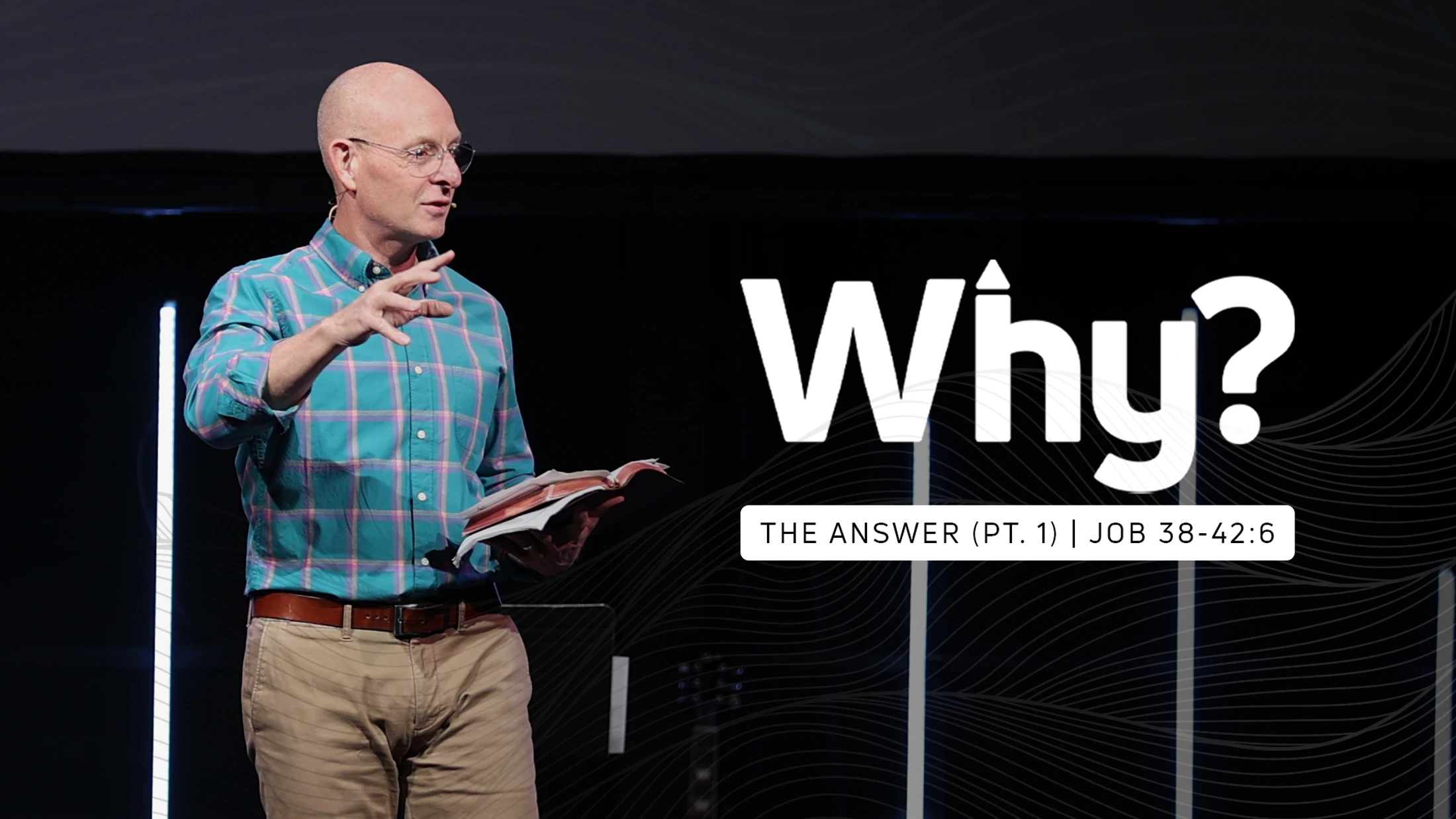
The sovereignly personal approach is fully adequate to answer ‘why’ because it boldly proclaims that God acts with universal authority and individual attention, not for a better arrangement of my circumstances, but for a deeper understanding of his character. Join Pastor Todd as he expounds on God's answer to Job in this sermon from Job 38–42:6.
Find the Old Testament book of Job. This is our fourth week in this series called Why and locate chapter 38. While you're locating Job 38, a simple question to help set the framework for our time in God's Word this morning.
Who here has played the game 20 questions? Just slip your hand up. I think most of us have played that game. In all honesty, I've not played the game that was in a box.
I didn't know 20 questions came in a box. I thought it was a made-up game you played on a trip around the table to kind of pass the time or to solve some kid who said I'm bored. You know, it's this game where it's a mystery game and it includes some deductive reasoning and so you get up to 20 questions to hopefully arrive at the right answer.
That's the gist of the game. Well, I want you to think about that game because what happens between Job 38 and Job 42 is a highly escalated version of that between God and Job. In fact, it's 77 questions and in four and a half chapters, God does speak to Job.
He does so, and what I say starts off in somewhat of a way of interrogation. I mean, He really, in a loving way, and yet He lets Job know, I'm speaking now. He comes to him in a storm.
But it moves from interrogation to revelation and God reveals more of Himself to Job. This is what we'll see over these four and a half chapters in which God, through 77 questions, answers Job's questions from chapter 3. So that's what's happening in our text today. This section of Scripture, 38 to 42, it follows, of course, two other sections in which Job heard from his friend.
So let's just do a quick review. His first three friends, they spoke to him and they gave their approach. They gave their insight.
It's what we call the humanly judicial approach, but it fell short. It had a timing problem. That's how it was distorted, so it never really answered the why question.
Eli, who shows up next on the scene, he gives a mentally theological approach, and it was incomplete because it only worked with the neck up. Now God is on the scene and He's going to speak to Job and He's going to give us what I call the sovereignly personal approach. It is the right approach and it's the approach in which we get an answer to the why question.
Now, I want to say this to you, next week, Lord willing, I will give you a very specific answer to why Job went through what he went through. I think personally the Bible tells us. Maybe not explicitly in Job, but I think implicitly in the book and explicitly in other parts of Scripture, we actually can say regarding Job's situation, here's why he went through it.
It dovetails into this larger thing we'll look at today called the sovereignly personal approach. It fits into that nicely. So you're going to find a lot of continuity in these two weeks that I'm praying will help you answer this question that all of humanity at some point asked, why.
Let's begin to answer today. Here's how we define the sovereignly personal approach, which I think you'll see emerge and surface. It'll bubble up all in these chapters.
Here's how we define it. Here's how we describe it. It's a little lengthy, a little more wordy than the previous two, which were either, you know, inadequate, incomplete, fell short.
This holds the line well, but every aspect of this description, this definition, doesn't matter. So follow with me, take a picture of it, jot it down in your journal. You'll need this this week and next.
The sovereignly personal approach is fully adequate to answer why, because it proclaims boldly that God acts with universal authority and individual attention, not for a better arrangement of my circumstances, but for a deeper understanding of his character. I'll contend for this truth today, and I'll, Lord willing, show you this from the text. I won't give you my opinions, that's not my role here, but I think this surfaces clearly from God's speech and answers to Job between 38 to 42.
So, what do you say we tackle those chapters for a bit? As we have the previous weeks, we will kind of go peak to peak. We won't read every chapter all the way through. I'll give you an overview, we'll read some verses that will give us insight into the themes of those chapters, but I have no doubt when we're done, you'll understand really the bulk and the gist of what God is saying to Job.
It'll be textually accurate and hopefully practically helpful. So let's begin, shall we? God begins in chapter 38, goes into 39, these first two chapters, what they really tell us is this, that God is giving Job what we call a telescopic view of his universal authority. So make a note of this, you'll see this play out in this chapter in a beautiful fashion.
You could use the word panoramic, you could use the word general. In other words, imagine this, that God takes Job and puts his eye into a telescope and he says, Job, let me show you everything that I oversee. I'll show you what I've created, what I care for, what I control.
I'll just give you a panoramic view of all that I've done. You up for that, Job? This is kind of what he says to him in chapter 38 when he says, get ready to answer me. And he begins in verse 4 of 38 by saying this, Job, where were you when I established the earth? You ought to circle the word earth.
And from that word earth, he does lay out for us a number of things that are either related to the earth or surround the earth or connected to the atmosphere or the universe. Again, he kind of goes through a panoramic view of all that he's created and controls, all these things that consist because he is God. In fact, follow with me.
I'm going to jump through these two chapters and just have you circle the number of items that he mentions to Job, usually in the form of a question, establishing his authority over every one of these things. Follow with me. Verse 8, he mentions the sea.
Verse 12, he mentions the morning or the dawn. Verse 19, he mentions light. Verse 22, he mentions snow.
Beginning in 24, going through about 26, he talks about a storm. He mentions lightning and rain, even wind. Verse 28, he talks about rain again.
Verse 30, water. Verse 32, he moves outside, I should say even a further distance, and talks about constellations, the whole idea of seasons. And then in verse 32, the bear and her cubs.
He goes back to the clouds in verse 34, you keeping up okay? So he's just mentioning all of these elements and animals of the earth and the atmosphere in the universe. Verse 39 of chapter 38, he mentions lions. Verse 41, ravens and their food.
He gets into chapter 39, he mentions mountain goats and deer in verse 1. It becomes pretty animal-focused now as this chapter closes. Wild donkey in verse 5, you keeping up? Verse 10, the wild ox. In verse 13, the wings of the ostrich.
You go down to verse 19, a horse is mentioned, which by the way, is probably the only domesticated animal mentioned in this chapter. Verse 26, the hawk. Verse 27, the eagle.
So do you see the panoramic view happening? I mean, in your mind, just picture Job's eyeball in this telescope, and God just zooming out and showing him all that he's created, and all that he controls, and all that he cares for, and all this, of course, is happening while he's being deluged with 77 questions. Did you make that? You control that? Did you devise that? Did you set that? I mean, this is a moment. I think what he's done by mentioning all the cosmic phenomenon, the meteorological items, the over 20 animals, it's just a sample list, it's not in any certain order, but I think its intention is to show us the vastness of God's authority and dominion.
That truly, God is sovereign over the entire earth, shall we say the entire universe. Everything is made by him. Without him, nothing was made that was made, John says, and so he is creator and controller of it all.
God is sovereign. This is the phrase you should kind of put inside your head, tuck into your heart. In these two chapters, God shows Job clearly, I'm in control.
I didn't need your permission. I don't need anyone else's. I created.
I control. I'm God. This is my domain.
So it's a staggering, stunning set of chapters. At the end of this, he actually summons Job to respond, which is a little scary, to be frank with you. Because of that, he does give just a few words.
Look at chapter 40, verses 4 and 5. In fact, would you do this with me? Circle every time you see the word I in these two verses. Here's Job's first response to God's first speech. I am so insignificant.
How can I answer you? I place my hand over my mouth. I have spoken once, and I will not reply twice, but now I can add nothing. If you were to ask me what was Job's first response to God's incredible, vast domain, this panoramic view he got of everything God created and controls, it'd be this.
Man, I'm nothing. I'm insignificant. He had a humble kind of silence.
He kept saying, I'm not going to say anything else. I'll just be quiet. I mean, he, if I can use these phrases, these words, he knew his place.
It was under God. After his first response, God speaks again, beginning in chapter 40, about verse 6. I love the bridge between 40 and, well, the next part of his second speech, there's this bridge in which he really questions Job some more. I want you to see this before we dive into the second part.
He says again, get ready to answer me. When I question, you'll inform me. This was repeated in the first part.
And then he says, Job, do you have an arm like God's? Can you thunder with a voice like His? So he's asking Job, like, Job, okay, I've shown you all that I control, all that I've created. I've shown you my domain, and you're humbled. You're rightly in your place.
You're submissive and correctly insignificant. But just to make sure that we're on the same page, Job, like, if you can do this, if you can create and control like that, like I do, then he says in verse 10, adorn yourself with majesty, splendor, clothe yourself with honor and glory, pour out your raging anger, look on every proud person, humiliate them, look on every proud person and humble them, trample the wicked where they stand, hide them together in the dust, imprison them in the grave. In other words, Job, you go ahead and do what I do, and then I'll confess to you that your own right hand can deliver you.
In other words, Job, if you can do what you've seen and what needs to be done to control and to create, then go ahead, because you don't need me. And Job's answer is, of course, I can't do that. I just told you I'm nothing.
I'm gonna keep my little, you know, words in here. I'm gonna stay silent. So God is really rightly showing Job and saying to Job, Job, I'm God.
This is my domain. I'm in control. I have created it.
You're part of that, but you didn't cause it. You're not in control of it. So he's setting the positions, and he moves from there into a very interesting section in which he now gives a microscopic view of what he's created, and I think he's doing this to show his individual attention and care.
So three words I want you to keep in mind today for sure is, in these four and a half chapters, God shows he's creator, controller, and caretaker. See, often we start with creator and controller, and that fits the idea of authority, but because of God's authority, he also cares for what he has created. It's the way we keep transcendence and eminence connected, because God is high and lifted up, exalted and lofty, and has created everything.
Because he's this, he also cares for his creation, so he's close, close and near to it. This is really what's happening in these four chapters. And so what God does now, between verse 15 of chapter 40 and the end of 41, is use two animals to show just how intricately and intimately and personally God cares for his creation.
And this is a very interesting section of Scripture. People debate, are these real animals? The two things, the two animals he uses are the behemoth and the Leviathan. Some have said the Leviathan is what we call dinosaurs, perhaps.
Some have said the behemoth is what we call a hippopotamus. Maybe it was a dinosaur as well then. We don't know precisely, okay? Some have said that the behemoth may have been hippopotamus, that the Leviathan was maybe a crocodile or a whale.
I've heard those. There's a lot of theories out there. Some think they're literal.
Some think they're actually symbolic or just metaphors for other things that the author's trying to communicate God. Let me give you a couple of examples. Some say, well, maybe what he's using, he's using the behemoth and Leviathan to show really what he's like.
He's using these symbolic animals to show that God's saying, I'm uncontainable. I'm untameable. Because you read their descriptions, you know, they're the fiercest of all.
They can't be controlled. No man can put a hook in their nose. He's kind of, this kind of language that shows something's outside of our realm.
It's not like us. So maybe he's using this to picture who he is. Some have suggested maybe they're picturing who Satan is.
Like Job, you can't mess with Satan. Like, you can't handle and control evil. Maybe that's what's happening here.
Because what's happened to Job, he's been wondering for 40 something chapters, how can I solve this? It's out of my hands. I can do nothing about it. He's maintaining integrity and blamelessness, and yet he can't solve it.
So maybe it's picturing evil, or maybe it's picturing God's incredible and specific care for his creation. If you read the chapters, you'll see that he talks about how he created their outer shell, their limbs. And he goes into really intriguing detail about how he made these two beasts.
Or maybe, here's a fourth option, it serves as a metaphor for Job's situation. Like Job, you're in a situation that you cannot control. It's not necessarily evil in and of itself.
This would just be representative of like suffering that you can't explain and can't figure out. I personally land on number three. If you were to corner me and say, what do these represent? I probably think they're real, actual animals in that time frame.
I don't know if they were dinosaurs, were they sea dragons? I don't know. I do think they're real, but I still think they represent something. They're used by God metaphorically.
And I think they're used by God in these two chapters to show that even in his vast domain, with the fiercest of creatures he's made, he has intimate, personal care of them. I think that's what the chapter shows. Now, I do like the fourth one, that perhaps they embody the idea that something's outside of our control.
We can't get our hands around it. But perhaps it's a hybrid. Like here's God intimately, personally caring for his creation, and knowing that he controls it too.
So these are the two things he zeroes in on. In this microscopic moment, he's talking to Job just using two animals. Let's look at them briefly, can we? Look at verse 15, chapter 40.
He says to Job, look at behemoth. And then this very intriguing phrase in 15, which I made along with you. So this is why I tend to land on that third option mostly.
I think he's saying, Job, I made this animal that's fierce and large and uncontrollable, but I made you too. So Job, I made all of my creation, I'm in charge of it, I'm authoritatively over it, but I care for it. And guess what? You're part of that, Job.
And he's making authority—watch this now—he's making authority not just compelling, but attractive. Would you admit with me that often we don't find authority attractive? We find it compelling. Who'd say amen to that? Like, if you don't, I will.
That's pretty compelling, right? But often we don't find authority attractive. I love the way the Lord says, Job, I've made everything, even these things you can't even contain, and I made you. It's like God is now very imminent with Job, up close and personal.
Look what he says about behemoth in verse 19. He is the foremost of God's works. Only his maker can draw the sword against him.
So who's above behemoth? God. So when Job hears this, he's like, okay, well if you made that crazy animal, wild and ferocious as it may be, and you've made me, I guess if you can control that, and you can care for that, and you've created it intentionally and specifically, and just for its purposes, then you've done that for me as well. Created me intentionally, specifically, on purpose for your design.
Like, you create control and you care for your creation. Like, it's very personal. He then moves to the Leviathan in chapter 41.
Just notice a couple verses 10 and 11. No one is ferocious enough to rouse Leviathan. Who then can stand against me? Who confronted me that I should repay him? And then this simple phrase that I think is very intriguing.
Everything under heaven belongs to me. So if the Leviathan is in a category all by itself, it's still not outside of the category of God's control, of God's care. And I want you to, in your small group, maybe you're on your dinner table, maybe on a date with your spouse, or even just in the car driving, I'd encourage you to read every single one of these chapters.
And I would read them in these sections. I'd read chapters 38 and 39, and think and talk about God's universal authority, His sovereignty. Then read 40 and 41, and think and talk about God's personal care, His nearness, His intimacy, His specific intentionality.
Because you're going to see that God goes into very good detail about how He made these animals, and why He made them the way that He did. So this is really what He does in this second section of His speech. He says to Job, I'm the creator and the controller, not you.
So God is just bellowing out here in a very loving way. I'm in charge of the fiercest and largest beast on the planet. And I can take care of you as well, Job.
Job replies to this in the beginning of 42. This is the longest amount of conversation Job has with God. He talks to God in those first few chapters, but God is silent.
Here in this conversation is the most Job says to God. And in this section, I want you to circle not the word I, but I want you to circle the pronoun you. Circle it when it refers to God.
And what you're going to find is that in Job's first response, he said the word I six times, indicating to us, man, I've got a much better understanding of who I am. I'm insignificant. I'm under God.
In this response, he has a much clearer, deeper understanding of who God is. That's why he uses this second person pronoun. Verse two says, I know you can do anything and no plan of yours can be thwarted.
There's not a whole lot of eyes in this section. Go down to verse five. I had heard reports about you, but now my eyes have seen you.
And so what does he do? He rejects his words. He repents of them. And then this sign of dust and ashes is much similar to where he was at the beginning.
Remember that? And so I think he's symbolically saying, though I didn't sin in a way that would cause you to take punitive action against me, I realized that even in my conversation with you now, I'm in waters, I'm in territory, I'm navigating things that are so deep and difficult that I just need to be quiet and not pretend like I know everything. Job realizes and he sees God clearly, more deeply. So understand what's happened here.
Do not let this fly by. Before we ever read about Job's restoration in the latter part of 42, before Job has ever gotten a hint that there'll be more children, more possessions, before Job ever knows the end is close, he knows God more deeply. Before his circumstances have ever been addressed, his character is being formed.
Through his suffering, God is accomplishing his major objective, watch this, which is internal spiritual formation, not external physical fixes. God's aim is Job's character, not his circumstances. God's aim, watch this, this is hard to swallow, God's aim is God's purposes, not Job's predicament.
In fact, I would submit to you and contend with you perhaps, that it was actually through the predicament that God actually accomplished his purposes, which was based on the sovereignly personal viewpoint that Job would know God better. So I think you can see, bubbling up in these verses, just this sampling, kind of peak to peak hike we took, what's surfacing is this sovereignly personal approach that does answer the why question. In its simplest form, it's so that you will know God better.
For Job, it was verse five, so that he would no longer just hear about God, but his spiritual eyes have seen the Lord. Now again, next week, I hope to lay out for you even more specifically why I think Job went through what he went through. But just know this, it would be kind of, it would fold into and be under this approach to the why question in general, that at a root level, here's what God is always after.
Church, hear this, this is what God is always after. It may be more than this, but it's never less than this. And we understand it through the sovereignly personal approach that what God is after, why this approach is fully adequate to answer why, and I'll have you read the rest with me.
Can we do that to make sure it cements in our heart, kind of lodges in our brain. Here's the rest of the sovereignly personal approach. We'll show it on the screen.
You pick it up with me and read with me. When we get there, there it is great. It's adequate to answer why, say it with me, because it boldly proclaims that God acts with universal authority and individual attention, not for a better arrangement of my circumstances, but for a deeper understanding of his character.
We're not saying that things, for some people at different times, they may get better. For Job in his situation, according to 42, they did. For some in Hebrews 11, it didn't.
But here's what we can say about all those people. They knew God more deeply. They knew God more fully.
Their relationship with God grew. That's what God at a root level is always up to in suffering. Now, I've made a strong contention for this.
I know it can hit us odd. I think it would be best at this point, with this truth in front of us, and we're kind of grappling with it and chewing on it, to make an application. To see, you know, how do I put this on? Like, what's the shoe leather piece of clothing that I can wrap this in and wear? Well, it gets even more intense.
So buckle your seatbelts. Based on Job's response, here's what I think our response should be, and it's just straight from the text. We're not making it up, but we'll put it in these words.
Accept God's divine right to act as he pleases. In other words, get in the dust and ashes with Job. Stop using so many words to approve of God or analyze God.
Instead, just posture yourself to accept his universal and divine right to be God. Submit to and trust in his authority. Replace your worry with faith.
Now, that's easy to write, but it's hard to live. Could somebody say amen and oh my? Yeah. So I'm with you in this boat that this is difficult living, but this is doctrinally, biblically sound preaching.
It's anti-cultural preaching. It's even anti-church culture preaching at times, because we have often as Americans kind of, I think unknowingly, kind of gotten to a position where, yes, God is in charge, and I want him to know that I approve of how well he's doing. Like, we can almost Facebook God, like, hey, thumbs up today, God.
You did a good job. We either think we can approve what God is doing, or we analyze God's actions as if, you know, we can have some kind of like editorial. Well, here's where I think God could have done a little better, like at some news show where you have all these commentators, and they're giving their opinions.
So God's not really interested at all in whether we approve or analyze. You know that, right? I know this sounds harsh. It sounds harsh to me.
I know it sounds almost crude, but we've Americanized the sovereign ruler of the universe. We've minimalized the authority of the creator of all things. We've trivialized how intimately and deeply God cares for his creation, and it's resulted in people who think that before I accept God's authority, I need to analyze it and then approve it.
And then, if all's well with me, God, I'm under authority. That's just backwards. And you don't need a preacher coddling you in that false mindset.
Job understands what God is saying, and we should as well, that God created everything. And by virtue of his creation of all things, he is the owner of it and in control of it, and can sovereignly, divinely act when he pleases to. But because of his sovereign, divine role as creator and controller, he acts in ways that are always caring.
He loves his creation. And so everything sovereign God does will always be for his glory and for my good in the end, always. It's an impossibility for God to create, control, and care in any other way.
In fact, this longer phrase, this sovereignly personal approach, it's really just a long way of saying this. We said it in our prayers. We say it in small groups.
You've heard it when we preach that we often pray, you know, God, may this happen for your glory and our good. No, this church, that's what we're after. That in our suffering, in any circumstance, that's what we're praying for.
And that's actually what will happen. God will always act for his purposes. That's his glory.
Romans 8. And our good. James 1, as well as Romans 8. Those two things never conflict. Often they conflict in our heads.
They conflict on the horizontal lifeline that we live. Like it looks like this is difficult. This is hard.
This hurts. But because God is eternally good and loving and just and powerful and transcendent and imminent and faithful and just, though I don't understand it, I can be assured of this. He's making sure that I know him more deeply and more fully, that I know him better through everything.
That's for his glory and my good. That's always happening. Now, let me see if I can go about eight feet deeper with you for a few moments, maybe like two or three minutes.
I think there's an aspect here that you need to grasp, and then we'll try to land the plane. It's hard to think about both of these existing all the time, that God can act in ways. He doesn't need permission, approval, or analysis.
He's God. He's authoritatively, sovereignly in control. And yet he acts.
When he acts, it's always good and just and faithful and right and true and loving on an intimate, personal level. How do those exist? Here's a good word for you. It's a doctrine.
It's called the simplicity of God. It's probably been one of the most helpful doctrines over the last six to seven years of my life, because we often want to compartmentalize God. We want to kind of slice him up and say, God is just.
God is faithful. God is loving. And we see his actions only in that slice of the pie.
And sometimes I've even heard this when we interpret Scripture, like, well, that's just because God's a just God. That's why that looks so tough over there, as if he left the loving category to go be just. Or we say, well, that's how loving God is, as if God would leave the just category or the faithful category to go be loving.
But that is not how God exists. Okay. The simplicity of God teaches that God is one being.
And this is so beautifully comforting. And this is really what makes authority so attractive. God is always all of those things all the time.
So when he's loving, watch this, he's faithfully and justly loving. Like he's never like, I'm really being loving here, but I'm probably being a little unjust and I'm probably playing favorites. That never happens with God.
He's always justly, faithfully, truthfully loving, or he's always lovingly, faithfully just. So when it says that God hates those who do evil, how does that work? I don't know exactly, except to say this, that in that kind of divine hatred, it is perfectly just and loving and faithful and true because God is one being. The simplicity means he's always all of those things at one time.
You can never doubt that what God does is right. It's a beautifully comforting doctrine. So when difficult suffering enters your life and you wonder why, here's the beginning of the answer.
We'll say more next week specifically, but generally this is always true. God must be doing something because he's solely, authoritatively, divinely in charge of all of his creation. He doesn't need permission or approval or analysis.
He can do it. He's God. At the same time, it must be good and loving, and the end result must be that I'll know him better and more fully because that's what God is after, deeper relationship.
He's not trying to fix a predicament or adjust the circumstance. He wants to form spiritual character. That's always what God is up to.
So trust that authority in your life. It's a lot of words. I realize that, boiling it down, have faith that God, as the sole, sovereign, divine creator, controller, and caretaker, can do nothing but what is best for you, even if it looks impossible, difficult, and hard.
That in the end, you will know God more deeply. Let me see if I can show you this in a diagram as well. I'm big on trying to find ways to summarize things or simplify it.
I know it's a lot of words today. It's a lot of truth to try to get your hands around. But here's the diagram of the book of Job as we presented to you four weeks ago.
There's earthly anguish. Job is trying to figure out what's up with this. No pun intended there.
And as he kind of works through all of these different approaches of his friends, God finally speaks at the top and gives the heavenly answer, which is that, Job, I want you to know me more fully and more deeply. So this is what your suffering is doing. That's what we see in the book.
Let me show you three words from today that I think overlay this perfectly and make it very practical. It will be hard, but it'll be practical. This is what all of us deal with probably every day or every week.
We could say in every issue. This is what you deal with. This is what I deal with.
Every single issue comes down to God's authority being seen in God's action on the earthly level. Like because God is God, he does what he pleases. And we can trust and have faith that's always right and always good, even though it's difficult or hard to understand.
So God's authority is seen by his action on the earthly level. My response to that should not be approval, analysis, permission. My response to that should be acceptance of his authority as displayed in actions that maybe I don't quite understand fully.
But I'm confident because God is who he is. It must be for his glory and my good. That's how it's going to be in the end.
So I accept that authority. And the sooner I make progress on that kind of posture of accepting God's authority. And this is a little kind of weird to say, but the better your climb up the left side of the pyramid, you won't get stuck with a humanly judicial approach.
You won't get stuck in the mentally theological approach. You'll find yourself making progress towards seeing things from a sovereignly personal approach that, you know, God, he can do what he wants. He's God.
I accept that. But I have the joy of knowing that because his authority is inherently simple, in other words, all those attributes at one time together, God will do his actions will result in his glory and my good because he's a loving father. That's I'll get to know him better.
At the end of this, I'll know God better. That begins with accepting his authority to do what he's done, whether he caused it, ordained it, permitted it, allowed it. You can choose your words there.
I'm not going to argue with you about that. But when the suffering occurs and you don't know why, start here. God doesn't need permission.
He's God. And he will only do what's best for his glory and my good. So I accept it.
God, show me, bring me closer. Teach me. I want a deeper relationship.
I want a fuller relationship in this. And God will do that. That's the posture you have to start with.
Every single issue begins with will you accept God's authority in your life? Now, let me just open a window and have you see the other side of this. That if you say no to God's authority, if you resist and rebel, what does that look like? When that occurs, we actually begin to misunderstand God. We don't know him better.
We don't know him more fully. We actually begin to misunderstand him. We form false narratives about his conduct, the way he's acted.
We create incorrect views about his character. And this often morphs into a theology that is at best detouring for many Christians and churches and often is just plain damning. We create God in a way that fits what we want to be true in the here and now.
It makes us comfortable. The problem is the here and now will end and you'll have to stand before God. I just don't want to be a pastor and a preacher to you that tells you what you want to hear in the moment because it makes you feel better.
The real issue is, will you accept God's, what I consider to be very attractive and compelling authority over every issue in your life? For one reason, he's God. He has created and controls everything. And by virtue of that, he cares for everything.
So God is universally authoritative, but intimately personal. You can trust a God like that. So will you accept his authority or will you rebel and end up with a theology that's throwing you way off the bus? In fact, let me just say this to you.
I've known a number of people who have strayed from the Lord as a result of being in a situation, a trial, suffering that they could not explain and did not want to accept as God's tool to help them know him better. They would not accept that. Here's what's happened.
They flip it and they think, well, I need to approve it or analyze it. God has to have my permission for this to be true. And so they do begin to misinterpret him.
They blame him for decades. They become very bitter and barren. You see, that's a sinister seed that the accuser, which we saw in Job 1, wants to plant in your heart.
And what happens inevitably is it grows a patch of weeds and thorns that just prick away at your life. You become parched, barren, bitter. I think it all goes back to a moment in which all of us have to ask ourselves, do I trust the authority of God over my life? His authority is compelling.
It's also attractive. And any resistance of that, denial of that only ends badly, ultimately. So I want to appeal to you as an honest and forthright preacher, as a shepherd in this flock, say yes to God's authority over every area of your life, even the ones that are difficult to swallow and hard to understand.
Do you remember in week one, when I asked you this question, I said, if I can show you from the Bible an answer to the why question, would you accept it? Maybe you don't remember that, but you can flatter me and say you do. We're at that moment. That's now 1130, November 14th.
I believe the Bible has shown us that God, at least at a root level, does what he does because he is the sovereign creator who controls and cares for his creation. And so when suffering comes, whether he allows, permits, ordains, or causes, however, it is for the ultimate purpose that you will know him better. So you can say what Job said in verse five, my ears had heard about you, but now my eyes see.
Like there's a whole new level of God. I didn't know about, but I, through this, I know you in ways I've never known you, God. Like that's the crossroads every single person is at.
Because in my heart, I want you to answer that question well. I do. I want you to answer that with a definitive, God, I'm under your authority gladly.
I just want to fall under your compelling, attractive authority, willingly, because that's what I want from you. Here's how I prayed for you this week. And I don't talk about this much, but I think it's appropriate in this moment.
As you know, the elders probably, maybe you don't know this, but the elders always get every few weeks, a list of all the members and their kids. And this is our prayer list. We meet every Tuesday morning.
You pray for our church. But even beyond that, there's a more specific individual way. The elders pray for all of our members.
I get this copy and your name is on here. If you're a member, you and your kids are on here, spouses, your family's on here. So this week, as I prayed through here, this is what I did.
I just spent some time thinking about the different situations that are in our church. And there's so many names. And I thought about, you know, sometimes it's a situation with your children or maybe situation with your finances.
It could be a situation with an illness. I mean, there's just all kinds of different situations. They're not all suffering.
I think they're all difficulties. There is a number of things on here, just flat out suffering that has happened. And you can't even explain why.
I don't know why. And I just got to the end, I was like praying that in all of these situations, and there's a variety of them, the spectrum's long, you know, it's wide. But whatever your situation that could tempt you to doubt your creator and just care for you, here's what I pray.
God, would you, when your word blankets our gathering Sunday, would you cause by your Holy Spirit a stir in our affections so that we say yes to your authority? So that no one in First Family bucks up against you and says, I don't approve of what you've done. I can't explain what you've done. I didn't get permission for that.
But instead, somehow, with Holy Spirit-empowered faith to say, God, I can't explain. I don't understand. But I trust you.
You are a creator, controller, and caretaker. And you can't do anything to your creation that isn't ultimately for your glory and for our good. So God, in the midst of all of my misunderstanding, here's why I know I can try.
Here's what I know you're up to for sure. Here's one answer to the question why. You're helping me get to know you better.
And Lord, I just accept that. And I look forward to deepening my relationship with you in the middle of this incredible difficulty. But that's what I'm praying that in this moment, you'll say to God that you won't rebel or revolt against your creator and end up in 20 years parched and bitter and barren, prickly.
Your kids are growing. You've got grandkids. And they're wondering, you know, why grandpa and why grandma's always mad at the church? Why you don't go anymore? Why can't they ever talk good about God or why what happened to? And I'm praying you don't go down that road.
The first step to avoiding that endgame is to do what's culturally very hard. That is to submit, submit to the authority of your creator God. Can we pray to that in this morning? Can we pray that every person in every row, myself, those on this platform in the booth, can we pray that we would submit to our creator's authority? Can we see it as compelling and attractive and know that who he is means he cares for us intimately and personally, though he never needs our permission or approval.
He's God. He is universally authoritative. Individually attentive for this purpose so that you will know him.
Can we pray to that in this morning? Before we do, perhaps this gift from some of our staff will help massage your heart for this prayer time. We were thinking about some ways to get the word to lean in on us a little more. So a few of our staff are going to give you what we call a digital open mic.
We've done this live today in all of our locations. We want you to hear more scriptures that lean into the same topic, the same thing from your staff and know that we love you. Your leadership enjoys walking through life with you and together we want to all take the posture of submitting to our maker.
So enjoy this brief digital open mic from some of our staff. Acts 17 24 through 27. The God who made the world and everything in it, he is Lord of heaven and earth, does not live in shrines made by hands.
Neither is he served by human hands as though he needed anything since he himself gives everyone life and breath and all the things. From one man he has made every nationality to live over the whole earth and has determined their appointed times and the boundaries of where they live. He did this so that they might seek God and perhaps they might reach out and find him though he is not far from each one of us.
First Chronicles 29 11 and 12 says, yours Lord is the greatness and the power and the glory and the splendor and the majesty for everything in the heavens and on earth belongs to you. Yours Lord is the kingdom and you are exalted as head over all. Riches and honor come from you and you are the ruler of everything.
Power and might are in your hand and it is in your hand to make great and to give strength to all. First Peter 5 6 and 7. Humble yourselves therefore under the mighty hand of God so that he may exalt you at the proper time casting all your cares on him because he cares about you. Isaiah 46 9 to 10.
Remember what happened long ago for I am God and there is no other. I am God and no one is like me. I declare the end from the beginning and from long ago what is not yet done saying my plan will take place and I will do all.
Zephaniah 3 17. The Lord your God is among you a warrior who saves. He will rejoice over you with gladness.
He will be quiet in his love. He will delight in you with singing. James 1 2 through 4. Consider it a great joy my brothers and sisters whenever you experience various trials because you know that the testing of your faith produces endurance and let endurance have its full effect so that you may be mature and complete lacking nothing.