
The Book of Nahum
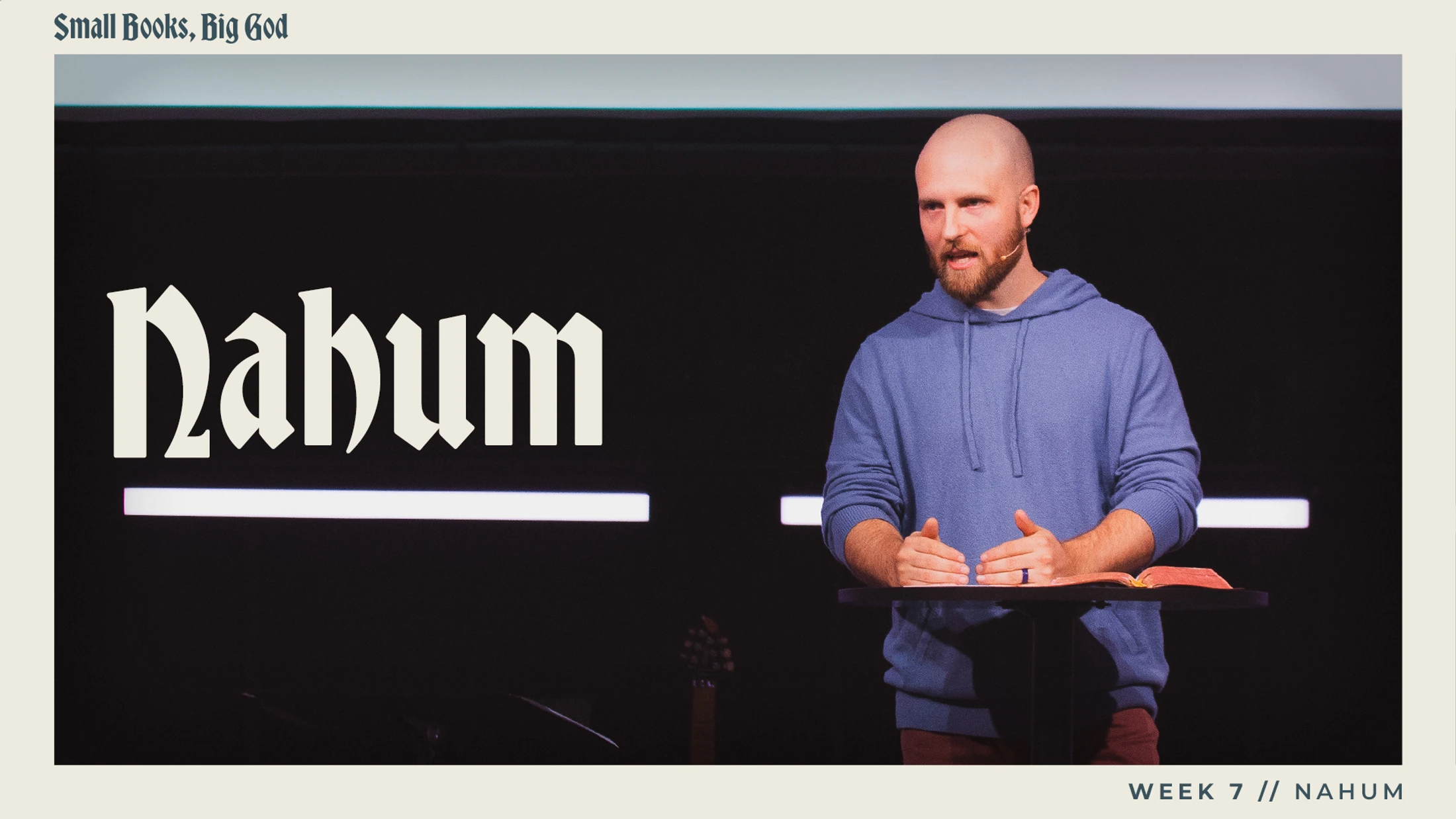
Because God is faithful, I can trust Him. Listen to week 7 of our study of the minor prophets, this week in the book of Nahum. Learn more about the series here.
They are known as the Minor Prophets, but there's nothing minor about their message, especially their message about the character of God. All of them pack a theological punch that one can't, shouldn't ignore. Listen in on our nine-week journey through seven of these little books and get a major look at the might and majesty of God in the series, Small Books, Big God, the Character of God in the Minor Prophets.
Well, good morning, everybody. How's everybody doing this morning? Doing good? Well, I'm doing great this morning. I wasn't doing so great last night.
Some of you know I'm a huge Georgia Bulldogs football fan, and they lost. And so they've actually lost two of the three weekends this year that I've gotten to preach. So just want to let you know, today's my last message.
I'm totally kidding, because that would be really bad priorities. But I do want to say, whether you're here in Ankeny, whether you're in Carlisle or Lamoni or up in the live stream venue, thank you for making the priority decision to be at church this weekend. That is the right decision, and that is having the priorities in the right place.
Today we're going to get into the book of Nahum. We're continuing in our series on Minor Prophets, seeing the character of God throughout the Minor Prophets, and the Minor Prophet in front of us today is the book of Nahum. So get your Bibles and turn over there.
It's probably not a lot of you spending a lot of time in the book of Nahum, and it's relatively short. It's only 47 verses in our English translation. So similar to last week, we're actually just going to read the entirety of the book to start off this morning.
But before we do that, we need to get a little bit of historical context and background so that we can, it helps us understand it a little bit better. Nahum is believed to have been written around 660 BC, and that's about 70 years after the northern kingdom of Israel was taken captive by the Assyrian Empire. It's a prophetic book, but it has narrative elements, and that's why it kind of reads more narratively than some of these other Minor Prophets that we have studied.
It is the recording of a vision of Nahum, who was God's prophet in Israel at that time. Nahum's ministry in Israel was concurrent with King Manasseh, son of Hezekiah, who was generally known as the single most wicked king in the history of the nation of Israel. So that's kind of the setting for which we get this vision in the year 660 BC.
With all that in mind, you've got your Bibles in front of you. We're just going to read, I'm going to read for you, and you're going to follow along, all 47 verses. You ready for this? Chapter 1, verse 1, the pronouncement concerning Nineveh, the book of the vision of Nahum the Elkishite.
The Lord is a jealous and avenging God. The Lord takes vengeance and is fierce in wrath. The Lord takes vengeance against His foes.
He is furious with His enemies. The Lord is slow to anger, amen, but He is great in power. The Lord will never leave the guilty unpunished.
His path is in the whirlwind and storm, and clouds are the dust beneath His feet. He rebukes the sea and dries it up, and He makes all the rivers run dry. Bashan and Karma wither, and even the flowers of Lebanon wither.
The flowers of Lebanon there, that's a reference to the cedars of Lebanon. Anyone ever seen the cedars of Lebanon? They're giant trees, and God's power and might is so great that they're called flowers to Him. The mountains quake before Him, and the hills melt.
The earth trembles at His presence. The world and all who live in it, who can withstand His indignation? No one, right? Who can endure His burning anger? No one. His wrath is poured out like fire, and even rocks are shattered before Him.
The Lord is good, a stronghold in the day of distress, and He cares for those who take refuge in Him. But He will completely destroy Nineveh with an overwhelming flood, and He will chase His enemies into darkness. Whatever you plot against the Lord, He will bring it to complete destruction.
Oppression will not rise up a second time, for they will be consumed like entangled thorns, like the drink of a drunkard, and like straw that is fully dry. One has gone out from you who plots evil against the Lord and is a wicked counselor. This is what the Lord says.
Though they are strong and numerous, they will still be mowed down and He will pass away. Though I have punished you, I will punish you no longer, for I will now break off His yoke from you and tear off your shackles. The Lord has issued an order concerning you.
There will be no offspring to carry on your name. He's now talking to the king of Nineveh, the leader of the Assyrians. I will eliminate the carved idol and cast image from the house of your gods, and I will prepare your grave, for you are contemptible.
Look to the mountains, the feet of the herald who proclaims peace. Celebrate your festivals, Judah. Fulfill your vows, for the wicked one will never again march through you.
He will be entirely wiped out. One who scatters is coming up against you, up against Nineveh. Man the fortifications.
Watch the road. Brace yourself. Summon all your strength, for the Lord will restore the majesty of Jacob.
Yes, the majesty of Israel, though ravagers have ravaged them and ruined their vine branches. The shields of His warriors are dyed red. The valiant men are dressed in scarlet.
The fittings of the chariot flash like fire on the day of its battle preparations, and the spears are brandished. The chariots dash madly through the streets. They rush around in the plazas.
They look like torches. They dart back and forth like lightning. He gives orders to His officers.
They stumble as they advance. They race to its wall. The protective shield is set in its place.
The rivers are opened, and the palace erodes away. Beauty is stripped. She is carried away.
Her ladies-in-waiting moan like the sound of doves and beat their breasts. Nineveh has been like a pool of water from her first days, but they are fleeing. Stop, stop, they cry, but no one turns back.
Plunder the silver. Plunder the gold. There is no end to the treasure and abundance of every precious thing.
Desolation, decimation, devastation. Hearts melt. Knees tremble.
Insides churn. Every face grows pale. Where is the lion's lair or the feeding ground of the young lions, where the lion and lioness prowled, and the lion's cub with nothing to frighten them away? The lion mauled whatever its cub needed and strangled prey for its lioness.
It filled up its dens with the kill and its lairs with mauled prey. Beware, I am against you. This is the declaration of the Lord of armies.
I will make your chariots go up in smoke, and the sword will devour you, will devour your young lions. I will cut off your prey from the earth, and the sound of your messengers will never be heard again." Chapter three, woe to the city of blood. That's what he's calling Nineveh.
Totally deceitful, full of plunder, never without prey. The crack of the whip and rumble of the wheel, galloping horse and jolting chariot, charging horseman, flashing sword, shining spear, heaps of slain, mounds of corpse, dead bodies without end. They stumble over their dead because of the continual prostitution of the prostitute, the attractive mistress of sorcery who treats nations and clans like merchandise.
By her prostitution and sorcery, I am against you. This is the declaration of the Lord of armies. I will lift your skirts over your face and display your nakedness to nations, your shame to kingdoms.
I will throw filth on you and treat you with contempt. I will make a spectacle of you, and then all who see will recoil from you, saying, Nineveh is devastated. Who will show sympathy to her? Where can I find anyone to comfort you? Are you better than Thebes that sat along the Nile with water surrounding her, whose rampart was the sea, the river her wall? Cush and Egypt were her endless source of strength.
Put and Libya were among her allies, yet she became an exile. She went into captivity. Her children were also dashed to pieces at the head of every street.
They cast lots for her dignitaries, and all her nobles were bound in chains. You also will become drunk. You will hide.
You also will seek refuge from the enemy. All your fortresses are fig trees with figs that are ripened first. When shaken, they fall right into the mouth of the eater.
Look, your troops are like women among you. Your land's city gates are wide open to your enemies. Fire will devour the bars of your gates.
Draw water for the siege. Strengthen your fortresses. Step into the clay and tread the mortar.
Take hold of the brick mold. The fire will devour you there. The sword will cut you down.
It will devour you like the young locusts. Multiply yourselves like the young locusts. Multiply like the swarming locusts.
You have made your merchants more numerous than the stars of the sky. The young locust strips the land and flies away. Your court officials are like the swarming locusts, and your scribes like clouds of locusts which settle on the walls on a cold day.
When the sun rises, they take off, and no one knows they're there. Lastly, this. King of Assyria, your shepherds slumber.
Your officers sleep. Your people are scattered across the mountains with no one to gather them together. There is no remedy for your injury.
Your wound is severe. All who hear the news about you will clap their hands because of you, for who has not experienced your constant cruelty." That's pretty intense, right? That's one vision. Three chapters for us, but the reason we read it all at once is it's one vision about the future and punishment of the city of Nineveh.
That's what the entirety of the book is. The judgment attack and downfall of the city. And Nineveh is probably a name that some of you recognize.
You're probably like, okay, I know that. I've heard that before. And that's because Nineveh is the city in view here, but it's also the city in view in the book of Jonah.
And so Nahum is kind of like a sequel to Jonah. It takes place about a hundred years. This vision takes place about a hundred years after Jonah went to Nineveh.
Some of you are thinking, like, I'm a little confused because I thought Jonah went to Nineveh and they repented, and God was like, I'm going to spare them. That did happen. And on the podcast this week, we are going to look at why it matters so much that the gospel be given down from generation to generation.
Because a hundred years later, everything that they repented of is totally out of sight to the point where now God is coming back to what he said in Jonah 1, that the evil of Nineveh had risen up before him, and it was a stench in his nostrils. So Nineveh, we kind of know about it, but what Nineveh is, is not just a city out in the desert standing alone. Like you might see, I kind of think of like Veggie Tales when you know it's kind of like, it's just a city that's bad and evil and then it gets conquered.
No, Nineveh was the capital of the Assyrian Empire. It represents all of the Assyrian Empire. And the Assyrian Empire was one of the most great and terrible empires on the face of this earth, known for absolute cruelty.
And that doesn't have a lot of meaning to us, unless you're a huge history buff, but some scholars say that the Assyrians were the ancient Nazis. Absolute cruelty. They would flay or skin alive some of their prisoners.
They would burn people alive. They would cut out the tongues of anyone who spoke against the king. Their religious practices called for children to be sacrificed because that's what they believed would protect the king.
In their culture, if a parent committed a crime, the punishment was the sacrifice of the child. This is great wickedness. And this is what God is seeing and responding to in Nahum.
You can see it, we read it right there at the beginning of chapter three. Woe to the city of blood, totally deceitful, full of plunder, never without prey. Not a moment where they're not preying on someone, taking advantage of someone, oppressing someone.
And a lot of times very violently. And this punishment of Nineveh, of the Assyrians, is what shows us the reality of the characteristic of God that we're going to see today. And that is that God is a faithful God.
Because a hundred years before the vision, and the vision was 40 years before it actually happened. So you have 140 years between when God said to Jonah, I have seen the evil of the Assyrian empire, and between the time that he did anything about it. But that doesn't change the fact that he did what he said he would do.
When Jonah went and Jonah won, he said, repent or I will destroy the city. And he did destroy the city. You see multiple times in the book it says, I will, especially in chapter one, it says, I will cut off your offspring.
Some researchers believe that there is not a person on the face of the earth that could trace their ancestry to the Assyrian empire. It does not exist. When God said, I will cut off your offspring from the earth, he does what he says.
He is faithful and true to keep every single one of his promises. Think about that. God keeps his word completely, 100% every time.
Nothing that he has said will be stopped and nothing that he is can ever change. In Jeremiah, it actually says that he's watching over his word to make sure that it happens. He's not just decreeing things and then they come true.
He's actively participating in making sure that his word is fulfilled every time. He is faithful and he keeps his word. And what we see so far in Nahum is that he's faithful in keeping his word to punish wrongdoing.
He's jealous and avenging. Chapter one, verse two, he takes vengeance. He's fierce in wrath.
He's furious with his enemies. He is slow to anger 140 years. That's a long time.
He's slow to anger, but he is great in power and he will not leave the guilty unpunished. That is not up in the air. It might seem like it is some days, but that is not up in the air.
God will punish the guilty and he will bring to ruin those who stand against what he desires for people who stand against him in arrogance and pride. And the fall of Nineveh is an example in history of how God is faithfully at work in history. Even in Nahum, he points back to some empire called Thebes who had all these good things going.
The sea and the river were guarding them and they had lush resources from Egypt and says, are you not better than them? They're scattered in ruin. Nahum is an example that God will not allow arrogant or violent empires to endure forever. The Assyrian empire specifically stands in a long line of violent empires throughout history and their fate, all those empires, their fate, their graveyard is a memorial to God's commitment to faithfully bring down the arrogant in every age.
Galatians 6 says it so clearly and a little more personally, do not be deceived. God will not be mocked for as a man sows also will he reap. God is proving that he's faithful to punish wrongdoing all throughout history.
And it's easy to sit back here and look back at arrogant, violent, oppressive empires all throughout history, Assyrians, Babylonians, Aztecs, Mongols, Nazis. It's easy to sit here today and be like, yeah, I'm glad God just ruined them and I love it. Uh, but let's bring that a little closer to home in light of what's all happening.
This has happened this week. In 2023, there were approximately 90,000 abortions per month in America, according to the society of family planning. And in 2024, the Charlotte Lozier Institute for life reports that approximately 96% of those are elective abortion, meaning they are not medically necessary, but they are chosen.
That's 1,036,800 people killed in 2023. That's wiping out the entire state of Delaware every year, all of Delaware boom gone. And it's not, it's not new for us to take a strong stand on this.
And I'm, I'm not going to back down. And I thought about this a lot this week. I was like, should I come hard on this? Um, but listen, we can sit here and think that the Assyrian empire is so barbaric.
For their religious practices and what they were required to be done on the different altars that they had set up to their Kings and their gods. And I am glad that God punished them and brought them to ruin. But listen, I'm going to say that again, 1,036,800 people, children sacrificed on the altar of the false God of self last year in America.
Don't think that we don't have child sacrifice in this country. And what was true for a Syria in six 60 BC is true for America in 2024 AD. God is faithful.
He is unchanging and his nature. He hates the shedding of innocent blood. He always has.
And he always will look at verse two, again, in light of what we live in, God is jealous and avenging. And he takes vengeance and his, he is fierce in his wrath. He takes vengeance against his enemies.
He's furious with them. He is slow to anger. How long has this been happening? But he is great in power.
He will not leave the guilty unpunished. And it's easy to look around at the culture and the news and the economy and think that, oh, well, you know, if we just had a policy or we just had a person, or we just had this party that things would go better for us. But here's the reality.
God is furious with those who make themselves his enemy by standing in opposition, standing proudly in opposition to what he desires. And don't hear me saying that I think America is in Nahum or that America is some chosen nation by God or any of that. I don't even think America is necessarily in view in the Bible, but what's in view is what God wants to have happen.
And empires throughout the history of the world have stood in opposition to that. And God has brought every single one of them to ruin without fail. And we should not sit here today and think that we are the exception to that reality.
And so because we are in such a politically charged week, regardless of where you land, I actually want to do something we don't really ever do. But we're going to stop right now, and we're just going to pray. And we're not going to pray that the gas is cheaper, the eggs are cheaper, the housing prices.
I don't care about any of that. What I'm saying is that we're going to pray right now for the leaders in our nation at every level, local, state, federal, every level of leadership that they would have the boldness and the courage to stand up for and protect innocent life in all stages. And so not just here in this room, on all of our campuses right now, we're going to take a break.
And I want you to turn in your Bible to Psalm 10, because we've been praying all week through Psalm 74. And tonight at Fresh Encounter, we're going to have a chance to pray through Psalm 40. And so in Psalm 10, verse 12, I thought this was very appropriate for us to pray through as a people.
It says, Rise up, Lord God, and lift up your hand and do not forget the oppressed. Why is the wicked person despised God and said to himself, you will not demand an account, but you yourself have seen trouble and grief observing it in order to take the matter into your hands. The helpless one entrusts himself to you.
You are a helper of the fatherless. Break the arm of the wicked evil person until you look for his wickedness and it cannot be found. Let's not be praying that we just get the leaders of the people that we like in the positions of power.
But let's be praying that no matter who the leaders are, that God would move in their hearts to protect what he wants protected. So on all of our campuses, whether you're here, upstairs in the Livestream venue, Carlisle, Lamoni, I want you to just find two or three people around you. We're going to take 60 or 90 seconds.
You can move around. It's okay. We're in church.
It's not weird to get together and pray in church. And I want you to just pray through this passage. I'm not going to give you a specific prompt or anything.
I want you to read the passage. Let the Holy Spirit move in your heart for what God would have you to pray. And then we're actually going to have a microphone right here.
We don't do this very often, and it is a little risky at times, but I believe that if the Holy Spirit's leading someone, we want to give them the opportunity to come and pray a spirit-led, succinct, text-based prayer over our church, our whole church, one family, not just this room. So if you feel like in the next minute or two while we're all praying that God is leading you in that way, I would encourage you to step out. So for the next 60 to 90 seconds, let's just gather up groups of two or three and pray for our nation, that the leaders of our nation, of our state, of our city would protect what God wants to see protected.
Let's pray. God, we're asking you that you would raise up and empower and embolden people to be leaders in every level of this country, not so that we can see an improvement in our lives, but so that we can see innocent people, innocent life protected, and that the absolute evil of murdering babies before they're born would come to an end in this nation, in our lifetime. God, we are asking that you would, like it says in Psalm 10, break the arm of the wicked until you look for their wickedness and it cannot be found.
In Jesus' name we pray, amen. God is faithful. He keeps his word and he never changes.
We might not see it. It might be 150 years from now, but it doesn't change that fact. It's true in the negative.
That's what we've seen so far with his enemies. He is faithful and he will surely do it, but it's also true in the positive for his people. And that's what we're going to look at next.
This is the great part. I want you to look at chapter seven, I'm sorry, verse seven of chapter one. First six verses we saw a lot of statements, the Lord is.
He's jealous, he's fierce, he's furious, he's slow to anger, he's great in power. Look what the Lord is statement in verse seven. The Lord is good.
Do you believe that? Do you believe that God is good? That that is the entirety of his nature, not just a part of who he is? He's not made up of a bunch of different little parts to make one thing. He is completely and wholly every part of his character. He is good.
Because if we've agreed together that he's faithful and he's unchanging, and we've seen that throughout history, and we believe that he's good, then we also have to admit that he is good even when we don't see it. And he's unchangingly good. He's always good.
The word good means kind, generous, benevolent. And that is his intent toward you to bless and help you and hear you and heal you. And everything that he made in Genesis, he called good.
Psalm 136, give thanks to the Lord for he is good. Embrace that with faith with your whole heart. You're not in a lottery, a bunch of balls bouncing around just hoping to be chosen.
You're not just a face in a giant crowd. You're not a single person in a line that stretches to eternity. You are known and loved by God.
And he has a good plan for you. Regardless of what other people have said, regardless of what other people have done, and Romans 8 says, regardless even of the choices that you've made that you regret, nothing will stop his goodness to you. Because he is good and he never changes.
God is good. That's who he is. He is faithful to that in the same way that he is faithful to punish the guilty.
Secondly, look at this, a stronghold in the day of distress. The word stronghold there is most commonly translated just strength. Stronghold is not really a word that we use a lot.
I think you could almost translate this, God is strong. He is strength in the day of distress. He is shelter, safety, protection.
If you look back at the first six verses, you see the imagery that's given is that of a storm. It even says God is in the whirlwind and storm. And so the imagery here of a stronghold is like a refuge, a place of protection.
That's what God is. That's not up for debate. There's nothing in your life that you're facing that you're like, I don't know, is the Lord's strength in that? That you'd be like, I don't think so.
Every single time, no matter what, God is strength in distress. It's unchanging. Keep going in verse seven.
He cares for those who take refuge in him. It's amazing to think about the fact that as intense and powerful as God's vengeance is, because he is 100% fully just and wrathful, but equally powerful is his place of protection and strength for you, because he cares for his people. The version I learned years ago said he knows or cares for those who trust in him.
He's not just faithful and just to punish wrongdoing, but he's also faithful to generously care for his people in their time of need. And that's what leads us to our take-home truth today. What we see in Nahum is God's faithfulness, but what does it lead us to? I think it leads us right to the end of verse seven right there.
That because of God's faithfulness, it's very simple. I can trust him because he never changes. He was the same in 660 B.C., in 2000 B.C., in 200 A.D., in 2000 A.D., and he's the same today.
Because of that faithfulness to who he is and what he has said, you can trust him. Now, trust is kind of a word that we throw around a lot, right? Very simply, very quickly, just trust me. Especially in today's day and age, people are always saying, can you trust that? Is that misinformation? All kinds of trust is just, we throw it out willy-nilly.
And so I want to put a definition in front of you of what trust is. When we say, because of God's faithfulness that we see in Nahum and all throughout history, I can trust him, what do we mean? And here's what trust is. Write this down.
It's not going to be on the screen, but I'll never forget when I learned this. Trust is believing the word of God and acting upon it, no matter how I feel. Because if you don't do that, you don't trust God.
If you just say, I trust God, and then doubt and do what you think is right, you don't trust God. Believing the word of God and acting upon it, no matter how you feel, that's genuine trust. Now let's go into that a little deeper because we can sit here today and say, oh yeah, I believe that for sure.
But what does every piece of that even mean? Number one, it's believing the word of God. That's why I asked you earlier, do you believe that God is good? Good. Or do you only believe what you see? Anybody have a picky eater at their house? Any wives have a husband that's still a picky eater at their house because it was never dealt with? Everyone's nervous to laugh.
My four-year-old son, Duke, he's not super picky. But sometimes when dinner comes out, he'll do this. He'll say, disgusting.
Now, we have to deal with that. But here's the reality. He's four.
Is he saying disgusting because he has a refined palate from years of tasting world-renowned food? No. The issue is that he believes, and he is absolutely convinced that things are horrible and cannot possibly be good. And he's never even tried them, never tasted it.
So that's why I'm asking you, do you believe that God is good? Or do you just see it and say, disgusting? Psalm 34, eight, oh, taste and see that the Lord is good. And some of you hold back in trusting the Lord and believing that he is faithful and he'll do it because you want to maintain control of your life. You want to drive the car.
You want to call the shots. You're not under the lordship of Jesus Christ because you look out at what that might mean for your life and you believe what you see. And you think, well, following Jesus is like a bunch of rules and regulations and limits and no fun.
And I don't, I see it and I don't think I would like that. Disgusting. But you've never actually tried it and experienced the depth of the goodness of God.
When you say, no matter how I feel, I'm going to act on what I believe to be true about God. People don't, people who don't trust God don't believe Nahum 1 7. And the fact that God is good is what motivates me to trust him when there's nothing that I can see to go on. Trust in a faithful good God who never changes is foundational to the belief that there's better days ahead.
That you're going to win. Maybe not here on this earth, but you are going to win. Christians win.
You're going to see prayers answered. Things aren't going to end and be in heaven necessarily the way they are now. And the reason I believe that and even believing that here on this earth is because I believe that God is good.
So it changes how I act, even when I don't feel it. He is at work in your life and in your family and in your future to bring everything to a place of culmination where you will bow in eternity and say, God is good. That's the culmination of everything.
That in eternity, you're singing and worshiping forever the fact that he's good. And you can look back and all the ways in which you couldn't see it at the time, you can now see and understand that he's good. And there's no trusting God if you can't first say, I believe that.
Not only is he good, but he is strength in distress. I wish I could say that my best days with God were the good days where everything was going great. But I think that those are the days where I tend to lean on my own strength and I start to get a little numb to my need.
And I start not to believe that God is strength. It's the dark days and the difficult times where I have to and should lean on him. And that needs to be true of every day of my life.
If I believe that, that even when I don't see it, it will change how I act and I will find my strength in God and not in myself. So trusting God means believing the word of God. It also means acting on it.
So when you're in those dark days, when you can't see that God's good, when you're in trouble or distress, as it says here in the passage, you do actually run to the lean on him for strength and understanding. When what I see doesn't look like it could possibly be good. I'm not reaching into my own tool bag to fix what I think needs fixing.
And I'm not riding the roller coaster of what I see in the right now, because what I believe to be true about a faithful God changes the way that I act. It changed. I believe in the word of God.
I'm acting upon it, no matter how I feel. This is what Nahum is showing us, that God is so constant, so sure that you can absolutely trust who he is and who he says he is. He won't let evil go unpunished.
He is good. He is your strength. And you can act on that even when you don't feel like it.
Now let's get really practical. Someone hurts you. They say something to you, hurts you.
They did something to you, maybe repeatedly, and you're not over it, but you're believing the fact that God's good and he's your strength and you're trusting him. And so I want to give you what does level one trust in God look like? Level one is, you know, I've been hurt. Someone said some things to me and I'm hurt, but I'm not going to take vengeance because I believe that that's God's and I'm not going to try to get payback.
I'm not going to be mean spirited in my thoughts or my actions. I'm just going to believe that God's good and he's going to use it for my good. That's good, right? That's a good job.
That's trusting the Lord with what's hurt you. But there is a higher level of trust. Look at level two.
Same situation, you're hurt. I'm not just withholding from taking my own vengeance because I trust God. I'm actually going to act and forgive them.
I'm going to write it off. I'm going to let it go. What you did to me resulted in a debt that someone has to pay and I'm going to forgive you and I'm going to pay that debt.
Even though I don't feel like it, I'm going to let what the Bible says about forgiveness and what God says about forgiveness change how I act because I believe that God is faithful. And even when I don't feel like it, I'm not going to show you how much you hurt me or try to hurt you in return. I'm not even looking for a return at all.
I am a forgiven person and I also want to forgive. That's awesome right there, right? And I think all of us have experienced that on both ends and how amazing it is. But that's not even the top level.
There is a level of trust in what God says about his faithfulness that goes even beyond that. Luke 6.28 says this, bless those who curse you and pray for those who abuse you. How many people here today are at that level of trust in God that you get down on your knees and you pray for the people that abuse you? That's tough, right? I'm not there.
In 2 Samuel 9, this is a great passage. David, the story of David, he's been on the run from Saul. He's been shamed, tried to be killed.
Everything imaginable. And in 2 Samuel 9, Saul is dead, Jonathan is dead, and David is king. And what does he do? Is he walking around the palace, you know, like, yeah, you know, I won finally.
No. Because he believes in a faithful God and God has said this right here. It wasn't written until the New Testament, but God is not changing.
When he said, pray for those who abuse you, that's not changing. That's who he is. And so what does David do? He reaches out to Saul's adult grandson, Meshibosheth.
And in that time, if you defeated someone, you killed their whole family because you didn't want to risk some distant relative rising up and coming back and getting you. So what do you think? I'm going to call him M. What do you think M is thinking as he's summoned to the king? Knowing Saul's my granddad, he's probably thinking, like, I'm going to die. But look what David does.
David was a man after God's own heart. Look what he does. He brings him in.
He's actually injured in battle. Both of his feet are injured. And he says, he reaches out to him and says, all of you, all, all of your people, they live over here, but I'm going to take care of you for the rest of your life.
And you shall always eat at my table. And it even says at one point, like he was treated as a king's son. This is the grandson of the man who hunted David for years to kill him.
And he trusts in the faithfulness of God so much that he brings in his relative and says, why don't you be like one of my sons? That is a level of trust influencing the way that we obey what we believe like none other. Believing so foundationally that God is so faithful that he will never change. And what he has said about himself and what is true is always true.
And when he has said, I have set before you things that are life, choose obedience and things that are death, that doesn't change. Choosing to forgive, choosing to bless people who use you. That's not all of a sudden going to be like, well, that was a good thing in God's economy, but now it's a bad thing.
It's always the right decision, no matter how you feel. And that's just one example. When you're hurt, we could go into plenty of examples, but in closing today, I just want to ask you, where are you at in that regard in your trust in God? Are you acting on what he has said because of who he is, no matter how you feel.
The same God that gave this vision to Nahum is the same God who is present in this room today. No different. And the same God that provided goodness and strength for his people who were in captive to captive in the Assyrian empire is the same God who is good to you and provides strength for you in the day of trouble.
So what situation in your life today are you trusting in something other than God? Maybe it's yourself. Maybe it's your own wisdom, your own plans, what you think to be right. Maybe you're taking refuge in places in distress that are actually harmful for you, and you need to find refuge in God.
Maybe you've never even trusted God's faithfulness to forgive you in the first place. God was so faithful that he sent his own son to die for you. And maybe you've never even confessed your sin and turned from your sin and embraced Christ by faith for your salvation.
Maybe that's what you need to do today so that you can start trusting him with the rest of your life. No matter what the situation is, whether it's in the world out there, in our nation, whether it's within your walls, someone's maybe hurt you, or if it's in here, God is faithful to do what he has promised to do every single time. And he never changes.
He's the same God yesterday, today, and forever. And you can believe what he says, and you can act upon it. No matter how you feel, you can trust him because he promises a good result.
Let's pray. God, thank you for today. Thank you that thousands of years later, you are no different than the God we read about in Nahum.
You will punish the things that we see that are evil, but you are also so good to us. You have been so good to us. You will be so good to us.
You have been a strength for us. You will continue to be a strength for us. God, help us to be a people that does not question your goodness and strength, does not question your justice.
No matter what we see, that we can confidently, no matter what it looks like, say, I trust the Lord. In all things, I trust the Lord. Not because I have any signs that that's true, but because I've tasted and seen that he is who he says he is.
And all throughout history, I can look back, the history of the world and my own history. I can look back and see that you do what you'll say you'll do, and you are who you say you are, and that never changes. We love you, and we thank you.
In Jesus' name we pray. Amen.