The Response of the Redeemed | Luke 1:46–56
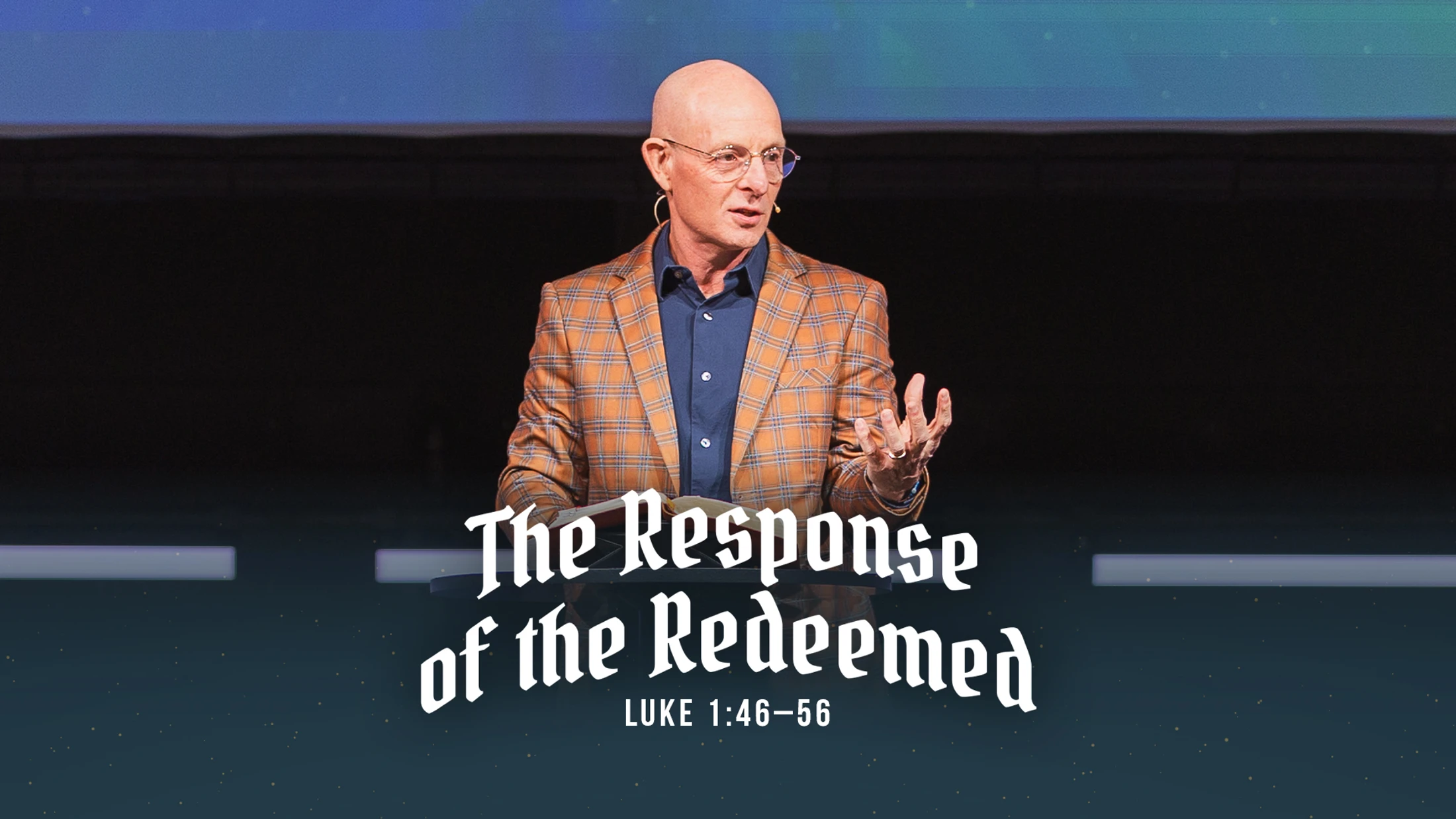
Explore how Christmas is the Triune God's rescue mission in motion, planned by the Father, carried forward by the Spirit, fulfilled in the Son, and welcomed with the grateful response of redeemed people. Let me ask you a question. Like as a redeemed person, when you watch the manifest presence of God in the midst of his omnipresence, when you see this occurring, when you encounter the reality of God's presence and power, how should the redeemed respond? In other words, when God moves in manifest ways and his presence and power is undeniable, what then? Mary gives us a beautiful answer in Luke chapter 1. In fact, she gives us a magnificent answer.
Turn there, would you? Luke chapter 1. Put an eye and a finger on verse 46. Let me show you the answer she gives us. You'll see this surface and bubble up all message long in every one of these verses.
But the response of the redeemed to God's work is simply this. Here's our take on truth. I'll give it to you up front.
That the response of the redeemed begins with awe at God's activity, not ours. You see, worship is always the root response to God's work. It doesn't mean there aren't other responses, but I will say this text shows us the first response.
The root response is always awe and worship at what God has done, not what we've done. Now, before we examine these verses, which they are known as Mary's Magnificat, let me just show you how this song of Mary's unfolds, how it moves along. It goes from the personal to the communal, to the covenantal.
You'll see this flow in the text very easily. The words will just kind of jump out at you, but this is Mary's response. This is her song.
This is her worship. And don't be surprised that it ends very covenantal. Don't recall, this is how Luke started this specific narrative, with covenantal language.
Now Mary is ending in the same fashion, and it's designed to show that God keeps his promises. We're going to examine this in three sections. So I'm going to read each section, kind of teach a little bit on it, then we'll go to the next one.
At the end, we're going to stand and we're going to have this read over us all at one time in an unbroken fashion. So let's begin our journey. Luke chapter one, verse 46, you'll see that Mary gets very personal, very quickly in response to all that the angel said to her and what occurred at Elizabeth's home.
She says this beginning in verse 46, my soul magnifies the Lord. Now you know why it's called Mary's what? Magnificat. Just a little history for you.
I'll push pause here for a second. That word is third in this quote by Mary, her song, it's the third word in the English translation. But in the fourth century, there was a translation of the Bible called the Vulgate.
It was a Latin translation. The first word of this verse in that translation is the word magnificent. In Latin culture, you typically named songs after the first word of the song.
So if you're wondering, Todd, why do you keep saying this as a song? It says Mary said, doesn't say she sung. One reason is because in the Latin culture, they read through this and saw the structure of it. And it really resembles a song.
There are four songs in Luke one and two, by the way, this resembles other songs like it. So I think it's fair to say it is a song, though scripture doesn't explicitly name it that. I think there's a lot of historical and structural reasons we can say it's a song.
The first word in the Latin translation of the fourth century is magnificent. So it became known as man put the title to it, Mary's magnificent. This is what we're reading because it starts with how Mary says, my soul magnifies the Lord.
Let's continue. And my spirit rejoices in God, my savior, because he has looked with favor on the humble condition of a servant. Surely from now on, all generations will call me blessed because the mighty one has done great things for me and his name is holy.
So those first few verses are very personal and it's not hard to spot, is it? Your Bibles are open. You see these personal pronouns, my soul, my spirit, my savior called me blessed. He's done great things for me.
So it's a very personal. And what Mary's referencing here is God's gracious activity towards her. His move of redemption in her life.
And I would say it's even just not redemption, but it's this idea of reversal. She says, I've gone from humble to blessed. This is what Mary is describing here.
In fact, can I just say to you, I think this is a lot of salvific language. It's redemptive language. I'm not saying this is when Mary became a Christian or was saved.
I'm simply saying she's words that often are used throughout the Bible to describe God's redemptive work, mainly the word favor. That's the word for unmerited grace. It's like God moved on his own accord.
God moved on my behalf of his will. I am the recipient of all that God did. I didn't earn it.
I didn't deserve it, but I receive it. It's this word favor. Mary, you're saying this is what God has done for me.
So it's very salvific and very redemptive. Here's the way I'd kind of try to explain it to you. Humble would describe the posture that grace engenders.
Blessed describes the status grace gives. But both of them are because of God's grace. When God's grace comes to you, it humbles you.
It convicts you. It exposes you. And yet in that moment, it's going to satisfy you.
It's going to heal you. It's going to forgive you. And so you're humbled.
You receive it. And then you realize you're blessed because of it. It's a beautiful, just personal section where we see redemption experienced by Mary.
It's very relationally personal. Incidentally, this response here by Mary is very reminiscent of Hannah's response in 1 Samuel 2. I'd encourage you with your family, your children, maybe with your spouse, read Hannah's song in 1 Samuel 2. You'll find a lot of similar themes, a lot of similar movements. I think it's intentional.
I think Mary is echoing what she's learned from Hannah's prayer over the time of her life because she's showing covenant continuity. That what God said then is now what God is fulfilling. A lot of continuity here.
But interestingly, Mary's song doesn't stay in the key of me. It modulates up to the key of us. Notice how verse 50, we begin to see a lot of her worship widening to the community.
Follow along as I begin in verse 50. You see it bridging now where it says, His mercy is from generation to generation on those who fear Him. There's your first plural pronoun.
So it's not just that Mary experiences redemption. Now, she's saying it's extended as well. It says, He has done a mighty deed with His arm.
He has scattered the proud because of the thoughts of their hearts. He has toppled the mighty from their thrones and exalted the lowly. And He has satisfied the hungry with good things and sent the rich away empty.
Now, you'll notice off the bat that there's a number of metaphors here that are escalating the reversal theme of this song. Remember, Mary's humble to bless it. Redemption and reversal.
But here there's an escalation in God's activity, a further illustration of it. It's a beautiful section on just the power of God. And so this redemptive reversal, this gracious favor, it's extended to others as well.
And I love the phrase generation to generation, because you begin to see that God's thread of mercy is just before her and after her. God is weaving this red cord of redemption through every generation. So in that sense, those who believe become part of the community, that know redemption.
Now, I want to just show you the five metaphors briefly. I'll just name them for you. I won't mention them long.
But notice the five metaphors that escalate this idea of reversal. First of all, in verse 51, proud to scatter. Do you see that? And notice that in this verse, God doesn't just confront the proud and then lets them stay in it.
He actually dissipates. He disperses. He destroys their pride.
He scatters it. Number two, the lowly go to lift it. This is also in verse 52.
He's exalted the lowly. And so we see that God's kingdom, it doesn't come from the top down in that sense. Among us, God's kingdom rises from the bottom up.
Grace moves towards humility. That's what it engenders. Those who are lowly receive God's favor.
They are exalted. They're lifted. The third metaphor is that the powerful are brought down.
The word used there is toppled. I love this because what he's referring to is how God exposes the false permanence of what we think are, you know, those who are really in charge. They're really in authority, pseudo-human power.
But God exposes that and brings them down. In other words, thrones and dominions that look immovable, they're not when God acts. If you don't believe me, just read Matthew, look for a guy named Herod.
Fourth metaphor is the hungry are filled. Don't you love the word satisfied there? Verse 53. And so need is actually not a liability in the kingdom of God.
Need is a doorway to this favor and this grace. But often we want, you know, we're prone not to admit our need to appear to be self-sufficient, which is what he mentions next. The fifth metaphor, the rich are sent away empty.
But here's what's so interesting, that self-sufficiency, it actually blocks the door to grace. Now hear this, church. The danger of riches and plenty, whatever word you want to use here, is not what they give, it's what they try to replace.
Riches cannot replace redemption. Self-sufficiency cannot replace Christ's sufficiency. And so these metaphors that show us this is the reversal that redemption brings about.
The lowly are lifted, the hungry are satisfied, the powerful are brought down. All these things, they're metaphors to show us that within God's community, this is what you can expect to see. It's saying this, that in God's kingdom, in his community, in his family, reversal is not like a feature, like, oh, every once in a while we see it.
No, reversal is the pattern in God's kingdom. It reminds me of Matthew 5 through 7, what we know as the Sermon on the Mount, in which he said, blessed are the thirsty, blessed are the hungry, blessed are the peacemakers, the lowly. And Christ's first sermon was one of reversal.
This song here really kind of previews that, no doubt. Now, if you think, well, Todd, that's just Mary's prayer. It's a one-off sermon from Christ.
I don't know if I'm totally into the idea that reversal is a pattern in God's kingdom. How about if I give you seven verses that say it outright? I'm going to do this quickly. Have your pen ready, your ears in overdrive.
But let me just bring all the evidence to the table that God's kingdom is a kingdom of reversal, that redemption is things flipping upside down. It begins in Genesis 3, 15. I'll just show you the verse.
You can read it for yourself. I'll just make a brief comment about it. Jot these verses down, read them later if you'd like.
But here's the first promise of the gospel. And it's not only a promise of reversal, it's within a context of reversal. Sin had just occurred.
The woman who ate with her husband, now she's going to have difficulty in offspring. But the promise is that her offspring will be the one who will break the curse. And though this offspring, who will eventually be Jesus Christ, he will have his heel bruised.
The promise is that he will crush the head of Satan. Amen? Now, that's reversal. And it's right here in Genesis, the first promise of the gospel.
We get to Matthew. Christ said very blatantly, the first will be last and the last will be first. So here, explicitly, God's kingdom is one of inversion.
Whether it's status or reward or expectation, God inverts things. The culture holds dear. 1 Corinthians 1, verses 26 to 29, the Bible says this, that God has not chosen what is wise, what is strong and what is noble, but instead he has chosen the foolish things of the world to confound the wise.
A beautiful set of verses about how things are upside down. They're reversed in God's kingdom. 2 Corinthians 5, 17 says this, that when we are born again, old things are passing away and all things are becoming new.
Is that not reversal, church? This is what God is doing. Habits are dying in people. Old ways are being gone.
The old flesh is being taken off and Christ is being put on. New habits are being formed. Transformation is occurring.
But even below just the external habit part, here's why that's happening. Because inwardly, 2 Corinthians 5, 21 says, God has declared you righteous. And he's done this even though you were unrighteous.
This is an amazing, astounding theological truth, that God in Christ has given you Christ's righteousness in exchange for your unrighteousness. What a glorious reversal. Christ Jesus is the one who does this and he did this leading the way in the lifestyle of reversal.
Look at Philippians 2, 8, 9, in which we see that Christ condescended and then God exalted him. He became obedient to death and then God gave him a name above every name. See the reversal there? It's a trend.
It's a theme. It's a pattern of God's kingdom. And it will conclude this way.
Here's Revelation 21. When the King of kings and Lord of lords says, I am making all things new. This is when every tear is wiped away.
We're gathered together with the saints of all the ages together in God's presence. There's no sickness. You won't get tired.
You won't take a nap. All those fleshly things that eat away at you, that nip at your heels, that trip you, they'll be gone. You'll be delivered from sin's presence, power, and penalty once and for all.
This is the time when Jesus says, I am making everything new. Do you see it from Genesis to Revelation? Are you absorbing this? The curse in Genesis, the crown revelation, God's kingdom advances through reversal, through redemption. Mary knew this personally.
She's now declaring this communally. This is what God's people experience. So church, let me just declare for you that in Christ, yes, the curse is reversed.
Death is no more. Mourning becomes dancing. Ashes become joy.
Years that were eaten by the locusts are restored. The old becomes new. The unrighteous become righteous.
All of this is through and in Christ. Hallelujah. Amen, church.
No wonder Mary's heart is singing. No wonder your heart should be singing now. You should be magnificently worshiping the Lord because of his activity, not only in your life personally, but in the people around you.
So we're through verse 53, and we should be asking this question now. Here's the question staring us in the face, eyeball to eyeball. Who is the community that experiences this reversal, this redemption? Like this sounds wonderful.
It sounds fabulous, marvelous, glorious. Like who gets this? Well, the answer is in the crescendoing covenant language that closes this narrative. Verses 54 and 55, will you look at it with me? Here, Mary answers the question.
Verse 54, he has helped his servant Israel, remembering his mercy to Abraham and his descendants forever, just as he spoke to our ancestors. So the answer is God's covenant people. That's who benefits communally and personally from this favor extended, from this grace, from this reversal and redemption, all these things.
They are the work of God for his covenant people. Your mind right now is thinking, okay, Todd, who is that? That sounds pretty Jewish. Well, first of all, let's just say it is.
The Bible says it is. It began with Abraham. It goes to his descendants.
So it is Jewish, hey, FYI, Jesus was a Jew. It's Jewish, hallelujah. But it doesn't only include Jews because the new covenant is better than the old covenant.
That's what Hebrew says plainly. And the new covenant is when it's expanded, the mystery is revealed that all of God's people now, it's not about bloodline, it's about belief. It's not about ethnicity.
It's about faith. Now, maybe you're wondering, are you just saying that, Todd, because you live in America and you need to make this scripture appropriate to all of us here in this culture? Are you just trying to make us happy? I'm going to walk you through six verses now. I'm going to show you how the Bible clearly, undeniably lays out who the people of God are.
You ready? Again, you just read the verses. I'll make a few comments, write them down. I pray your heart is enlarging with worship and praise.
Galatians 3, 7, Paul writes this, you know then that those who have faith, these are Abraham's sons. A pretty clear cut, wouldn't you say? Just right out of the gate, Abraham's sons are those who believe by faith. And these are just six, by the way.
There's more. I'll just share these though. And so Paul defines Abraham's descendants by faith, by belief, not by blood.
Galatians 3, 29 is somewhat repetitive in the same book, same chapter. He says, if you belong to Christ and you are Abraham's seed. So he really connects it to the idea of descendants.
You come from Abraham. You're heirs according to the promise. Heirs means you get what Abraham's descendants get.
There's an equality happening. Romans 4, 11 and 12, Abraham here is called the father of all who believe without being circumcised. And he's called the father of all who are circumcised.
So they're all lumped into one family with Abraham as the father. So you can say as a Gentile, father Abraham. Yeah, you can sing that too.
Romans 4, 16 and 17, the promises by faith so that it may be guaranteed to all the descendants. And notice his next phrase, because it's written, I have made you the father of many nations. Now, Paul here goes back to Genesis language because he's showing here, this church, that it's always been God's intention for his family to be multi-ethnic.
Even in the Old Testament, you can find shadows of this through folks like Rahab and Ruth. Gentiles for sure, but brought into the family through the blood of Christ and through faith. So just keep this in mind.
Here he's saying, this is the way it was meant to be. What we've been watching is the mystery being fulfilled. That's the word used in the Bible.
Something that wasn't quite understood at the beginning, but now is that the people of God are both Jew and Gentile. He is the father of many ethnicities. Ephesians chapter two, notice how it says here that we were once excluded from citizenship.
We weren't part of Israel, but now in Christ Jesus. So how does this happen? It happens in Christ. His incarnation really matters.
His crucifixion really matters. And because of Christ, you are no longer foreigners and strangers, but say at church with me, fellow citizens, you're in the family. Ephesians chapter three, verse six, Gentiles are co-heirs.
We're members of the same body, partners in the promise of Christ Jesus. Church, hear this. The new covenant does not create a second family.
It's not replacing a family. It simply enlarges God's family. This is not a revision in God's plan.
It's a fulfillment of God's plan. I hope every single Gentile in this room, there may be some Jewish people, I don't know, but know this, you have joined with those with whom it started. And God's family is now Jew and Gentile.
It's made up of those who believe. Aren't you thankful for this kind of grace that has been extended and shown to you? Aren't you thankful for God's activity through the centuries that it started with a Jewish man and Chaldean part of the globe? And it worked its way westward century after century after century till one day in the Southern town of Chattanooga, a redheaded boy in the eighth grade heard the gospel of Jesus Christ and trusted and believed in God saved him. Till that day when you were somewhere in this world, just a Gentile, a far from God, a pagan.
And you heard the gospel and God saved you. He has made you part of his covenant people. Amen.
If you have not ever believed in Jesus, you are outside of that covenant. You are not recipients of all of these things. But here's the great news.
It's not restricted by blood. You can come to Christ. I believe in the good news of Jesus Christ.
It's called the gospel that Jesus Christ lived perfectly. Empowered by the Holy Spirit, died sacrificially. Was raised again supernaturally.
He did all of that to take your place. You and I, we should have died for our sin and paid the penalty, but Christ stood in for us. God raised him from the dead.
And so sin has been paid for, for all who believe. And now Christ has now ascended. He's calling across the four corners of the earth to all people everywhere to repent and believe the gospel.
And if you have never done that, if you never repented of believing what's wrong and turn to believing what's right, which is that Jesus Christ alone saves. This morning, right there where you are in your chair, wherever in this campus or other ones, whatever your location, believe in the name of the Lord Jesus Christ and you will be saved. You'll receive redemption, a reversal, not only of your inward status, of eventually of your habits, Christ will transform you.
All the old will pass. Everything will become new. You'll be in God's covenant family.
You'll be more than a conqueror. You ever wonder why Paul would say that? I actually don't like that sometimes. I like the word conqueror.
Don't you? Like, I think that's a pretty good goal. Like, hey, I think I'll take the title conqueror. Paul said, no, because of Christ, you're more than a conqueror.
And so if that's the news, I want to know what is more than a conqueror. I think conqueror is pretty good. You know what's more than a conqueror? You know what's better than a conqueror? Listen, a son or a daughter.
Why? Because you get all the benefits without any of the work you're in. Jesus has done all the work. We believe and we're children of God.
John 1 12 says that's better than a conqueror. That's God's covenant family. That's his covenant people.
What incredible grace through Jesus Christ. This is what Mary's singing about. This is why she's praising God for his work in her life shown in the past and now moving forward generation to generation.
So brothers and sisters, when we think about Mary's magnificent in these three movements, these three streams, this kind of current that it takes personal, communal, covenantal. This is more than a wonderful testimony. This is a worshipful testimony to the reality, the impact of the incarnation.
That's been our focus all month long. And the incarnation shows us some very important things that waiting is never wasted. These folks waited centuries.
Christ came and his impact, his life and death and resurrection eternally impactful for all who believe what actually seems new. It's actually very ancient. God's covenant people goes back to Abraham and we're included in that.
What feels sudden perhaps is actually deeply rooted in God's character. And while some consider it to be an interruption, it's really just God's promises fulfilled. This is the incarnation.
It's the moment where God's redemptive plan became visible. Yes, his birth, but incarnated in the womb as well. This is God's work.
We're the glad recipients of it. We're witnesses of it. So because we didn't produce it, manufacture it, start it or begin it, it's God's.
We watch it. We witness it. We receive it and we worship because of it.
That's why our simple summary is what we said at the beginning. This is our take home truth. I want you to read with me one more time.
The response of the redeemed begins with all at God's activity, not ours. To worship is always the root response to God's work. As I've digested this text over the past eight or nine days, I think I've said hallelujah hundreds of times.
I said it several here at 1030. I said it a bunch at 830 over there. My heart bursts with hallelujahs when I read Mary's Magnificent.
As that was happening over the past few days, a few times I thought of a hallelujah chorus. You're probably familiar with that. So majestic song and handles Messiah.
But interestingly, it's not the end. It's not the grand finale of his work. Did you know that? I mean, it sounds like the ending, doesn't it? I mean, the music swells, people stand and you hear that famous line, the Lord God omnipotent reigneth.
And you feel like, let's just end it there. It's actually the end of part two of handles Messiah. What follows the hallelujah chorus is movements towards resurrection, coming of Christ, the consummated kingdom, the song worthy is the lamb and this amen that rings into eternity.
The hallelujah is just in the middle. It's just a bridge in light of all that's yet to come. That's where Mary stands in Luke chapter one.
You see, Christ has not yet been born, though he has been incarnated in her womb. The cross has not yet occurred. The tomb is not yet empty.
And yet Mary sings a hallelujah. She sings magnificently. She worships exuberantly, deeply because she's watching God's promises come to life.
And though the story's not finished because God wrote it, the ending is secure. So I'm going to ask you to join me in singing a hallelujah before the story's finished. I'm going to read this over you.
I'm going to pray it'll prep your heart to respond in worship, to be in awe of God's activity and to declare before him his righteousness and holiness and justice and might. So would you stand with me, First Family? Let me read over you Mary's Magnificat in its full entirety. The worship team's going to join me.
I'll just read these verses over you. Some of you may want to bow your heads and close your eyes. Some of you lift your hands even in this reading.
But let's join in with Mary in this response of the redeemed, prepare ourselves to worship God almighty as well. Luke 1, 46 to 55. And Mary said, My soul magnifies the Lord.
My spirit rejoices in God, my savior, because he has looked with favor on the humble condition of his servant. Surely from now on all generations will call me blessed because the mighty one has done great things for me. His name is holy.
His mercy is from generation to generation on those who fear him. He's done a mighty deed with his arm. He has scattered the proud because of the thoughts of their hearts.
He's toppled the mighty from their thrones and exalted the lowly, satisfied the hungry with good things, and he sent the rich away empty. He has helped his servant Israel, remembering his mercy to Abraham and his descendants forever, just as he spoke to our ancestors. And all of God's people say together, Amen.