
The Source of Our Exhortation (Pt. 1) | 2 Timothy 3:1–17
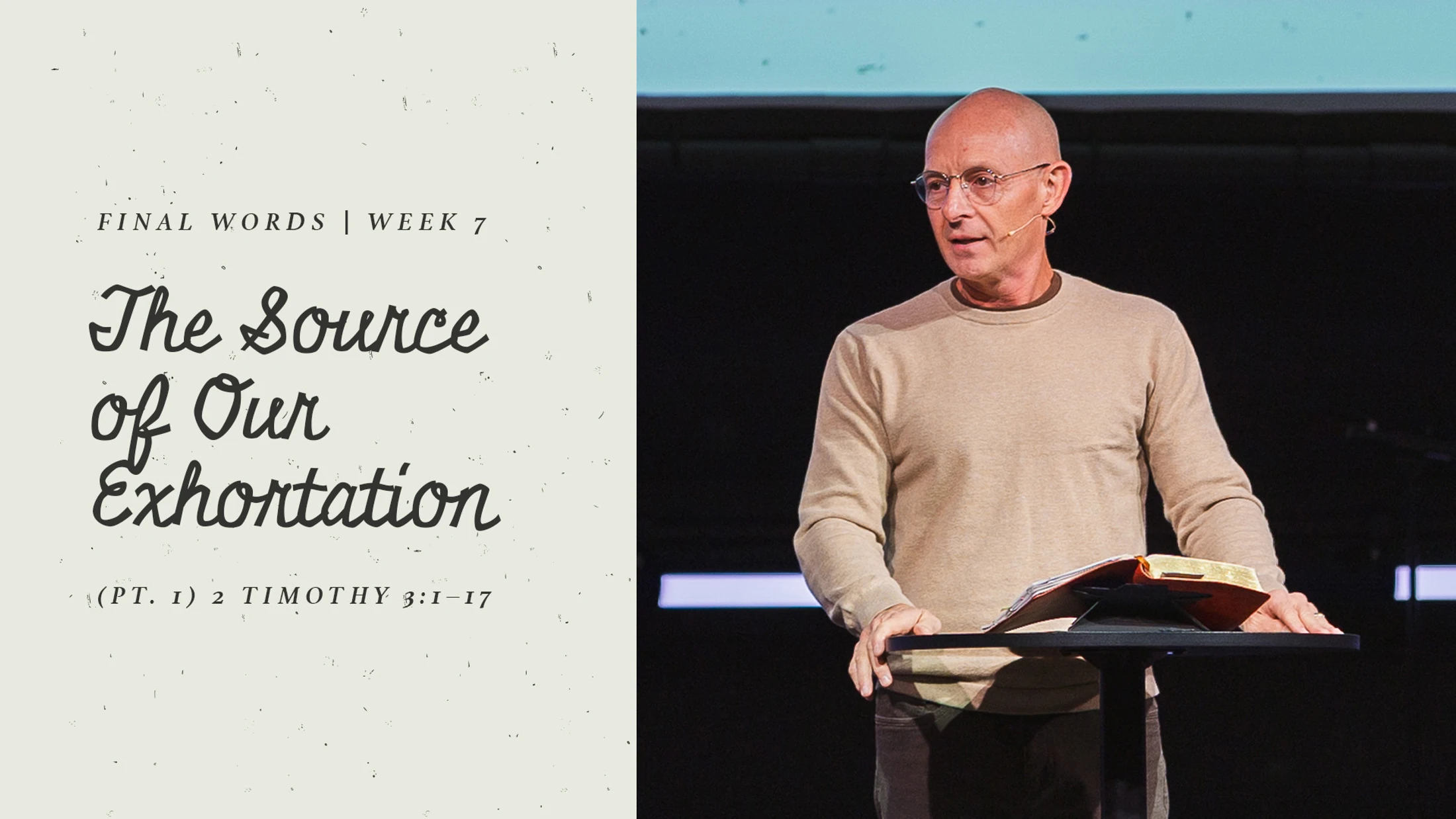
Paul's final letter wasn't just for Timothy, it's for you. It calls you to endure, to stay rooted in God's Word, and to live with bold faith in a drifting world. These are his final words, and they still speak today.
It's good to see everyone this morning. Let's take our Bibles in all of our locations, both here in this room, Lamoni, Carlisle, our gathering in Guttenberg and Cornerstone, just a little north of us and all of our campuses. Let's take our Bibles, get under the weight of the Word, because we haven't said it together for several weeks.
Can you say it with me? It's the Word that does the work. And so whether we're singing it, preaching it, sharing it, studying it, the Word does the work. Let's watch it do its work this morning.
And as we get under its weight, 2 Timothy chapter 3, find that location in your copy of the Scriptures. As you're locating that, just a brief word to you that this chapter, I believe, serves as the north star for all of 2 Timothy. This chapter, within the setting of the entire letter, it is what ensures that we are facing true north.
This will guarantee our direction, clears away the fog, it gets us through the storm, so to speak. This is what will make sure that we arrive safely home, God's Word. And so this chapter really is a compass, so to speak.
It's the north star for a lot of what's going on in this book. If you recall, this section that really focuses on God's Word began back in chapter 2, verse 14. And so we're in this third section of 2 Timothy that began in 2, verse 14, goes all the way through the end of chapter 3, and it really is all about God's Word in contrast to man's words.
What we're going to see today and next week is that this chapter is bringing to a climactic finale this contrast between man's words and God's Word. We're going to see that man's words, they destroy, they're deceptive, but God's Word, which is divine truth, it always saves. Scripture is trustworthy, sufficient, and it stabilizes and guides us.
We're going to see all this today in 2 Timothy chapter 3. So let's take our Bibles, let's look at these 17 verses. We're going to be making a pretty rapid dash through them. I want you to see this chapter in three sections, the first one being verses 1 to 9, the second one being 10 to 13, the third one being 11 to 14, I believe it is, or 14 to 17, excuse me.
Let's just kind of concentrate on this if we can. The first nine verses really of this North Star chapter show us in detail the kind of times we face, and I'll contend with you that the kind of times we face based on this portion are demonic times. With that intriguing thought in front of us, let's read the first nine verses.
Paul says this, know this, hard, say that word with me, hard times will come in the last days. Some translations will say perilous, others will say difficult, one says terrible. All of them good words for this concept that hard times will come in the last days, for people will be lovers of self, lovers of money, boastful, proud, demeaning, disobedient to parents, ungrateful, unholy, unloving, irreconcilable, slanderers, without self-control, brutal, without love for what is good, traitors, reckless, conceited, lovers of pleasure rather than lovers of God.
They hold to the form of godliness, but they deny its power. Say the next three words with me, avoid these people. Just those three words, they hearken back to what we saw last week, that there is a call among God's people and God's pastors to show refusal and restraint when it comes to words from men that are wrong, that are anger, that are deceitful, treacherous, that detour us.
There is a place for the right kind of engagement, but there's also a call for restraint and refusal. He says herely, what are the three words? Avoid these people. He then gives an example of these people.
Verse 6, among them are those who worm their way into households, they deceive gullible women, overwhelmed by sins and led astray by a variety of passions, always learning and never able to come to a knowledge of the truth. Just as Janice and Jambres resisted Moses, so these also resist the truth. They are men who are corrupt in mind and they're worthless in regard to the faith, but they will not make further progress, for their foolishness will be clear to all, as was the foolishness of Janice and Jambres.
A lot of information there about the times we're in, wouldn't you agree? Paul says at the very outset what I think is an overarching description of them. He says they will be hard times, perilous, terrible, difficult. Now I think what Paul is driving at here is he lists these 18 or so traits of people in these kinds of times.
I think what he's driving at is more than just describing circumstances or consequences. We may read this and think, oh, this is the result, but what's it the result of? I think what Paul is driving at is the core reason things are this way. We could just think, like I said, that it's circumstantial, that it's consequential, and so we've got to live with it, but let's get below the surface.
Why are the last times, the end times this way? And by the way, the last days or the last times or the end days, we've been in those since Pentecost. It's a below elementary question to ask, are we in the last days? The Bible is extremely abundantly clear. We're in the last days.
We have been since Pentecost. Issue settled. Okay? And Paul here says that these will be difficult days.
They're hard days. They're perilous days. The word hard there, or perilous, or difficult, or terrible, is the same word used in Matthew 8 to describe the two men who were demonically possessed in the region of Gadara.
This verse is very similar to 1 Timothy 4, where he says that in the latter days, folks will give an ear to deceitful doctrines from demons. So I'm going to contend with you that this word hard, perilous, difficult, terrible, is the setting of the stage for the rest of this section through verse 9. That the reason people are this way, Janice and Jambres being examples of that from way back in Moses' time, is because Satan is working hard. His entire demonic regime is at work trying to deceive, and detour, and ultimately destroy people through the false words of men.
You see, you may see this and think, Todd, it's just a tough time. Money's tight. Economy's rough.
Schedules are thick. Lots to do. People have different beliefs.
It's getting worse. You may think all that. True.
What's driving all that is the demonic realm. Satan hates God, and Satan hates God's people. I would contend with you, Satan hates God's creation.
He hates all people, and he's seeking to destroy them, and this is what this verse describes. Now, when you look at this list, you may think, Todd, are we going to go through all 18 or 19 of these things, because we'll be here until tomorrow morning? We're not going to do that, because I want to show you what I think is the initial problem in the list, the initial thing that happens, and I believe you can see it in verse 2. The first item or trait or description is that people will be lovers of self. Now, look down at the end of verse 4, and again, use this phrase, they're lovers of pleasure rather than lovers of God.
I believe those are bookend summaries of what's going on, that people love self. They love their pleasure. You could even say they love their money.
That's the second one mentioned in verse 2. But when you trade love for God for love for self, when you experience and go after that moral inversion, this is what happens. You become boastful, proud, demeaning, ungrateful, and go through that list. That's the result of loving yourself instead of loving God.
It'd be a worthwhile exercise to go through all of these, sure. But I, in this amount of time, simply want to say to you, Satan is doing all he can to distract you and deter you from loving God and doing all he can to seduce you to love yourself. And the minute you make that trade, the second you buy into that moral inversion, you will find a degradation occurring.
This really is the rotten fruit of rejecting God's word and accepting man's words. So I would say these are doing far more than describing end times. This is far more than like prophetic clickbait for some kind of post, right? This is describing universal heart conditions when we reject God's word.
This is almost prophetic in that it shows the steep decline that occurs personally, culturally, civically, corporately, when God's word is set aside and man's words are held in higher esteem. This is what occurs. Church, a culture, a life, a family untethered from God's word will always redefine good and evil.
They'll always say loving yourself is more important than loving God. And this kind of culture produces leaders who prey on the vulnerable, false teachers, heretics who manipulate weak-willed women, women who are always learning but never arriving at the truth. This is exactly what this verse says.
And they're being lured by men who use their words to entice and pull these women away from liberating truth to damning error, which shows me something. False words lead to false worship. Be careful what you listen to, give attention to.
No wonder Paul would say avoid these people. Believing their words is going to lead to the wrong kind of worship, and what you worship you will start to love. Now one word of clarity.
Paul here in his example, verses 6 through about 8 or 9, he's not saying this is an overall and overarching description of all women. He's simply saying that there are women, and notice the three traits, they are overwhelmed by sins, they are led astray by passions of all types, and then they're always learning but never able to come to a knowledge of the truth. So they're on this massive search to try to figure out, you know, what's right? And he says those are the kinds of women, not that all women are that way, but those who have an incredible amount of sin just laden on their shoulders.
Probably he's referring to lots of regret, consequences from past sins and previous sins. They've never dealt with that, and so they're just trying to figure out how to fix things, how to solve things, what's really right, where can I find meaning? Then terribly, I'll use the word manipulative men, they come into these situations, and they feed on those types of women. Women who at those points are gullible, they listen to these false teachers, and they end up with even more misery and regret.
And Paul describes these kind of despicable men who do this to these kinds of women by comparing them to two Egyptian magicians. That's who Janus and Jambres were, two Egyptian magicians. We don't have their names in scripture other than here.
We don't know for sure what they did, but there is some Jewish literature in history that says these were two of the magicians that opposed Moses when he went before Pharaoh. Perhaps you recall this if you're a new believer, just learning the Bible. There's a moment in the life of Moses in Exodus where he went to Pharaoh and said, let my people go.
Maybe you've watched Prince of Egypt, you're kind of on track with me now, right? And he throws down his leadership staff, and it becomes a snake, then he picks it up and it becomes a staff again, a rod. Well, there were two Egyptian magicians who said, oh, that's nothing, we can do that. And they imitated, replicated the very same thing.
So the thought was at the moment, wow, these are powerful men, they must have some kind of godliness. You see how this example fits the text? They had a form of godliness, they had some access to power, but it wasn't God's power, it was Satan's power, it was demonic power. And so they imitated in the moment an act that made them look like they were spiritual.
But here's the proof that they had the wrong kind of power. Here's proof they didn't have the power that actually solved the real problem. When God came and freed His people, redeemed His people, and destroyed and judged Egypt in that moment, where were the magicians then? Did their power work to prevent or to save? Not at all.
They had an imitation power is all. It was demonic, it wasn't legitimate, and when the real near-the-hour surfaced, redemption, that did not do the work. You can just check the bottom of the Red Sea.
Check the historical records. Yes, they had a form of godliness, it looked like they had some kind of tap into a spiritual power somewhere, but it could not save, it only led to judgment. And this is such a beautiful, and I would say stark and stirring, sobering example of false teachers.
They, in the moment, can sometimes be like, wow, that seems pretty legit. That seems pretty real. But in the end, it never works to solve actual real problems.
The souls of people, only the gospel, only God can do that. And Paul here is saying very clearly, what's driving all of the fake power, the imitation, is the devil and his demonic regime. That's what's driving all of the words of men that want to detract you and distract you from God's word, and lead you to destruction.
Now I want to pause here, and before we move on in this text, and just press on you pastorally for a moment. Some of you underestimate, you undervalue, you underplay the role of the supernatural. I think it was about Wednesday afternoon, and just continuing to read through this text, the Holy Spirit just pressed on me pretty hard like, Todd, don't miss this moment with the flock.
So I just want to just come before you as a fellow sheep in this flock, one who does have oversight with our other elders, one who does most of the preaching and teaching. I want to say to you, you can't read these nine verses and think that there isn't a supernatural world that's operating outside of the natural world that you see. There is a God, and there is an enemy of God, his name is Satan.
It's been that way since the beginning of time. It's recorded for us in the scriptures, the meta-narrative shows that. And the beautiful news is, God has won.
We know that, but he, Satan, is going to make it very difficult to live in this time while we await our ultimate victory. That's what's going on. And if you think, well, it's just circumstances.
It's just happenstance. It's just a coincidence. Admittedly, there are things that happen because of our stupidity.
And there are things that happen that aren't our fault, that happen to us. Admittedly, those things happen. But there is an enemy who's trying to destroy your life.
His name is Satan. He's the arch enemy of God. He has a regime of demons.
And their whole mission, according to the gospels, Christ's own words, is to steal, kill, and destroy. And you are in his crosshairs. Let me tell you one of the ways he works.
I'm giving you this because of my informal research. There's some opinion here, but not much. Satan will try to seduce you and tempt you to cut corners, to think things don't matter.
He'll want you to believe some lies that it's not as important as maybe your elders say or your small group says. And so what happens is you start missing the little things. You find reasons to be gone on the weekends.
You don't make the corporate gathering a priority. It's like, you know, I can just miss church. It's not that big of a deal.
And so you miss one week, then you miss a month. And you say, well, I read the Bible last week. I know the Bible pretty good.
And so you kind of start cutting corners on your involvement with scripture or prayer, your small group, community, accountability. All those things that we do on a regular basis, we'll call the spiritual disciplines. They're commands in scripture.
Corporate worship, community, accountability, scripture, prayer, generosity. Those are all things commanded, but sometimes because we're in them regularly, the enticement is like, you know what? You could take a break. Just back off a bit.
It's okay. It's not going to matter that much. And so a week turns into a month.
A month turns into six weeks. Six weeks turns into two months. Next thing you know, it's half a year.
And you say, no one from church has called me. As in suddenly it's the church's fault. Or yeah, I haven't seen my Bible.
Where is that book? I can't find it. Pick your habit or discipline. What happens is Satan seduces you and pulls you away from the things that are holding you steady.
And you are more vulnerable. And then he comes after you with a massive, large temptation. And often my informal research says that the man or woman who gets in at that moment suddenly feels very guilty.
Let's say they're caught or they confess. Guess where they run? And this is going to be really just nose to nose, eyeball to eyeball conversation here. They run to their church.
And I'm glad they do. But it's amazing to me, it feels like, man, I don't know how this happened. I can't imagine why I would do this.
They've got regret. They've got consequences. There are people they've got to now kind of navigate through this thing with.
It's a mess. And they're wondering. And sometimes we'll say, well, let me ask you something.
I haven't seen you for like six, seven months. Yeah, I just got too busy. How's your Bible reading? You know, I don't really read it.
And they could list for you how they gradually, almost unknowingly, just started dismissing the small habits that were keeping them anchored, hearing God's word, sharing God's word, reading God's word, the anchor, and they just began to let go of it. And what happened? Satan preyed on that. I just want to encourage you in this moment, when you feel and you sense Satan really tempting you to let go of the small but very important habits and disciplines that keep you anchored, you resist the devil and he will flee from you.
Most of the time, Satan has not come at you with like, hey, there's a massive sin I want you to commit. I know you're involved in a small group, listening and engaged at church, serving, reading God's word, but I want you to go commit this incredibly disastrous large sin. You would spot that and say, no way.
He pulls you gradually. He reels us in. And when we do commit that sin that sometimes we think may wreck our life that we're not able to get through, even though we know there's forgiveness and there's restoration, in the moment it feels like, man, what have I done? You know what's happened? Is all of our excuses for months about the little things were the very cord Satan was using to reel us in.
I can miss a week. I can miss a day. They won't.
They won't care. It doesn't bother them. It's not a big deal.
And you add up months and months of that and you're ripe. There is a supernatural world led by Satan and he's trying to destroy you and he's going to do it in small, seductive ways to the things that are really anchoring you. I trust you hear that congregationally.
I tried to express it pastorally. I love you. I know you love each other.
Let's hold each other to the basic disciplines that keep us aware of Satan's tactics and devices so that we don't fall away and sin in ways that are so destructive that people are scarred and injured and we ourselves have consequences that just, you know, dog us forever. I'm praying God will make us very sensitive to the importance of regular disciplines involving his word so we can fight Satan well. One of those is knowing who to listen to and who not to listen to, right church? Which is why he says in chapter two and chapter three, avoid these people.
Don't give them time. Don't give them air. Don't engage with them.
When you have to, be gentle. Don't get into an argument and fight about these kinds of words. Let's be anchored in God's word.
It'll be the best tactic to fighting what's really behind all of these difficult perilous days and that is Satan and his demonic realm. Let's look at the next section, can we? Where Paul describes the posture he takes during these difficult times. It's verses 10 through 13.
The Bible would say this to us, but you, and he's speaking here of Timothy. So he's contrasting Timothy to these false teachers. Of course, the example being Janice and Jambres, these demonically empowered and corruptly deceitful teachers.
He says, this is not you, Timothy. You have followed my teaching, conduct, purpose, faith, patience, love, and endurance along with the persecutions and sufferings that came to me in Antioch, Iconium, and Lystra. By the way, Lystra is where he met Timothy.
So he's bringing Timothy back to his roots. He's saying, Timothy, you've watched me since the day we met and you've seen how I've lived. You've seen what I've taught.
You've seen all I've been through. Look at the next part of the verse, what persecutions I endured. The Lord rescued me from them all.
So he's saying, giving in to man's words and thinking you can avoid issues and problems. He said, that's a terrible approach. Instead, trust the Lord.
Even in these very difficult moments, your posture should be one of devotion. God will deliver you. In fact, verse 12 says this, all who want to live a godly life in Christ Jesus, they will be persecuted.
So he's saying to Timothy, Timothy, this is going to happen to you as well. You've watched it. You've seen it in me.
You've seen how I've postured myself to endure. Now it's your turn, so to speak. And yes, evil people, verse 13, and imposters, they will become worse.
They're going to go down that road of verses 1 to 9. They're going to make that moral inversion, that trade continuously and increasingly. But you, don't you do it. You continue in what you've seen in my life while these folks are being deceived and they have been deceived.
So he's really contrasting here their posture of chasing man's words, of trying to make sure that there's people-pleasing moments and no one has to pay a price. He's saying this is not the posture we take in difficult times. We have a posture of devotion that comes from the scriptures.
You'll see this in the next section. But he's really showing that his life was a word-anchored life, that his pattern was one rooted in doctrine. He was word-driven, not crowd-driven.
He was rooted in the scriptures and this kept him steady, kept him calm, kept him secure. Paul really is here an example of the Psalm 1 illustration. The tree planted by the rivers of water bears fruit in its season.
Its leaves don't wither. It has roots that go way down deep and it holds that tree in place when the winds of opposition come. Paul is here showing us that doctrine shapes direction.
It shapes devotion. Timothy watched it and he's saying, Timothy, you follow what I showed you, not what you know these false teachers have done, even as far back as Egypt. Now this is a two-sided coin here.
We see this is clearly encouraging, that there's a promise that God will hold us by His Word and by His Spirit. He'll hold us in place no matter how difficult it gets. If we stay word-anchored, it will not move.
It won't budge. But that also means there's going to be attempts to budge it, not D-U-G-E-T, to budge it. There's going to be attempts to move it.
Persecution is going to come. I'm not sure at what level, where you are on that spectrum, but Paul here says we need devotion, we need to do this because it will be difficult. It won't be easy.
But here's what I want to say to you. An anchored word life may not always be physically safe, but it will always be eternally secure. This is why I so despise the phrase, the right side of history.
If something's wrong, let's correct it. But I don't want to make our decisions based on if we're on the right side of history. That's such a man-approval-centered philosophy.
I want to be on the right side of eternity, don't you? That's where I want to land. And so we're seeking what does God say about every single issue. So that may cost us at times, but the more faithfully you walk in the truth, the more clearly you'll see not only the cost of following Christ, but the worth of following Christ.
You'll see the end game. And you'll know that perilous times, yes, they are exactly that, perilous. And so they require persevering disciples where our convictions come from scripture, not culture.
But it is well worth standing strong, standing gently, not being a coward or retreating, but standing firm on our convictions from scripture with a strong spine and a big smile. We cannot follow both the crowd and cling to the cross. And so the word must be what fuels us and really gives us the kind of posture of devotion that we need because we know persecution is on the horizon if it's not already here.
Now, as I was thinking through this this week and this section, it hit me that today is actually a day the American church remembers the persecuted church. If you didn't know this, today is the National Day of Prayer for the Persecuted Church. This is driven mainly by Voice of the Martyrs, a wonderful organization.
If you were to go to their website today, you'd find they're doing a 24-hour prayer. I don't want to say vigil, but a prayer kind of environment on various social media platforms to try to increase the amount of prayer for the persecuted church across the globe. Here's some larger numbers for you.
I won't go to specific situations in this moment, but did you know that for the year that ended in January of 25, 4,400 Christians were murdered for their faith across the world? 4,700 were imprisoned and 7,700 properties were attacked because they were churches or houses of worship. You may not see a lot of that in this part of the world, but it's happening in many continents. It's being exacerbated right now in Africa.
India has seen an increase. Many of the Stan countries are experiencing this. Many of your brothers and sisters in your true and real and eternal family, they're undergoing great persecution today.
Can I ask you to pray for them? In fact, I just want to ask you that and say, okay, do that later today. Could we just pray right now for them? Could we take a few minutes, a few seconds, just a short amount of time and pray for all of those who are holding a posture of devotion in consequential times way worse than we currently know? It may come for you. I told you before, I think right now we're just in the marginalization area.
Persecution usually follows what is first, marginalization. You pay a price for your faith, but it's maybe in different ways like economically, your employment, promotion opportunities, taxes. There's different ways that they're going to marginalize you.
When that doesn't work, then they'll actually physically come after you. I don't know when that could occur, but that's happening in all parts of our world. Could we pray for them? Here's how I want to do this.
I'm going to ask every person if you just would join me in praying for the persecuted family of God across the globe. And would you pray just above a whisper? I'm going to pray out loud. Would you join me? And right where you are, just pray above a whisper.
Can we fill this room for just a few seconds with prayer for people who are suffering persecution and have a posture of endurance and devotion for the gospel? Let's bow our heads, can we? I'll let us in prayer. Would you lift your voice and pray just above a whisper? Heavenly Father, I join my brothers and sisters in this room, I join those in other campuses, all locations, as we together lift our voices, we ask for your grace and mercy to help in a time of need to those who are suffering for the gospel in physical, very visible ways, whether imprisonment, martyrdom, or I pray that you would unite your family spiritually somehow through and by your Holy Spirit, let them know that we are remembering them and praying for them. We ask God that you will increase and deepen their devotion to your son and to your scriptures in the good name of Jesus, we all pray for them together by saying, amen.
It's the scriptures that Paul really zeroes in on now as we close out this chapter. This will be his last four verses, will you? He's been in this topic since chapter two, verse 14, but he does now zero in in a very concentrated fashion as he talks about the sacred scriptures. Look what it says beginning in verse 14.
Here's the second but regarding Timothy. But as for you, so he says in verses 10 to 13, have a posture of devotion like you saw in me. Now he says, as for you, continue in what you have learned and firmly believed.
You know those who taught you and you know that from infancy you have known the sacred scriptures which are able to give you wisdom for salvation through faith in Christ Jesus. All scripture is inspired by God and is profitable for teaching, for rebuking, for correcting, for training in righteousness so that the man of God may be complete, equipped for every good work. What a beautiful culmination to this chapter and a half in which he's focusing on God's saying, this is really the source of our trust.
This is the source of all of our maturity. This is what does the work in the power of the spirit. It's the word of God.
And Paul here really is really calling Timothy back to what he's learned, what he's known. You see it in verse 14, verse 15. You see in verse 16, he declares that God's words inspired.
And of course, you see why this is the case because it completes us and matures us. In other words, Paul is shifting the attention now of the readers of this church from man's words again to God's word. He's exalting God's word.
He's showing that it's far superior and better than man's words. Here's why it's superior. He uses the phrase inspired.
Speaking of scripture, all scripture is inspired by God. What does that mean? Is it like a writer of a book or a song? He gets inspired or she gets inspired and they just kind of jot some beautiful poetry? These are the words for the concept. And really, the literal meaning is God breathed.
It means exhaled by God. It's the breath of God. So the Holy Spirit inspired.
He moved upon. He breathed. God breathed upon men through the Holy Spirit.
And while they kept their distinct personalities, they wrote exactly what God intended. It was His breath upon them. The word breath and the word Holy Spirit are almost synonymous in scripture.
So God breathed upon them His Holy Spirit and they were moved, supernaturally compelled, and they wrote scripture that is verbally and fully inspired by God. We call that the plenary inspiration. We call it inerrant inspiration because it is from God.
It's breathed out by God. It's God's very words, which means this. Listen very carefully.
Scripture doesn't merely contain truth. It is truth. And it's not just accurate.
It is a lie, which is why the Word of God brings people to life when empowered by the Spirit of God. These two inseparable partners, the Word of God and the Spirit of God, they're always at work. And here, Paul is reminding Timothy, this is why it's superior.
In fact, can I just show you real briefly three things it does that nothing else can do in this text, in these last four verses? I'm going to say a lot more next week about these four verses, but I just want to show you this briefly. The Word of God saves. You see that in verse 15.
It's able to give you wisdom for salvation. The Word of God shapes. It's profitable for teaching, rebuking, correcting, and training.
It's verse 16. And the Word of God strengthens. It matures you.
It completes you. Nothing else does that. That's why it's living and powerful.
It's God's breath upon you. It saves. It shapens.
It strengthens. So let me ask you a question. What do you need the Word of God to do in you and for you today? That's not meant to be a selfish request.
I'm not asking you to think about yourself. I'm saying to you, of all the things you're looking for, there's not a book or a seminar or a class you can take that will do what the Word of God will do. The holy, sacred scriptures are the life-changing book that God has given us.
It's His Word. Christ is referred to as the living Word. This is the written Word.
I just want to encourage you to engage, interact, whether it's for salvation or sanctification. The Word of God has the answer. What does the Bible say in Romans 10? That faith comes by hearing and hearing a word about Christ.
So anyone here today who's lost, you've yet to believe, you're kind of a skeptic, maybe an agnostic, you're curious. You're not necessarily trying to say, hey, I'm trying to fight you, but you just don't know much about it. You're interested.
You've been coming for a few weeks. Maybe it's your first week. I give to you what God's Word says, that Jesus Christ came.
He lived 33 years. He gave His life on a cross. He died in the place of sinners.
He was sent by God to do exactly that. When He died, that sacrifice covered the sin of the whole world, 1 John 2 says. God saw that, was satisfied.
He raised Jesus from the dead. And now God promises to anyone who believes that Jesus died and rose again as the way to have their sins forgiven, God says He will save you and give you eternal life. That's the Word of God.
That's the message from God to us. So if you've yet to believe in Christ, could I invite you, could I urge you, trust Christ. Whatever your location, when you're hearing this message of the gospel, believe the gospel and be saved.
That's the Word of God bringing life to you. That's God breathing upon you and bringing you to life and bringing you out of spiritual death. If you're already born again as a Christian, if you know Christ as your Savior, how is your growth? How is your sanctification? I would submit to you this, more than likely it goes as fast as your obedience.
You will be sanctified. I believe that the fact of our sanctification is settled. You will be made like Christ when He comes.
What we participate in is the pace of it. Some of you are creeping along. You're slow like a turtle in your sanctification.
Why? Because you just have these disobedient patterns and moments. The Word of God will free you from those and bring you out of those and increase the pace of your sanctification. Just do what God's Word says.
This is what the Word does for you. And in perilous times, difficult, terrible, hard times, filled with deception, decline and drift, all, of course, empowered by the demonic realm, the Word of God remains as the only source that saves, shapes, and strengthens. So I want to encourage you.
Keep reading it when the culture keeps raging about it. Build your convictions on God's revelation, not man's speculation. Because Scripture is the safest place to stand.
Church, our culture in these times, they don't need new truth. They need a renewed trust in the old truth. In the truth, as Jude said, once and for all delivered to the saints.
The Word of God. We need renewed trust and a deeper commitment to the Scriptures. So plant your life in the God-breathed Word.
It's able to form you to be the kind of person described in 10-13, not the person mentioned in 1-9. That's what man's words do. 10-13 is what God's Word does.
So with all that kind of percolating, all those planes circling the airport of your mind, let's land this, okay? Let's take all these thoughts, these three sections, these 17 verses. Here's a sentence that I feel comfortable sharing with you as a take-home summary, as a take-home truth. That only the God-breathed Word can produce God-formed, God-focused people.
Now, what's implied in there and is clear is that the Holy Spirit does that. But that's implied in the fact that it's God-breathed. When God breathed His Word, it was through His Holy Spirit.
He inspired these men through the Holy Spirit. So as we read it, the Holy Spirit opens our eyes to it. And then the Holy Spirit empowers us to do the obedience the Word calls for.
So again, I want to say this week to you again, these are inseparable partners. The Holy Spirit, the Holy Scriptures, they always work together. So when I say to you, only the God-breathed Word can produce God-formed, God-focused people, that's the work of the Spirit taking the Word and turning you, transforming you into something you could never do on your own.
So I urge you, I plead with you, pursue a Word-anchored life. This is the tool the Holy Spirit of God uses to transform your life. You've taken a picture of it, you've written it down in your series guide.
Can you say it with me out loud with passion and commitment? Together church, only the God-breathed Word can produce God-formed, God-focused people. So pursue a Word-anchored life. This is far superior and better than loving yourself, loving pleasure, loving God, by anchoring your life in His Word.
It may have some difficulties attached to it in different degrees depending on where you live. But the end result of eternal life is far better than the end result of man's words, which is eternal death. Let us anchor our life in God's Word.
In my reading this week, I ran across a story of a British missionary of the 1800s, William Burns. His story captivated me because of one moment in which he encountered the power of God's Word. He was a missionary in China, and as he was going from village to village in the mid-1800s, preaching the Gospel, often he'd be invited into homes.
He recounts in his diary that in one home he entered and was noticing the surroundings, and on top of a wooden shelf was an old book, but it was sitting there in a singular fashion. So he wondered what that book is, and for a moment he thought, I wonder if that's a Chinese New Testament. It kind of looked like that, but it was covered with dust.
And so he asked the homeowners, he said, what is that book? And they said, oh, a foreigner left it with us years ago. We don't know what it means. So he said, could I see it? And they gave it to him, and sure enough, it was a Chinese New Testament.
So he said to them, can I read this to you? They said, sure, we don't know what it means. He said he read that to them, and his eyes began to fill with tears, and he said he looked up and noticed their eyes were filled with tears. And they said to him, can you read us more? He said he stayed there for several days.
At the end of his stay, that entire family trusted Christ. He wrote this in his journal. This is the part that really got me.
He said, the Word of God lay in their house for years, but not in their hearts. Once opened, however, it spoke as if it had just been written. Open your Bible's church.
Anchor your life in it. God has spoken. It's the Scriptures.
Let's pursue a Word-anchored life.