
The Treasure of the King | Matthew 2:1–12
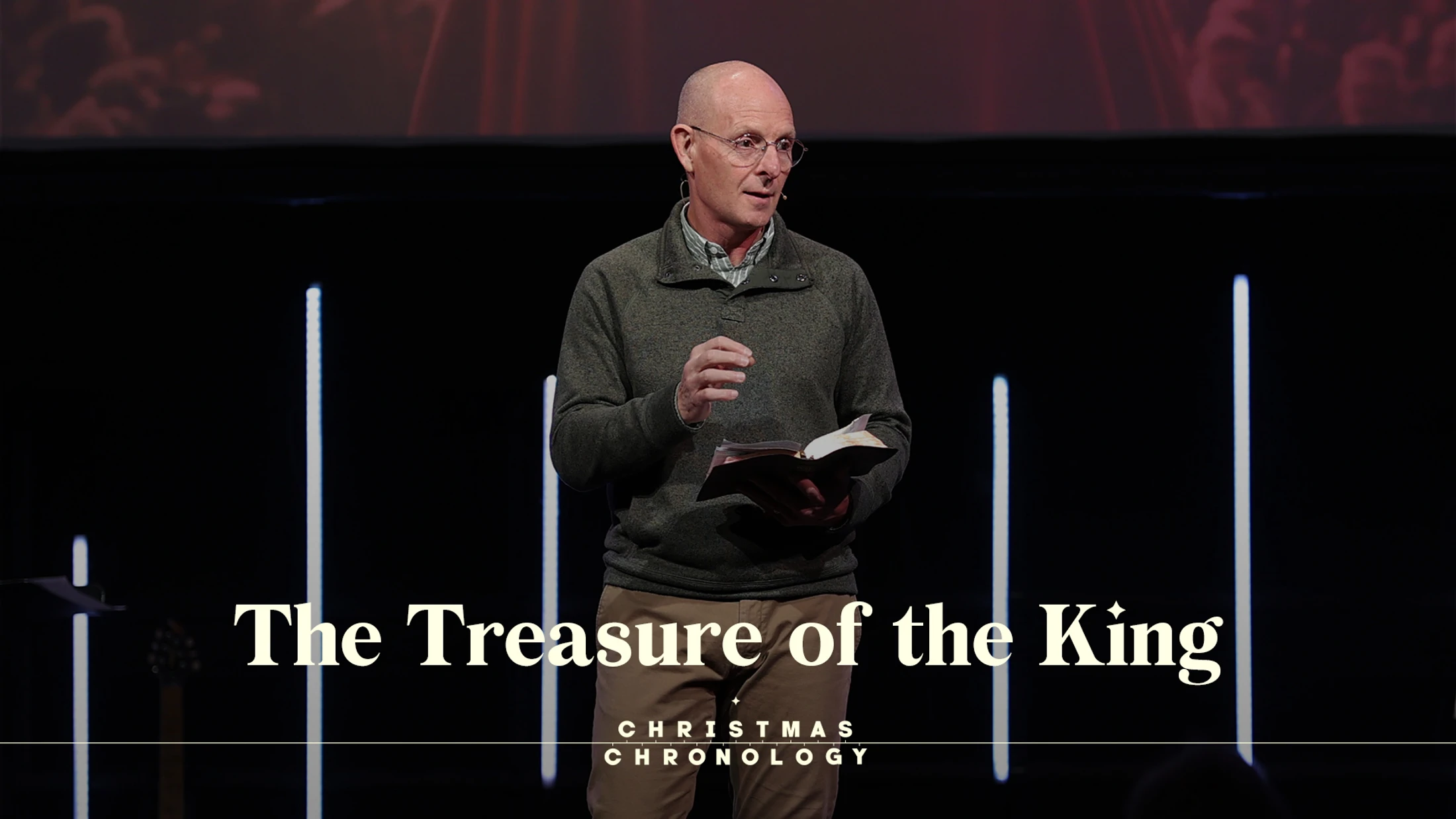
Christmas Chronology, this is week four and so I want to welcome you here and welcome our live streaming audience. Glad that we're tuning in regardless of our location. Let's have our Bibles ready, get under the word and say it with me church because it's the Word that does the work.
Amen. It will do its work this morning, I'm positive. In light of that, let me just ask you to begin to think about something because it's something that no one here really understands.
We're going to start thinking about it and I'm going to provide a little longer runway this morning because very few of us, I would say no one in this room really understands the concept we're looking at today. No one upstairs, no one at our campuses, no one in this room, no one really gets the concept that's laid out in our text today. It's the concept of kingship.
As an American you just don't have any framework for understanding kingship, I don't either, and the sooner we admit that the more progress we'll make in the text. I mean think about it, the last time you remember a king was probably in history class and you revolted against that one, right? Monarchies have never really been a part of our experience. When you do think about a king, you either think of one from the movies, which you thought, I wouldn't mind that guy with the white hair, or you think about maybe a really worst-case scenario like North Korea.
Sometimes you think about United Kingdom, but even that monarchy has certain ways and parameters. It's not a true kingship or queenship in that sense. There's political pressure even into that seat, and so it's hard to really think about as an American, like when Jesus is king, the kingship of Christ, like how do we put our hands around that? Well that's what we're going to attempt to do today.
We're going to talk about the kingship of Jesus. King Jesus, the kingship of Christ, the kingdom of God. In thinking about this and how hard it would be for us to kind of get our hands around a concept that we have just no framework for, experientially at least.
Our elders were talking last Tuesday morning and praying for our church and especially for this environment today, as we were aware this would be a hard thing to kind of grasp, and we talked about it and prayed for our flock. One of the phrases that I thought from our discussion I thought was very helpful was this phrase here. We were asking ourselves what does the king look like and how would we describe a king to our church? And one of the phrases was this, the king in your life is the thing or person that always gets a yes.
To put it in the other direction, and Travis mentioned this, he said that the thing or person to which you can't say no is king. And so maybe perhaps that sounds a little forced, a little coerced, but if I can just be very transparent with you, I think that is kind of the culture of kingship. In a very real sense, in a true kingdom, the king eventually always gets your yes.
That's the power and priority of a king. And so think about that phrase as we come to the book of Matthew chapter 2, a chapter that really is all about the kingship of Jesus. Now we're gonna look just at the first 12 verses, but the entire chapter really is about Christ as King.
In fact, I would say to you the entire book of Matthew is about Christ as King. You know, the four Gospels present Jesus from four different perspectives. Matthew's perspective is that of a king, the king of the Jews.
So all 28 chapters relate to that overarching theme. Chapter 2 is no exception. I'm gonna say more about the kingship of Jesus, the kingdom of God, the kingship of Christ on this week's Extra Point Podcast.
So Tuesday, be sure to listen in. I'll try to peel back the onion a little bit more, but I want to get started today in trying to understand more about the kingship of Jesus and what occurred when he was born, what we're celebrating today. So Matthew chapter 2, your Bibles are open there, right? As we prepare for the first 12 verses, realize that what we're going to see today really is two main characters, King Herod and King Jesus.
So the two main characters in the whole chapter, we're gonna look at 12 verses. The other group of characters, they're the wise men and they interact with the kings in different ways. So that's kind of the motif of the chapter as a whole.
Two kings are in view and one group and how they respond to these two kings. Let's just see how this plays out in the first 12 verses. You'll see undoubtedly it is a compelling look at the kingship of Jesus.
What I want to do today is walk you through the first 12 verses and here's what we're gonna see. I want to show it to you up front so you can watch it emerge as each verse unfolds. Okay, so here's kind of our treasure for the week up front, here's a sentence that goes along with it.
Our treasure, as you guessed by now, is what? Kingship. But it's hard to get our hands around that, so we're gonna say this today, we're gonna see it unfold from the scriptures that Jesus is the king worthy of every yes. He eventually always gets a yes.
We're saying from this text we're gonna see he's worthy of every yes. So we're headed that direction. I want to show you five ways in which this simple truth is expanded in these 12 verses.
Have your journals ready, your Bibles open. Let's tackle the first one by reading the first two verses, can we? Matthew chapter 2, here's verses 1 and 2. We're gonna see that Jesus is first of all a current king. Let's read together, after Jesus was born in Bethlehem of Judea in the days of King Herod, so there's already the first mention of one of the characters, wise men from the east arrived in Jerusalem saying, where is he who has been born king of the Jews? So already by verse 2 you see the contrast taking shape in the chapter, don't you? Two kings, King Herod, and now this one has been born king of the Jews, and already the third group's in play.
How will they respond? Well the wise men of course ask that question in verse 2, then they say that we saw a star that's rising and have come to worship him. Notice in this text something that sometimes we overlook and miss, and that's this. Jesus is a current king.
These magi did not approach the house of Joseph looking for a king to be. The wording of the text is clear. Where is he who has been born king of the Jews? And sometimes we read that like we hear the Lion King movie, we think in Simba terms.
I just can't wait, you know, to be king, right? But that's not what the magi have said. Where is he who has been born king of the Jews? Something is present tense, it exists. He is king.
And so we should instead think in terms of the Carol's silent night, which says so theologically, Jesus Lord at thy birth. So let's be theologically, historically clear. Jesus is king.
Now there's a couple of words about that you need to kind of lock into your brain. There's the reign of Jesus, and there's the realm of Jesus's reign. I'll say more about those to you on the podcast.
They help us understand the kingdom of God, the kingship of Jesus, and how it's a current kingdom. There is the reign and the realm. So just keep that in mind.
I just want to say to you that even though those words have some differentiation, they both point to the fact that Jesus is currently, now, king. And it's seen, like I said, in the language of the text. But not just in this text only, where the wise men say where is he who is born king of the Jews.
John the Baptist proclaimed this in chapter 3. He said, repent for the kingdom of heaven is at hand. Some say is near. So if a kingdom from heaven is near, it must mean that that kingdom's king is near.
There's no kingdom without a king. And so Jesus was near the king of the kingdom. He said this about himself in chapter 4 of Matthew.
He said, to quote John so to speak, he just said, repent the kingdom of heaven is at hand. He said in Matthew 28, all authority has been given to me. So church, here's some Q&A.
If you have all authority, what does that make you? King. So Jesus is a current king. He's reigning now.
As I'll say on the podcast, he is reigning in an inaugurated fashion. That's what he brought to us in his first coming. He'll consummate that kingdom at a second coming.
At that point, his kingdom will not be contested as it is now by sin and Satan, demons. So there's a contested form of it, so to speak, going on currently. But it is nonetheless still a kingdom in its inaugurated fashion.
He is king. I love the way Luke records this very concept in chapter 17. The Pharisees were questioning Jesus and one of their questions was this, so where is your kingdom? Here's his answer.
The kingdom of God is in your midst. Who is he referring to? Himself. He is the king of the kingdom that had arrived.
So church, let's rejoice that Jesus is the current king and he deserves every yes in our life. Let's look at the next thing about King Jesus. He's a contrasting king.
Let's see this in verses 3 to 8. Let's keep reading through the first 12 verses. Here's what the Bible would say, again mentioning the two main characters. Here he's going to focus mainly on King Herod.
It says when he heard this, speaking of King Herod, he was deeply disturbed and all Jerusalem with him. By the way, those are two different types of disturbances. King Herod was disturbed because he was threatened.
All Jerusalem was disturbed because Herod was threatened. And they knew if he's threatened that's not good for us. They weren't worried about Jesus, they were worried about Herod.
I'll tell you why in a moment. Let's keep reading. And so Herod assembled all the chief priests and scribes of the people and asked them where the Messiah would be born.
He's conniving, he's plotting. So these religious folks say in Bethlehem of Judea, and they refer to the Old Testament here, this is what was written by the prophets beginning of Micah, and you Bethlehem in the land of Judah are by no means last among the rulers of Judah, because out of you will come a ruler who will shepherd my people Israel. So then Herod secretly summoned of the wise men and asked them the exact time the star appeared.
He sent them to Bethlehem and said, go and search carefully for the child. When you find him, report back to me so that I too can go and worship him. That's just an outright lie.
The wise men, based on verse 2, had come to worship him. Herod is not looking to worship Jesus, he's looking to kill Jesus. And suddenly we get insight into the contrast that Matthew is giving us between these two kings.
Herod is a slaughterer, Jesus the one born is a shepherd. You see verse 6, out of Judah will come a ruler, speaking of king, who will shepherd my people Israel. What a contrast.
Matthew does a beautifully inspired job here showing us Herod is insecure, fearful, deliberately plotting to kill Jesus. Yet Jesus came in fulfillment of prophecy to shepherd God's people. So there's a real contrast here.
Let me say a word about Herod to kind of let you see even more of the contrast, even historically. Herod, history says, had ten wives. He murdered one of them.
With these ten wives he had many children, many sons. He murdered three of his own sons. So as you kind of read history and learn about Herod, you realize he was very frightened, very threatened to live a life and had a reign that was very insecure, quite prosperous.
He was the one who rebuilt a lot of the temple, kind of known as Herod's temple, and yet he lived in constant fear that somebody's gonna, you know, take him out and be the next king. He killed multiple relatives, multiple conspirators. It was in this person's life, this Herod, towards the end of his reign, this is when Jesus Christ was born.
And as you read the text you can just, the fear, the insecurity of Herod is very palpable just in the text, especially verses 16 to 18. He was so scared that he had all the boys, two years old and younger, in Bethlehem murdered, slaughtered, killed. It's interesting, isn't it? He thought that Jesus came to rule over a portion of the Jerusalem area where the Jews lived, and so in this Roman occupied area, here's this baby and he's gonna grow up and take my job, I got to get rid of all the baby boys, but Jesus came for something far larger and greater and bigger than just a pocket in Israel.
He came to rule the earth. He came from heaven. So there's just a massive contrast.
Here's Jesus, the second person of the Trinity, taking on human flesh, condescending as king, but not just to be a local one-ethnicity king. He came to establish the kingdom of God, to rule the earth, to provide salvation for any ethnicity who would believe. This is the saving king.
Herod's the slaughtering king. I find it interesting, Herod wanted to kill Jesus and Jesus came to save Herod. What a contrast.
You know, this isn't the only time we see a contrast between these two kings, and I might say between two kingdoms, in the book of Matthew. If you were to go to the right just a few chapters, in the longest recorded sermon of Jesus, called the Sermon on the Mount, it opens with a set of beatitudes, which is simply statements or exhortations that lead to a blessed life. Most of those first statements start with, blessed are thee, so they've become known as the beatitudes.
Blessed are the meek, blessed are the pure in heart, blessed are the peacemakers. And if you read it, you realize like, this doesn't sound like the description of somebody who's like gonna make a big impact and take the world by storm and really just, you know, kind of bowl us over. He's there giving us his kingdom values.
This is what followers in the kingdom look like, and they're very counterintuitive. It's a beautiful description of life in the kingdom. It's even more counterintuitive, more counterculture when you get to chapter 6. And the phrase is, you have heard it said, and then he lists a number of issues.
Adultery, divorce, hate, murder, making a promise. He's all these different issues, and he said, you've heard it said, and he'll tell you what the culture said about it, and then he says this, but I say unto you. And you just begin to see this contrast between earthly kings and kingdoms and heavenly king and his kingdom.
Aren't you thankful that Jesus the King is not like the earthly kings? Amen, church? He's not at all like that. I think that's one of the reasons that we struggle to get our hands around the kingship. Not only do we have very limited, if any, experience in as Americans, we just don't really know of too many good kings.
Jesus is the perfect king. He's the current king. I'm so thankful that Jesus, his life and kingship is so different and it contrasts with all that we've seen in our world.
Here's the best way to describe it and sum it up. Every other king takes, King Jesus gives. He gives his life, he gives us his joy, he gives us his word, and so many other things come from this incredible generosity of King Jesus.
Every other king takes, and so because Jesus is the king who gives, he is worthy of every yes in your life. Thirdly, he's an anticipated king. Can I just reach back into that section again and just pluck out two verses? They're the ones from Micah.
This shows us that he's an anticipated king. These are prophecies written, oh, 400 at least years before Christ was born. Micah here is prophesying Jesus would come out of Bethlehem.
Well, that's exactly what happened in Micah's prophecy is just one of about 300 that were, they were all fulfilled perfectly to the T by one person, Jesus Christ. So Jesus Christ is the long-awaited Messiah. He's the king that was anticipated.
He's also the king that we are anticipating. And can I say to you that the surest foundation that he'll fulfill every promise pertaining to his second coming is the fact that he fulfilled every one pertaining to his first coming. Acts 111 says that as those disciples are watching him ascend to heaven, an angel said, just as you have seen him go, you will see him come again in like manner.
And so they anticipated his first coming, we now are anticipating his second coming. The king is on the way. And I can assure you with 300 prophecies supporting this assertion, Jesus is returning.
King Jesus is coming back. I'm so thankful that that day that he comes, his kingdom will be consummated. I mentioned those two words earlier, I'll say more about them again on Tuesday, but just notice in his first coming he inaugurated the kingdom.
In his second coming he'll consummate it. He will establish it once and for all without any type of a person or thing or anything contesting it. Every wrong righted, perfect justice, it'll be a beautiful day, the new heavens and new earth, and Jesus reigning.
That's what we're anticipating. Here's how Revelation would describe it, listen to these verses here. Then the seventh angel blew his trumpet and there were loud voices in heaven saying, the kingdom of the world has become the kingdom of our Lord and of his Christ and he shall reign forever and ever.
Amen church? That's what we're waiting on. So we have a king and we're anticipating his second coming. So because he's the coming king, he deserves every yes in your life.
Look at the fourth thing, perhaps my favorite in the text. He's a universal king. Can I read 9 through 12 for you? And would you do me a favor? Will you just underline every time you see the word they? Whether your journal or your Bible, just underline the word they every time you see it.
After hearing the king, there's verse 9, they went on their way and there it was the star they had seen at its rising. It led them until it came and stopped above the place where the child was. When they saw the star they were overwhelmed with joy.
Entering the house they saw the child with Mary his mother and falling to their knees they worshiped him. Then they opened their treasures and presented him with gifts, gold, frankincense, and myrrh. And being warned in a dream not to go back to Herod, they returned to their own country by another route.
Question, the eight they's you underlined, who are they? They're the Magi. They're the wise men. There's probably more than three.
The Bible doesn't give us an amount, it just tells us there are three gifts. So many folks have surmised or deduced that must be three wise men. I personally think it was a pretty large entourage.
Because the Magi, the wise men, are really astronomers. They're scientists and they're from the East. They're not Jews.
They're from Babylon, Persia area. They've made this long trek so they've had to have a lot of supplies, and food, and protection. Probably multiple animals, horses, and camels.
So I would just picture a rather large entourage showing up at Joseph's house, knowing they had searched and mathematically and scientifically deduced this is where the king of the Jews lives. That's what they were searching for. It's an amazing story for lots of reasons.
Mainly because these very first worshippers were Gentiles. And I believe what you have in this moment, early in Christ's life, at the house of Joseph, is a beautiful symbol of what will happen for all eternity. Of really what the church looks like.
It's Jew and Gentile together worshipping King Jesus. Aren't you glad that those wise men, those astronomers, those Magi, searched for the Lord? Maybe you're wondering, how did they find him? That seems like an impossible task from the Babylon area all the way to Bethlehem. And you know on horseback or camelback.
And they didn't have GPS or Apple Maps. I mean that's a tough job, right? How did they find the king of the Jews? Which by the way, they didn't know he was named Jesus. They just knew he was king of the Jews.
So how did all this take place? Here's my best understanding. I write about this in my book called Christmas Footprints. I'll give you just a brief snippet.
I believe these men are from Babylon. And they're in the long line of what the Bible would call like the king's cabinet. These are men who would serve kings.
Give the king advice. They would check the stars. We don't mean astrology, but more like astronomy.
And the atmospheric elements. They would read. They were very learned in writings.
And of course they read Scripture. And so they were probably in the area where Daniel and his three friends served for at least 70 years probably. In fact, did you know in Daniel 2 that Daniel, Shadrach, Meshach, and Abednego are all called wise men? I think they were probably part of this group whose job it was to ascertain current events or future events based on historic writings.
God gave Daniel several visions. He wrote those down. My sense is that even after Daniel passed and these writings existed, these wise men, these magi, kept checking to see when is this time of this king of the Jews that Daniel wrote about.
If you read Daniel, you'll find that it's about a 483 year period between the end of their captivity and the coming of the Messiah. So mathematically, these scientific men, this group of really wise astronomers, no doubt knew numbers and calculations, they began to track this and calculate this. And I believe at the right time when the star arose, miraculously placed by God, and then led to the exact house, they knew what Daniel had said.
And so they made their way, followed prophecy, followed a star, and God brought the very first Gentiles to the birthplace of Christ to worship Him. It's a beautiful picture, that God is seeking people from every nation, language, and tribe, and tongue. And in this very beginning moment you have both Jew and Gentile worshiping King Jesus.
So he is a universal King. Listen very carefully. I'm not saying that salvation is universal in the sense that it just everybody gets it.
I'm not speaking of universalism. But salvation is universal in its scope. In other words, there's no distinction as far as who can come to Christ and who can't.
Amen, church? It's every ethnicity under the reign of Jesus. Any race, any ethnicity, anyone, Jew or Gentile, can believe in the gospel of the Lord Jesus Christ and be saved. This is whom God is drawing.
He's drawing people from every nation, language, tribe, and tongue. So I just would say this to you, maybe make a note of this, this wonderful moment in which we see the universal King truly doing what we know will happen. It's a fulfilling event.
This very moment was predicted in Isaiah chapter 60 verse 3. Can I read it for you? Listen to this and understand now how it applies. Isaiah 63, and nations shall come to your light and kings to the brightness of your rising. It's also a very foretelling event because Revelation describes for us this will be the scene around the throne one day when someone from every nation, language, tribe, and tongue were worshiping King Jesus.
So church, just know that Jesus is a universal King. The scope of his reach is to every ethnicity. God calls all men everywhere to repent and believe.
The scope of his reach is universal, hallelujah. So because he's king over everything and everyone, he would be worthy of your every yes. Notice the fifth thing, he is a worthy king.
I'm gonna pluck three words out of the last part of verse 11, you see it there? The last part of verse 11 it says, falling on their knees they worshiped him. Kind of in the middle. That's a beautiful picture of the response to Jesus by these Gentile astronomers, these Gentile, you could even call them king makers, when they saw King Jesus they fell on their knees and they worshipped him.
And the reason is clear because he was worthy of that response. And notice their response, it was pretty clear that they had a bent knee and an open hand. They fell on their knees and then they gave him gifts.
And so if you're looking for a really succinct definition of worship, it could just be that you're humble and you're generous. That when you're humbly generous in your praise and recognition of the worthiness of Christ, that's worship. Now let me just kind of bear my heart on something here regarding this idea of worship to our worthy King Jesus.
Both of the words worship and worthy, they come from the same root word, all right? That root word in Old English is worth-ship. So down through this years it's become worthy or worship. The original word for both is worth-ship.
It describes, when used like a noun, what someone is. That's when it gets translated worthy. You with me? So God is worth-ship.
Or he's what? Worthy. So this is why I don't like phrases like, let's ascribe to God worth. Because we're not giving God worth, he already has it.
He is worthy. I think I know what we mean by that. I don't want to pick that apart too intensely.
But what we want to do instead is recognize God's worth. And when we recognize what already is the noun of that, then suddenly we experience the verbs of that. We worship.
So because God is worth-ship, we worth-ship. Same word, one's a noun, one's a verb. Can I just say to you in all pastoral frankness, he's the noun, you're the verb.
God is worthy in all of his perfection and holiness, majesty and magnificence. God is a worthy King. So your response isn't to try to give him that.
It's not to say, well I confer that upon you. He already is worthy. Our job is to recognize that and then, in visible and verbal ways, to worship God.
Notice that they fell to their knees, they gave gifts, they no doubt proclaimed things verbally, they called him King of the Jews. I like the way in this text, and I'm not a worship expert, I'm undergoing lots of changes in this area all the time, all right? But I like the way in this text that two things were happening to these magi, these wise men. Two things I don't think we really have, when I say we, it could mean our church, it may just mean Christendom in this part of America in general, but two things we have a hard time balancing.
It seemed like they balanced the cranial and the emotional, and we could even say physical. Maybe there's three things, but they seem to balance and employ things that were mental or cranial, like they deduced from the writings of Daniel, I believe, and calculated in a mental way, something was happening in Bethlehem that's significant worldwide, a king is being born, let's get there. That's a mental deduction.
They get there and they realize it's the King of the Jews, and then they express their worship of him with their hands and with their resources, with their words, like they didn't just have a mental assent to something and then stand there like zombies, they did something. And I think sometimes in in our corner of the, can I say the American church? Maybe I could say the Midwest church? We do pretty good up here. I think this is true at our church.
I think we do pretty well with the neck-up worship. Like, we think rightly, theologically, accurately, and I'm not saying that's wrong or bad. I would say at times it can seem limiting if when suddenly it wants to get to your heart and you feel your chest pumping, you say, well, can't show emotion, just want to stand right here.
And we almost kind of rely on the no part, the mental part, the cranial part, when the rest of our body is screaming to worship King Jesus, to fall on our knees, to sing loudly, to say hallelujah, to praise him verbally. And sometimes we are content with just a mental worship, and we resist visible and verbal worship. We sing the songs, but sometimes, you know, that's all we do, right? So can I push on you a little bit? Because I'm getting pushed on, too, by the Holy Spirit.
I'm growing in this area. I would be, I'll be very transparent. I think in the last probably five or six years, I've just been praying for God to give me more desire to worship visibly and verbally, so that I'm not just a mental worshiper.
I'm not just cognizant of something. I'm actually actively recognizing it and then, you know, verbally and visibly responding to it. So I'm praying for God to grow me immensely.
I think our church could stand to grow in this area. I'll say more about it on Christmas Eve, next Sunday. Our actual take-home treasure is worship.
We're going to look more closely at the response of the Magi, of these wise men. I just want to kind of lay some groundwork to tell you that there are times it feels intimidating, and I'm not trying to say, I'm not trying to force or manufacture a response. What I'm trying to do is free people from being afraid to respond.
I was talking to one of our members recently, and I've had this talk multiple times, different venues. She said to me, she goes, Todd, the Lord has been just really just massaging my heart and drawing me close, and I just want to lift my hands up in our services and praise the Lord. So I said to her, guess what? Why don't you? She goes, well, I'm just a little afraid of what someone's gonna think or say.
So I think that exists. I just want to encourage you, if the Holy Spirit leads you to express physically and verbally what you know mentally, express it. It's called worship.
I've had folks say to me, Todd, at some points in the message, I just want to say amen. Guess what I say to them? Say it. Go ahead.
So I'm just trying to nudge you a little bit. I think we could grow in this area where we're not just neck-up worshipers, but as the Lord leads and we're gonna free our hands to go up, or we're gonna free our eyes to fill with tears, our mouth to open up and say hallelujah or praise Jesus or thank you, Lord, even at a time when it's not in the song. Let's ask God to give us Holy Spirit-empowered courage to recognize the majesty and worthship of King Jesus so that we, in turn, worthship.
Amen. These five things, I hope, have expanded, really, the core truth of this text, these first twelve verses. There's a contrast between two kings, but only one is worthy and deserving of your every yes, and it's not King Herod, it's King Jesus.
I told you that the chapter is a beautiful profile of the kingship of Jesus, and the first twelve really contain the Magi's response to both kings. You know how they treated King Herod? They said, hey, we're not going back the same way because he's got a harm plan for us. So they disobeyed King Herod because they adored and loved King Jesus.
Don't you love that? In other words, King Jesus got the wise men's every yes, and that's what King Jesus wants from us. His kingship is deserving, it's worthy of your every yes. So to cement that deeper, to help you ponder that, to facilitate your heart feeling what your brain knows, I'm gonna ask you to read two just poignant, powerful passages about the kingship of Jesus.
So would you stand with me, church? And together, as the band joins me, I want to ask you to read with passion and clarity and conviction these two scripture passages that point us to the kingship of our God. The first one's 1st Timothy 6. Read with me, church. In the presence of God, who gives the life to all, and of Christ Jesus, who gave a good confession before Pontius Pilate, I charge you to keep this command without fault or failure until the appearing of our Lord Jesus Christ.
God will bring this about in his own time. He is the blessed and only Sovereign, the King of kings and Lord of lords. Amen, church? And Revelation 19, read with me.
Then I saw heaven open, and there was a white horse. Its rider is called Faithful and True, and with justice he judges and makes war. His eyes were like a fiery flame, and many crowns were on his head.
He wore a robe dipped in blood. His name is called the Word of God. A sharp sword came from his mouth so that he might strike the nations with it, and he has a name written on his robe and on his thigh.
King of kings and Lord of lords. Give God glory this morning, would you, church?