
When God's Presence Goes Public (Pt. 2: Supremacy and Confrontation) | Exodus 7:8–10:29
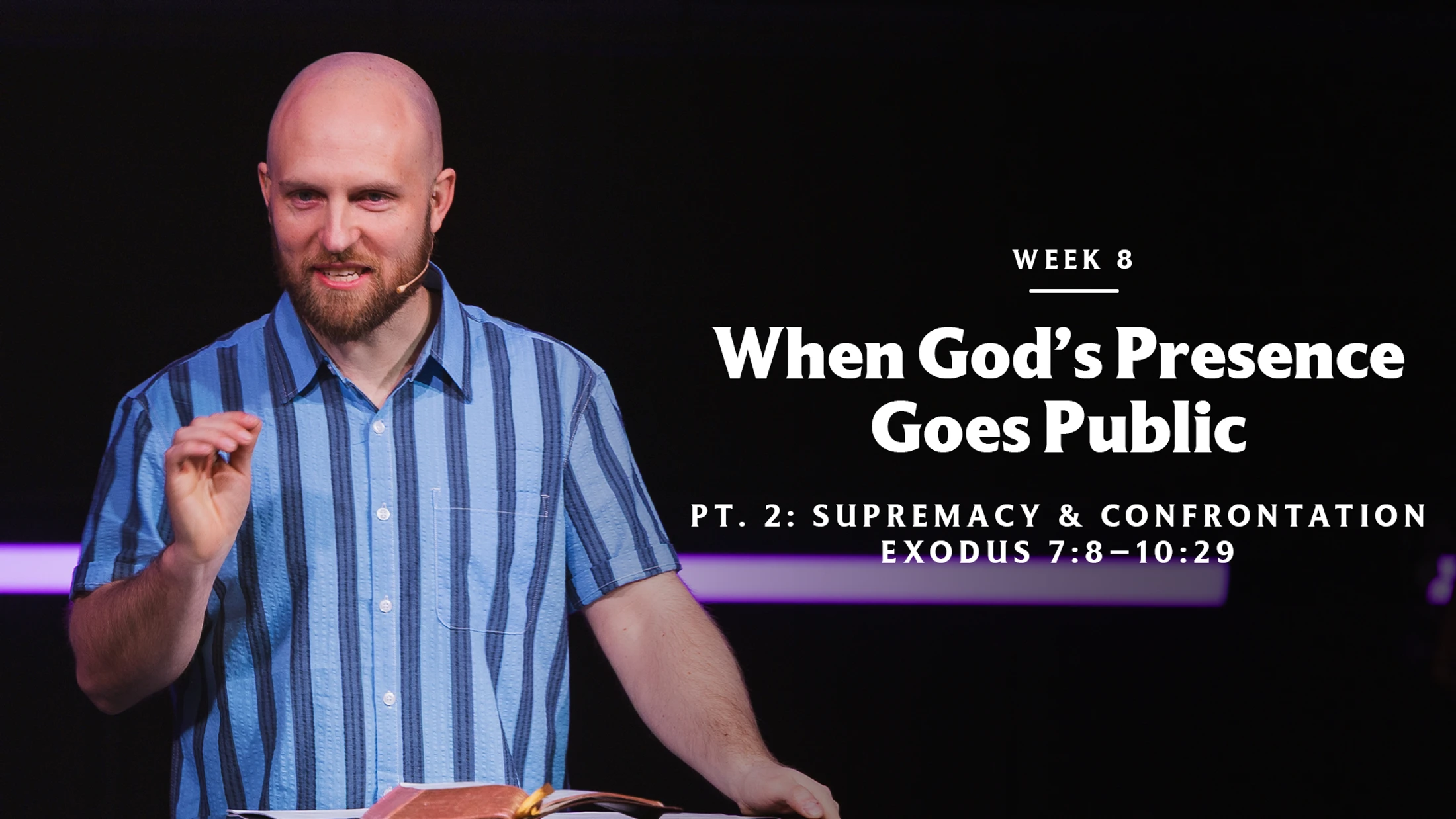
God's presence is never neutral: he confronts what opposes him, proving his divine supremacy.
Listen to week 8 of our series in the book of Exodus. Learn more about the series here: https://firstfamily.church/exodus
Exodus tells the story of a God who isn't distant, but moves toward his people in power and mercy. God reveals himself as I am, leading Israel out of slavery and into the life-changing reality of his presence. As I was studying and getting ready for this, and I knew we couldn't get through nine plagues in one week, I kind of was like, well, I'm gonna need to zoom out a little bit.
And as I was doing that, I think the Lord really just gave me, he just kind of let me, very graciously let me see something that I had never seen before. And that's what we're gonna kind of look at today. And it's this idea that the nine plagues, they do have individualism to them, but they, I believe the text shows that they are actually a single answer.
All 10 probably are, but we're gonna deal with nine today. They are an answer to a statement that is formed as a question. And we're gonna look at that.
But first, how many of you have heard this statement before? You're not the boss of me. Every parent is laughing, unless that's your child, you're not laughing. My sister, two nights ago, said when my nephew was about three, that was every moment of discipline.
Them giving discipline and him yelling back at them, you're not the boss of me. Meanwhile, he cooks no food, drives nowhere, probably needs help in the restroom. Doesn't do anything to sustain any of his life.
He is in one, he is under 100% of my sister and her husband's authority in his life. But his expression and statement about authority was you're not the boss of me. In Exodus five, which we've covered a couple of weeks ago, we see the exact same statement.
God tells Moses and Aaron to go to Pharaoh and it's the first time that they're in front of him and they lay out what God has said and Pharaoh says this. It's a question, but it's really a statement. Who is the Lord that I should obey his voice? That's the same thing as saying, you're not the boss of me.
And what unfolds from there is what we're gonna look at today. And it is God answering that question, responding to that statement. Because it's not a genuine statement of seeking.
Pharaoh's not actually, he's not saying to Moses, tell me, who is this God so that I can obey him? He's saying, you can almost read some tone into it. Who is the Lord that I should obey his voice? You can hear that, right? God is going to answer that statement, not with an argument. He's not gonna lay out a logical roadmap for Pharaoh to follow.
He's not even gonna give an explanation really. He's going to give reality nine times, again, and again, and again, and again. And it's with this purpose.
You can see it in many places throughout chapters seven, eight, nine, and 10. I'm just gonna take you to it in chapter seven, verse five. God is laying out what's gonna happen to Moses and Aaron.
And he says this, the Egyptians will know that I am the Lord when I stretch out my hand. That is what he's doing across all nine of these plagues. He's doing other things too.
But that's what we're gonna see today. You shall know that I am the Lord. You're asking, you're telling, saying, you're not the boss of me.
Well, let me show you. I am the boss of you and much more. The plagues are a judgment mechanism.
We know that God has said, I will judge the Egyptians. And that happens. They're also a deliverance mechanism.
It is the way in which the Egyptians finally release the Israelites. But it is also a revelation mechanism that God is showing this is what I am like. I am the Lord.
He starts that even before the first plague. Look at chapter seven, start in verse eight. We're not gonna read through.
I'm gonna give you some summaries because if we read through this, we would need to have five loaves and two fishes because we'd be here for lunch. So in chapter seven, it's the first time they, it's the next time they go before Pharaoh. And God says, Pharaoh is gonna, he preempts what Pharaoh is gonna say.
He said, he's gonna ask you, who's your boss? What's your authority? If God has authority, show me. That's what he's gonna say. He tells this to Moses.
So they come before Pharaoh and Pharaoh says exactly that. And Moses does what God tells him to do. When Pharaoh asks you to show whose authority do you come here under, throw down your staff and it will become a serpent.
He does exactly that. Pharaoh's magicians, they do the same thing. Now we don't know how that was done.
Was it like Prince of Egypt, the movie kind of has it like, it's like a trick. Like, you know, they're just actual magicians doing sleight of hand. I think there's actually pretty good argument that this is demonic and that there are spiritual beings with power at play here.
There's no plague here. But what happens is that before the plagues even start, God is saying, this is not a standoff. It's not power versus power.
I'm not like, he's like, it's already over. Moses' staff serpent swallows the other. And before anything happens nationwide, God is saying it's not equal.
It's not even close. There's no rival. So you see that they go out from there because it says, after Aaron's staff swallowed their staffs, Pharaoh's heart was hard, verse 13, and he did not listen to them as the Lord had said.
So there we, chapter seven, verse 14, the first plague starts, water turned to blood. From there, over the next three chapters, this is what we see play out. The Nile turns to blood, frogs cover the whole land, gnats fill the entire air, flies swarm everything, all of the livestock die, boils break out on their bodies, hail falls from the sky, locusts consume everything that the hail left, and darkness covers everything.
That's the trajectory of the next three chapters. And like I said, there's a lot in those nine plagues. Some of it even attaches to Egyptian gods, what they believed about those gods, what they were over.
There's no way I can get into all that, but there are a few patterns that we should see in this response. The plagues are God's response to Pharaoh's statement. You're not the boss of me.
And so there are a few overarching patterns that we should see. The first is that they really come in cycles of three. One, two, and three are the first cycle.
That's Nile to blood, frogs, and gnats. They start, they are the first cycle, but the cycle, sorry, let me try to figure out how to word this. The three cycles match up on plague one and four and seven.
Those start the cycles. Even though one, two, and three is the first cycle, you see one, four, seven matching. And let me tell you how that is.
So the first plague of each cycle, that would be Nile to blood, flies, and hail. They begin with a warning to Pharaoh early in the morning. God meeting him in his routine and giving him a warning of what's about to happen.
The second part of the cycles would be plagues two, the frogs, the livestock, which is plague five, and the locusts, which is eight. Those have a warning as well, but it comes at an unspecified time. And then the third is the gnats, plague three, the boils, six, and the darkness, which is the final one.
And those come with no warning at all. So there's almost like this progression that God is renewing. Hey, I'm giving you a warning, starting it out.
Hey, here's another warning. And then you're still not listening. There's no warning.
And he repeats that. It's intentional. God's not in heaven throwing out cosmic spaghetti, just being like, I don't know, maybe flies will work.
These are intentional ways in which he is going about responding to that statement. You're not my boss. Who are you that I should obey? So there's a pattern to how they work out, how the warnings come about, but there's also a pattern and cycle to their severity.
In the first cycle, they match up across the whole thing. In the second pattern, they are grouped. The first wave, one, two, three, is more about disruption.
Blood disrupts, okay, they can't get water, frogs, they're everywhere, gnats, just very annoyance. It's very disruptive to their life. And you can even see that a little bit in Pharaoh's response.
The first plague, it takes seven days for him to be like, okay. So there's a level which he's like, I'm cool. I can wait you out.
It's just, their life is disrupted. It's at the beginning of these that we see again in chapter seven, verse 17, the purpose of all this. One of the purposes of all this.
717, here is how you will know I'm the Lord. And then he lays out the first plague. That statement, I think is repeated six times across this narrative.
That this is how you'll know what I am like and who I am. He's telling Pharaoh what he's going to learn. So you have the first cycle is very disruptive to their life.
And in that cycle, there's a great moment because the magicians, wizards, whatever you wanna call them, they are able to recreate the first two, right? They can't take them away, but they can add to it. They're able to do the same thing. They're able to produce more frogs.
And then in the third plague, Aaron takes some dust and throws it in the air and it becomes gnats, which is an inanimate thing becoming alive. And look what they say in plague three, in chapter eight, verse 19, we'll start in 18 actually. The magicians tried to produce gnats using their wicked and occult practices, but they could not.
And the gnats remained on people and animals. And this is what they said to Pharaoh. This is the finger of God.
So starting in plague number three, they're starting to recognize. I know we said, you're not my boss, but I'm getting a little nervous because this is something different. That's the first crack in the armor.
The second wave, so you see the disruption. The second wave is really about suffering. There's flies everywhere.
The livestock gets sick and die and people get boils. And it even changes further because God now begins to make distinction. The plagues fall on Egypt, but not on his people.
And what's amazing is that the Bible tells us it's six times God says, this is what I'm like. But in those six times, he says it differently. The first time he says, this is how you'll know.
The second time when he does the gnats, he says, this is so that you may know that there is no one like the Lord. No one can do what he does. The third time is in verse 22 of chapter eight.
And it's when he makes distinction, he says that you may know that I am the Lord in the midst of the earth. I'm not necessarily distant or removed, I'm present. I am making distinction between my people and others.
I'm not just a big guy in the sky throwing down giant lightning bolts. I am the Lord in the midst of the earth. So there's suffering.
And then the third wave, seven, eight, nine is total collapse. Hail destroys every crop. What that doesn't destroy, locusts come so thick that it covers the sun.
I mean, you think the cicadas are loud in the summer. Imagine that, they eat every possible thing that's left. And so there's nothing left.
That's a total economic collapse. There's no food. And then darkness covers everything.
Now you can make light, right? You could light fire, you can produce light. You can build a light, you can build a light bulb. You cannot make darkness.
You can make something dark by closing the door, putting the covering over it, turning the light off, but you can't produce darkness. It just happens, it's a result. And so God is saying, again in chapter nine, verse 14, there is none like me in all the earth.
I can make what you cannot. The sun's out, but it's dark. God is saying every, through these nine plagues, he's saying every single thing you see and depend on, it all belongs to me.
I am the boss. God is not just repeating himself over and over. He is actually revealing what he is like.
You'll know that I'm the Lord. There's no one like me. I'm present in the earth.
The earth and all that is in it is mine. He's expanding his answer to that question. Who is the Lord? He has no equal, no rival, Psalm 86.
He is the present living God, Psalm 46. And he is the one who rules over the earth and all that is in it, Psalm 24, which means he doesn't share authority. He does not compete for space and he accepts no other thrones.
Deuteronomy 4.35, years and years later, God to his own people says, to you it was shown that you might know that the Lord is God and that there is no other besides him. It's one statement. Nine things, we'll see the 10th next week, to say one thing.
I am the Lord and there is none like me. Pharaoh asked for the proof and he got it. Again and again and again and again and again.
But it's not just God's response to his statement that we see repeated. We also see repeated Pharaoh's response to God's revelation. Over and over in the text it says, Pharaoh hardened his heart.
In the first, I think four plagues, it says Pharaoh hardened his heart or his heart was hard. In the remaining ones, it says God hardened his heart. And we know from even before this that God had said, I will harden his heart.
Now there's a lot of nuance there, but there is something at work that is in play between you and the Lord. And there is some reality that God does harden hearts and people harden hearts. And I can't exactly work out for you where that line is or how that all works, but that's a sobering reality.
That there was a time where Pharaoh was the one doing it. And there was a time when God was the one doing it. And that should genuinely scare us.
Pharaoh's problem is not a lack of evidence. His hard heart is not because there's not proof or he's maybe still got some questions. He sees it.
And even just by the time you get to plague three and they just toss a little dust up and all of a sudden it's living gnats on everything. I mean, that's evidence enough. And that's only 30% of the way through.
It's not confusion. It's not ignorance. It's resistance.
And you can see it happening in real time. There's resistance early on with no consideration. Nile turns to blood seven days.
He's like, I don't care. And over time, through chapter seven and chapter eight, you start to see that resistance weakening. When we get to the hail, he sends for Moses and says this, this time I have sinned.
The Lord is in the right and I am in the wrong. The crisis is so great that you, it seems like there's a moment of repentance. Look at chapter nine, verse 34 though.
When Pharaoh saw that the rain, hail, and thunder had ceased, he sinned again and hardened his heart. He and his officials. When the crisis is bad enough, he's running back to the Lord.
And when things get good again, he's like, I'm good, I'm good. Actually, I didn't mean it. I just needed a little bit of rescue in that moment.
You see that over and over and over. Pressure, response, relief, and reversal. When God wants to see pressure, response, maybe relief, surrender, and it never comes.
Now we know it doesn't come because that's how God planned it and designed it. I don't know what he's planned and designed in your life. I don't wanna stand up here and believe that anybody here is in Pharaoh's position.
I wanna believe that there's opportunity today for every single person to feel pressure and respond with surrender, not reversal. Pharaoh asked that question, who is the Lord that I should obey his voice? And God answers that question fully, not partially, not vaguely, completely. And Pharaoh answers back, not with his words, but with his refusal.
This is what the plagues are showing us about God and about ourselves in some way. And so our overarching presence principle for today, to wrap all this up, would you read this with me? Just to summarize what we've learned from this huge 30,000 foot flyover of the plagues. And it's this, God's presence is never neutral.
He confronts what opposes him, proving his divine supremacy. And you can see that in everything we just covered. His presence is never neutral.
He shows up and nothing stays the same. The Nile is not the same. The land isn't the same.
Pharaoh's not even the same. By the end of the 10 plagues, he's broken. There's no moment where God shows up and nothing changes.
When he manifests his power, it has to change. His presence is never neutral. And he confronts what opposes him.
Pharaoh is set up as the authority. He's set up as God. Who is like the Lord that I should obey his voice? And God meets that defiance very directly.
Not once, not twice, but again and again and again, 10 times. Confronting every place in the land and in the culture that Pharaoh would say, that's actually mine. God says, no, that's mine.
I'm the boss. Proving his divine supremacy. No category left untouched.
The earth is his. The sky is his. Light is his.
People are his. Health is his. Life and death itself are his.
There is no rival and no equal. That is the God that we are here today worshiping and serving. Now, right here is where probably about Friday, I just got under the immense weight of personal conviction.
I had been honestly studying this and thinking like, what a ridiculous thing to say. Who in their right mind says that out loud? We're all here. I hope that you're one of God's children.
Pharaoh wasn't, but that you would ever say out loud, you're not the boss of me. I really doubt anyone's coming up to the front today after the service and saying to one of our pastors or elders, who is like God that I should obey him? That's kind of what I was thinking. Like, this is a ridiculous statement.
And I was at my desk on Friday and the Holy Spirit just put a stake into my heart. And he said, you might not ever say those words, but your life is shouting by what you do. Who is like the Lord that I should obey him? And I just began to feel extremely convicted.
And you know what it is for you, how you treat your kids, what you talk about at work, where you spend your time, what you look at on the internet, how you spend your money, what you think about money, who you think owns money, the way you speak, how you run your business, the way I treat my neighbors, how I deal with brothers and sisters in the church, how I treat and speak to my wife. Are those things shouting, who are you that you should tell me what to do? Meanwhile, we show up here and we would never say that. We would hear someone say that and be like, you better watch out, bro.
But that's what our life is screaming by how we act. We are screaming to God, you're not the boss of me. Just let that sink in.
We read the story and we so want to be the people of Israel receiving the deliverance. And we miss how often we're actually Pharaoh. And God is saying to us over and over, this is what I'm like.
And we're saying, you're not the boss of me. So before we go any further, we need to recognize that like the plagues are a pattern, this is a pattern. We saw Pharaoh's question slash statement.
We saw God's answer to that. And we saw Pharaoh's response. We make that same statement all the time with how we live.
So we should look and see what God's response is to that statement from us. And it hasn't changed. The same God who revealed himself to Pharaoh in the plagues is the same God who reveals himself to us.
Which means the answer is no different. God is the one over you. He has no equal and no rival.
We talked about it earlier. Psalm 86, it says, there is none like you among the gods. You alone are God.
Psalm 46, God is your refuge and strength of very present help in trouble. He's the present and living God. Not distant, not removed, but near and alive.
And Psalm 24, the earth is the Lord's and the world and those who dwell in it. Everything belongs and answers to him. He's over it all.
That's what Pharaoh saw and was revealed to him. Power over creation, power over life, authority over everything. It's the same God today, but that's not the full answer for us today.
And this part was extremely gracious of God because in that place of significant conviction, because you all know the places which you're telling God, you're not my boss. And my guess is that a lot of you, you're like, I don't even like that about myself. I don't wanna be like that.
And so God is revealed to us as over us, but he is also revealed to us, not just that he's over us, but the gospel is that he is for you. And so the same God that turned the Nile to blood is the one who shed his own blood for you. The one who confronted Pharaoh's rebellion is the same God who stepped into yours and didn't just prove his authority over you, but he proved his love for you on the cross.
1 John 4, 19, we love because God first loved us. You could probably say we obey because God first loved us. God shows his love for us in this, Romans 5, 8, that while we were still sinners, he died for us.
He's not just over you, he is actually given for you. That's what he is like. So who is the Lord that I should obey his voice? He's the God who loved you and me while we were still in rebellion and didn't just confront our sin with his power, but he paid for it and didn't just demand our response and obedience, but he actually made a way for it to happen.
That changes the answer because the question isn't just who is God to be over me? It's who is God that he would give himself for me? And that's why you obey his voice, not because he's just over you, but because of what he has done for you. And just like Pharaoh, again and again and again, we clearly see the answer to that question all through here. This, the plagues revealed what God's like to Pharaoh.
God has revealed what he is like right here in his word. And so just like Pharaoh, the answer, God's answer in his word and in Jesus to that statement from us, you're not my boss, it demands a response because authority is at stake. You can either harden your heart and continue to see yourself as the boss in great delusion, or you can seek God for all that he truly is.
And you can fall on your knees in worship of the living God of the universe who has no rival and who loves you so much that he sent his one and only son to die for you. You can either harden your heart or you can soften your heart, but there's no neutral. There's no middle ground.
One of those two is happening right now. And the Bible speaks directly to that. I said earlier, I don't know the nuance and I don't know if anyone does of how this hardening works.
Someone has said the same sun that melts wax also hardens clay. I don't know how that works, but the reality is the details of how it works don't matter. What matters is this Psalm 95.
Today, if you hear his voice, don't harden your heart because God knows there is some kind of reality where one day it will be too late. Hebrews says that at some point, Esau sought the place of repentance and couldn't find it. I don't know where that is.
I don't know what that looks like, but don't test it. If you hear his voice today, don't harden your heart. And this is where it gets real because you already know, like we said, where this meets your life.
You know that place of authority that God's pressing on right now. And it's not generally unclear or vague. And it's not theoretical, it's real and personal.
And so not hardening your heart, softening your heart looks like genuine response. It looks like saying yes, where you've been saying no. Bringing those parts of your life under the authority of God's word and what it says for you, real obedience.
Pharaoh shows us partial obedience. He says, okay, all right, I'll let you go, but not the livestock, those got to stay here. Okay, all right, you can go, but just the men and don't go too far, partial obedience.
It's not obedience. It's like being pregnant. You can't be kind of pregnant.
You are, or you're not. You either obey or you don't. No partial obedience, no negotiated obedience.
Well, on my terms, I'll do that because the Lord does not share authority. He calls for all of your allegiance, not just part of it. This is exactly what is at stake all through Exodus.
God is saying, let these people go so that they may go and worship me. It's not just about getting out of the land. It's about bringing the people to himself so that they could worship him.
That's the response that flows out of a decision about authority all through the Old Testament. What people are asked to do, whether it's before the one true God or false gods, when that is their authority, they're asked to bow, submit. Submission is shown in worship.
You don't worship what you don't submit to. And that's happening right now. In your heart, there are things that are desiring and inclined for your worship, things that want you to see yourself as authority.
And God wants to remove that from you and bring your life under his authority in every aspect that you would bow before him. So where do you need to submit? Where do you need to obey? If you hear his voice, the right response is not to delay. It's not justification, it's not negotiation.
It's simply to surrender and worship. This is the moment right here. It's not later, it's not out there, it's right now.
Don't let yourself out from this and say, I'll think about that this week. It's right here. Authority and worship is at stake.
Because when you see the answer to that question, who is the Lord and God shows you his power over you and his sacrifice for you, there is only one response. And that is who else is worthy, right? Worthy because of what he can do. Man, the plagues are power on display.
And worthy because of what he stepped into your life and did. None, none, no one, there is no other worthy. And so as we close today, I'm gonna give you a real simple challenge.
And I have no doubt that some of you will not like this, and I am 100% okay with that. I think all of us have places in our lives that have some significant and deep surrender needed. And some of them are so deep that they wouldn't even be appropriate to bring out in a large group like this.
You might need to find another person. You might need to get some accountability. You might need to talk to a pastor.
But I do think that there is a simple but not easy way that you can represent that heart desire. And I wanna preface it right now by saying, I'm not asking for your performance. In Psalm 134, it says this, "'Lift up your hands to the holy place and bless the Lord.'" That is a command.
He's not saying, if you feel like it, raise up your hand. And I remember when I was in college, being in the place where I was like, I don't raise my hands during worship, bro. I don't do that.
And I will never forget God saying to me in chapel at Moody Bible Institute, you don't do that not because of a preference. You do it because it's one little bit of authority that you get to hang on to. And I thought, that's ridiculous.
It's just raising your hand. There's no deeper meaning to that. And week after week after week of being in chapel and standing there like this singing and the Holy Spirit just pounding onto my chest, you wanna be your boss.
So that's why you don't lift your hand up. And you might think that's ridiculous. That's not serious at all.
And I'm telling you, there is a release of surrender when you just do that, because you're thinking, I don't know, I'm gonna look weird. People are gonna be looking at me. I'm gonna feel out of my comfort zone.
And all of those things, that's just a moment for you to simply say, you're the boss of me. And so I'm gonna challenge you, whether you're, I'm not even, I don't even, this is not a personality thing at all. Today, we're still gonna sing.
And I would challenge you, lift up Psalm 134 to, lift up your hands to the holy place and bless the Lord as a way to say, you're the boss of me. And I'm gonna, I will stand on it so strong. There will be a flood in your heart of surrender that you cannot explain, I cannot explain.
But there is something so amazing that God is able to take such a simple and easy, honestly, gesture and use it to just pour gas on that fire of surrender in your heart. And the opposite is also true. The more you say, I'm not doing that, ridiculous.
What does he think? Because I don't raise my hand, I don't love God. I don't think that, but you're just entrenching yourself. It's a simple ask, it's a simple verse.
But yet even if you can't simply do that, how do you think you're gonna give up the authority on those big things? Those things that really do have mega and massive impact in your life and relationships. Don't fool yourself, they are connected. So that's the challenge.
I know you all have places where you need to give over greater surrender and greater authority to God. But would we be able to leave today with a physical posture of what our heart's saying? You're the boss of me. There is none like you.
And no one else is worthy of my submission in worship. It's the same moment that Pharaoh was in nine times, the 10th next week. And every time, no, no, no, no, no.
And his heart got to the place where it was too late. So how will you respond today? Will you harden your heart to that simple ask and to the Holy Spirit? Or will you come under his authority and respond because he is so worthy and there is no one like the Lord. And let's say that statement that we heard in the negative, who is the Lord that I should obey him? We should say it as he is the Lord, so I should obey him.
Let that in the positive be the banner and flag over your life today and going forward.